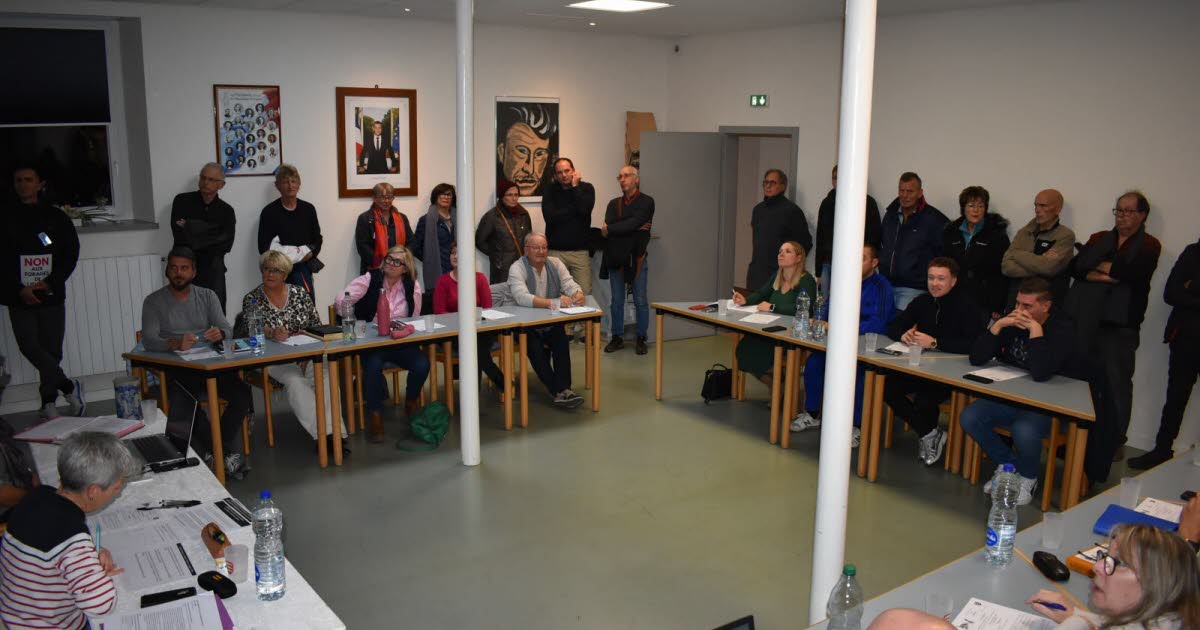
Durrenbach council opposes Lithium de France drilling project, Digi Mart USA News (Durrenbach, Alsace, France): The Lithium de France drilling project returned to the agenda of the Durrenbach municipal council on Monday, November 2, drawing strong public interest. About 200 people gathered for the session, and roughly thirty were able to attend the meeting while the others remained outside under the supervision of four gendarmes.
At the previous council meeting on September 17, the project had already prompted a significant mobilization. Council members were initially set to vote on transferring to the intercommunal authority the competence related to amending the local urban planning document (PLU), linked to the Lithium de France project.
A few hours before that session, however, they learned the resolution would ultimately have no legal effect. Even so, the council took a symbolic position on the project, run by a subsidiary of the Arverne group, by voting on a simple question: for or against.
Thirteen voted in favor and two against.
On November 2, one more council member voted against the project. Asked to vote on the environmental authorization request to open mining works in the municipality, filed by Lithium de France, 14 of the 15 council members said no.
The vote was by secret ballot but remains consultative. The same result applied to the following item, concerning the transfer of competence to the Sauer-Pechelbronn intercommunal authority for the PLU amendment.
At the start of the session, deputy mayor Édouard Lieber referred to a petition against the project signed by 388 people, representing about 950 voters. “It is a significant number, but it is not a majority.”
While acknowledging the desire to preserve their living environment, Lieber stated: “We want to preserve our purchasing power, our industries and our jobs, but when projects aimed at developing resources present on our own territory emerge, we are sometimes the first to want to block them.” He concluded: “The future of our territory deserves better than a debate reduced to a ‘simple’ yes or ‘no.'”
After the meeting, Valérie Dennler, president of the association Villages paisibles, reported on the session to those who had remained outside the hall. They agreed to meet again at the next session of the Sauer-Pechelbronn intercommunal council.
The council also addressed the proposal by Merkwiller-Pechelbronn to leave the Sauer-Pechelbronn intercommunal authority (CCSP) to join the Outre-Forêt authority. Thirteen council members voted against, and two abstained.
On September 28, the CCSP had also spoken out against this departure.