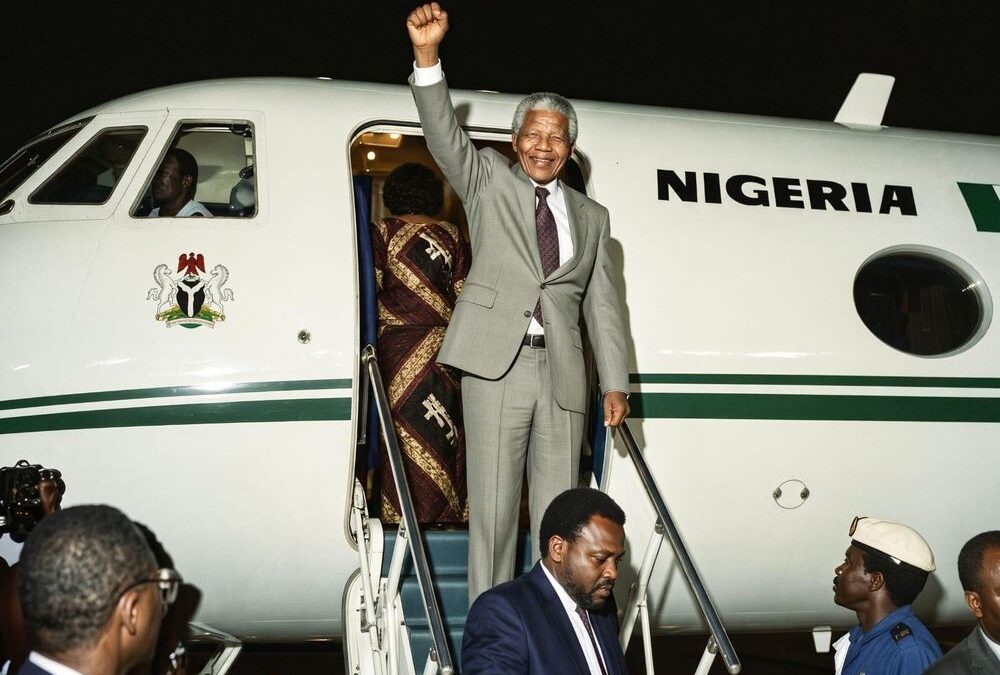
Nigeria and South Africa economic development lessons, Digi Mart USA News (South Africa): While visiting Nigeria, Nelson Mandela makes a series of gestures. It is critical for South Africa and Nigeria to learn from their pasts as they chart their economic courses.
The writer argues that, considering their past achievements and setbacks, neither country can afford to pass up the chance for collaborative development in Africa.
At the heart of Africa’s economic future sit two countries whose influence extends far beyond their borders: Nigeria and South Africa. They are two of the continent’s most important economic powers, yet their strengths and weaknesses reveal two very different development challenges.
Nigeria is a demographic giant. With approximately 237.5 million people in 2025, its population is almost four times South Africa’s 64.7 million.
It has an enormous consumer market, natural resources and an entrepreneurial population. South Africa, meanwhile, has a more sophisticated financial system, established industrial capabilities, mineral wealth and infrastructure that has historically made it one of Africa’s principal commercial gateways.
In 2025, South Africa’s nominal GDP stood at approximately US$427.2 billion, compared with Nigeria’s US$290.8 billion, while Nigeria recorded growth of approximately 4.0%, compared with South Africa’s 1.1%. Nigeria’s economy is clearly growing faster, but South Africa still produces a larger economy despite having a much smaller population.
The difference becomes even more striking when GDP per capita is considered. South Africa’s was approximately US$6,598, compared with Nigeria’s US$1,224.
South Africa therefore generates about 5.4 times more economic output per person. GDP per capita is not an individual’s salary or disposable income.
It is an average measure of economic output. Nevertheless, the gap reflects substantial differences in productivity, industrial development, infrastructure, financial sophistication and institutional capacity.
Nigeria can be described as having elements of oligarchic capitalism, with highly concentrated wealth and non-inclusive economic growth. It produces billionaires, wealthy entrepreneurs and successful corporations, but that does not automatically translate into a prosperous population.
The World Bank has explicitly described Nigeria’s growth as non-inclusive, noting that richer households benefited disproportionately during earlier periods of economic expansion. In other words, Nigeria demonstrates that producing wealthy individuals is not the same as building a wealthy society.
South Africa has a different economic structure. It has a more established middle class, a larger formal economy, a comparatively extensive social protection system and a state that redistributes resources through taxation, social grants and publicly funded services.
Its social grants support older people, children, people with disabilities and other vulnerable groups. Public healthcare and other essential services also provide support to people who cannot afford private alternatives.
Statistics South Africa reported that 40.1% of individuals benefited from social grants in 2024, while 50.4% of households had at least one grant recipient. The OECD has also documented the redistributive importance of social transfers, particularly for the poorest households.
But South Africa’s challenge is that redistribution alone cannot create a growing middle class. The economy must generate enough productive employment, business ownership and income growth to move people out of poverty and into financial independence.
The World Bank and IMF have both highlighted South Africa’s difficulty in translating redistribution into sufficiently inclusive economic growth.
Perhaps the most important lesson Nigeria and South Africa can offer each other lies in the way their economies distribute opportunity and prosperity. Nigeria’s challenge is not simply the absence of wealth but the limited extent to which that wealth translates into productive employment, broader ownership, reliable public services and opportunities for ordinary citizens to move out of poverty.
South Africa’s challenge is increasingly about economic mobility. It must create an economy capable of moving more people into sustainable middle-income livelihoods rather than allowing unemployment, weak growth and declining household purchasing power to push more people towards poverty and dependence on state support.
Social grants should never be dismissed as a failure. They are an essential instrument of social protection and help prevent millions of vulnerable people from falling into deeper deprivation.
However, they cannot replace productive employment, expanding businesses, rising incomes and the accumulation of household assets. This is where the two countries have important lessons for each other.
Nigeria needs to learn from South Africa that economic development must be accompanied by functioning public institutions, the rule of law, independence of the Reserve Bank and Judiciary, social protection, investment in public amenities and infrastructure and mechanisms that allow the benefits of growth to reach ordinary citizens. South Africa, in turn, needs to learn from Nigeria’s entrepreneurial drive, commercial ambition and capacity to build businesses.
It must create an environment in which more South Africans can become entrepreneurs, employers, investors and economically independent members of a growing middle class.
Nigeria must learn how to distribute opportunity more widely. South Africa must learn how to expand the productive economy that makes redistribution sustainable.
Neither redistribution without sufficient economic growth nor wealth creation without broad participation can deliver the prosperity that these two countries need.
South Africa’s development is also visible in the scale of its public-service architecture. It has an extensive system of public schools, universities, hospitals, provincial health services, municipal infrastructure, electricity connections, water networks, sanitation, public transport and social protection.
These systems are far from perfect. Inequality, corruption, deteriorating infrastructure and municipal failures have weakened service delivery.
Nevertheless, South Africa has developed a public institutional framework that Nigeria has yet to establish at the same scale.
South Africa’s 2025/26 consolidated government expenditure was approximately R2.59 trillion. This included around R508.7 billion for learning and culture, R298.9 billion for health, R422.3 billion for social development and R286.6 billion for community development.
The government also planned approximately R1.03 trillion in public infrastructure expenditure over the medium-term budget period. These figures demonstrate the state’s capacity to mobilise substantial resources for public amenities and services.
They must, however, be understood as budget allocations, not proof that every rand is efficiently spent or that every community receives adequate services. World Bank data for 2024 put electricity access at approximately 90.2% in South Africa, compared with 62.5% in Nigeria.
However, this indicator measures access, not the reliability or consistency of supply. Nigeria’s figures conceal a much deeper electricity crisis.
While 85.5% of its urban population has access, only 23.5% of the rural population does.
Even households connected to the national grid frequently experience prolonged outages. Millions of households and businesses consequently depend on expensive petrol and diesel generators to supplement an unreliable supply, while poorer households often cannot afford that alternative.
South Africa’s electricity system has also experienced serious reliability problems, particularly during the years of load-shedding. Nevertheless, the difference in national infrastructure coverage remains significant.
Access to safely managed sanitation was also approximately 74% in South Africa, compared with 32% in Nigeria.
The population comparison makes this particularly important. South Africa must provide services for approximately 64.7 million people; Nigeria must provide for 237.5 million, with substantially lower economic output per person.
South Africa’s advantage is not that everything works. It is that it has a more developed institutional and infrastructure foundation from which recovery can take place.
Nigeria must build much more of that foundation while serving a far larger population, but it must also start to leverage its population.
Nigeria’s greatest asset is its people. Its population represents a vast potential workforce, consumer market and source of entrepreneurial capital.
Nigerian businesses have built financial institutions, technology companies, commercial networks and distribution systems despite unreliable electricity, difficult logistics and regulatory uncertainty. This resilience is impressive, but an economy should not require extraordinary individual resilience simply to function.
Entrepreneurs need dependable infrastructure, security, predictable regulations and access to capital.
The Japa phenomenon illustrates the consequences. Professionals and working people leave in search of environments where their qualifications and labour can create better opportunities.
Nigeria is losing some of the human capital it needs to drive industrial transformation. The country must also confront the political economy of its dysfunction.
When politically connected interests benefit from import dependence, public contracts and privileged access to strategic resources, the incentive to build a competitive productive economy can weaken.
Nigeria needs to move beyond population-driven consumption towards manufacturing, agricultural productivity, value addition and exports. Its oil and gas resources offer opportunities, but they are finite.
Long-term prosperity requires building industries around energy, petrochemicals, agriculture, technology and services.
South Africa’s challenge is almost the reverse. It already possesses sophisticated financial markets, industrial capabilities, mineral resources, professional expertise and established commercial institutions.
Yet corruption, failing municipalities, rail and port constraints, unemployment and policy uncertainty have weakened its productive capacity. South Africa needs to restore its industrial competitiveness and create conditions in which businesses can invest, expand and employ.
Nigeria needs South Africa’s institutional depth: enforceable contracts, credible regulation, functioning capital markets, dependable logistics and professional public administration. South Africa needs more of Nigeria’s entrepreneurial urgency: commercial ambition, adaptability, market-building and the willingness to identify opportunities despite difficult conditions.
Nigeria inherited an agricultural export economy, railways, ports and commercial centres at independence in 1960, although it was not industrialised to South Africa’s level. South Africa entered democracy in 1994 with a considerably more sophisticated industrial and financial economy, but one built on racial exclusion and concentrated ownership.
Both inherited productive foundations. Neither could assume those advantages would preserve themselves.
Nigeria must also resist retaliatory nationalism. South African businesses such as MTN, Shoprite and MultiChoice have established operations in Nigeria, which support local employment, suppliers and consumers.
Threatening legitimate businesses because of political tensions risks punishing Nigerian workers and undermining investor confidence. There is also a commercial imbalance worth confronting: South African businesses have built a significant presence in Nigeria, while Nigerian-owned enterprises have not established a comparable footprint in South Africa.
Nigeria should ask why more of its capital is not building manufacturing, financial and technology businesses across African markets.
Both countries must protect investment. Political hostility makes expansion pricier and discourages the very capital needed to create jobs.
While Nigeria and South Africa become preoccupied with one another, China, India and the United States continue expanding their economic and technological influence across Africa.
The two African powers should be building complementary strengths. Nigeria offers a vast market, energy resources and entrepreneurial dynamism.
South Africa offers industrial capabilities, financial institutions, logistics expertise and established commercial networks. Nigeria must convert its demographic potential into institutionalised productivity, while South Africa must convert its inherited industrial and institutional advantages into renewed growth.
Neither country should mistake the other’s weaknesses for evidence of its superiority.
Nigeria must confront the institutional failures driving its citizens abroad. South Africans must recognise that migrants are not responsible for its governance failures and that African enterprise can contribute to its economic renewal.
This points back to the wider continental vision associated with Sir Abubakar Tafawa Balewa and Nelson Mandela: African prosperity cannot be separated from cooperation and shared development. Nigeria and South Africa are too big to fail, but being too big to fail does not mean they are incapable of failing their people, wasting their inherited advantages or surrendering their place in Africa’s economic future.
Phapano Phasha is a businesswoman, thought leader and philanthropist.