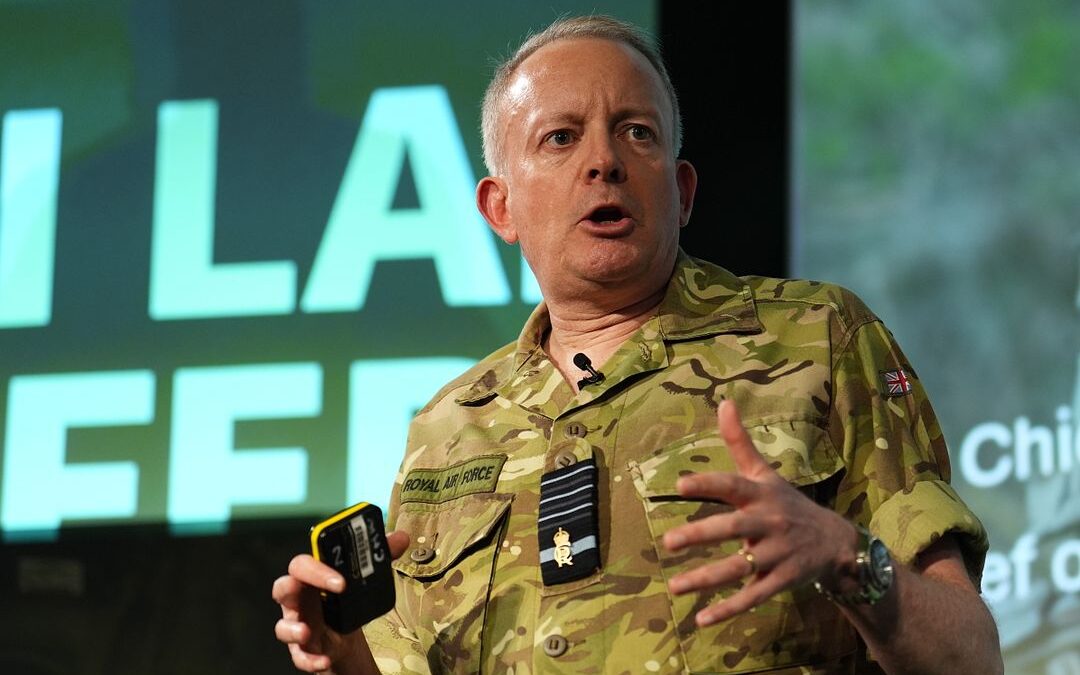
UK defence chief warns of Russian threat in Europe, Digi Mart USA News (Oslo, Norway): The head of the British armed forces, Sir Richard Knighton, has accused Russia of being behind murders, sabotage and cyberattacks in Europe. In a rare interview with the Financial Times, he said Britain must “catch up” with its European allies in understanding the threat from Russia.
“We are talking about targeted assassinations, we are talking about sabotage, we are talking about cyberattacks. These are very real things from the Russian state that we have evidence of in Europe, and to some extent in the United Kingdom,” Knighton told the newspaper.
Russian former spy Sergei Skripal and his daughter Yulia were attacked by Russian agents in Salisbury in March 2018, in an attempted murder. British authorities concluded that the nerve agent Novichok had been used.
Dawn Sturgess, a 44-year-old mother of three, died after being exposed to a “significant amount” of the nerve agent, which had been kept in a perfume bottle.
Knighton told the FT that Russia’s “appetite” for taking risks has “clearly grown.” He said terms such as “hybrid activity” are no longer adequate to describe how serious the situation is.
“This is the most dangerous time I have experienced in my adult life,” he said, adding: “The threat, first and foremost from Russia but also from other parts of the world, is increasing.”
The remarks come shortly before a new defence agreement is due to be signed. The agreement aims to strengthen defence of the North Atlantic, the Arctic and the Baltic Sea.
The cooperation, known as the Joint Expeditionary Force (JEF), is led by the United Kingdom, and the Scandinavian countries, the Baltic states and the Netherlands take part.
The agreement is scheduled to be signed aboard the British aircraft carrier HMS Prince of Wales, which is currently docked in Oslo. “One of the things that is absolutely necessary is that we manage to hold back Russian submarines, so they cannot threaten or attack ships in wartime,” Knighton told the FT.
Knighton also noted that Norway last year purchased British Type 26 frigates designed to hunt submarines, a purchase worth around 10 billion pounds.
The Arctic region has in recent years become a particularly important security area for NATO in general, and is defined as Norway’s most important strategic priority. Climate change is melting sea ice, opening shipping routes that were previously covered in ice.
In addition, important undersea data cables run through the area.
“By making this area safe, we also keep the east coast of the United States safe,” the British defence chief said.
U.S. President Donald Trump has urged European countries to take more responsibility for their own security.
“We in Europe clearly must step up and rearm, so that we can deter our enemy,” Knighton said. He also noted that the United States has nonetheless shifted its attention away from Europe and toward Asia over the past 15 years.
The British government has pledged to raise defence spending to 3 percent of the country’s economic output by 2030. Analysts estimate this would mean around 11 billion pounds in additional spending per year.
Knighton said British authorities must make the threat understandable to ordinary people, especially because the state is asking society to spend more money on defence.
Correction: The first version of the article stated that Sergei Skripal and his daughter Yulia were killed with the nerve agent Novichok. This was incorrect; they were attempted to be killed.
The error was corrected on November 8 at 11:00.