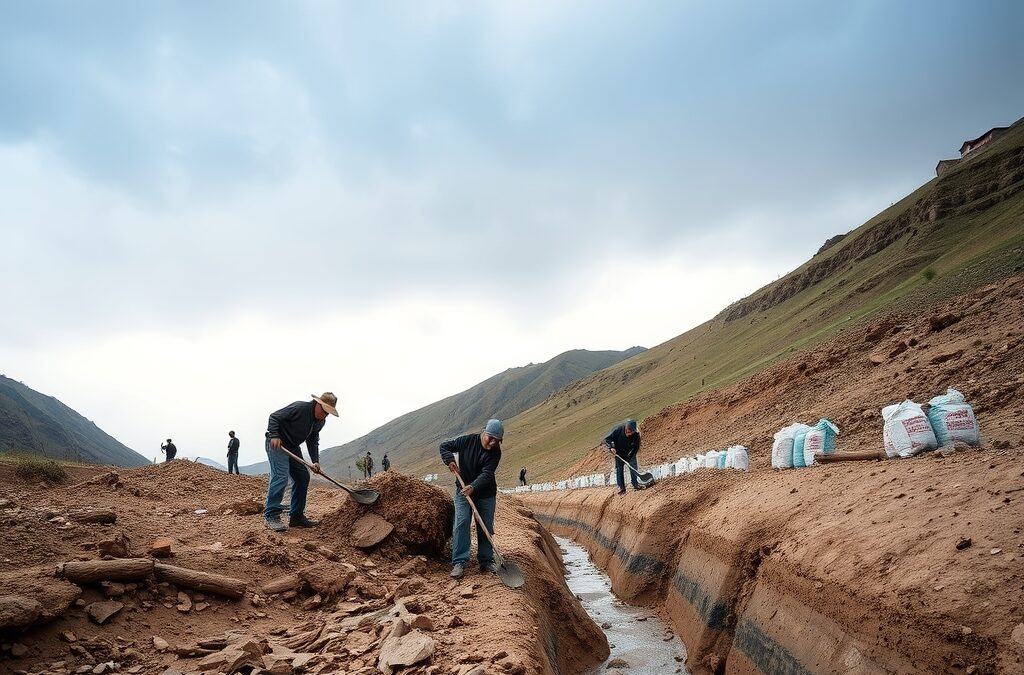
ANA river and ravine cleaning El Niño preparedness Peru S/ 179 million, Digi Mart USA News (Peru): The National Water Authority (ANA) is carrying out cleaning and dredging work on rivers and ravines in six regions of Peru to reduce the risk of mudslides and floods ahead of the El Niño phenomenon, with a budget of nearly S/ 179 million. The agency, attached to the Ministry of Agrarian Development and Irrigation (Midagri), reported that it has so far removed 2.64 million cubic meters of excess material from riverbeds.
According to the ANA, the physical progress of the cleaning and dredging work has reached 42.21%, while budget commitments stand at 69.6% and certification of allocated resources at 69.8%. The executed budget, meaning spending that has been recorded as expenditure, stands at 16.3%.
The work is being carried out in Tumbes, Piura, Lambayeque, La Libertad, Áncash and Lima, regions considered priorities because of their exposure to intense rainfall. Of 70 activities scheduled to run until December 30, 2026, 31 have already started at critical points, with greater momentum in Tumbes, Piura, Lambayeque and Lima.
Removing excess material is intended to facilitate water flow and reduce the danger of overflows in riverbeds identified as vulnerable.
The ANA said contractors are paid according to the progress of the work and the delivery of results, without advance payments. Emergency Decree No. 008-2026, published in the official gazette El Peruano, authorized a transfer of up to S/ 129.4 million to the ANA from the contingency reserve of the Ministry of Economy and Finance (MEF), plus an additional allocation of up to S/ 50.1 million for dynamic barriers.
The decree was countersigned by Cabinet Chief Luis Galarreta, Economy and Finance Minister Elmer Cuba, and Agrarian Development and Irrigation Minister Marco Vinelli.
The decree states that the ANA has identified 70 critical points of high vulnerability in rivers and ravines across the six regions that require urgent attention to reduce risk to the population, infrastructure and productive areas. It also requires recipient entities to report monthly to the National Commission for Risk Management of the El Niño Phenomenon on physical and financial progress, and to submit a final report with corresponding georeferencing.
Transferred resources may not be used for purposes other than those authorized.
Of the total budget, more than S/ 50 million (S/ 50,059,056) is earmarked for purchasing and installing dynamic barriers in ravines, mainly in critical areas of Lima and Huarochirí. These structures are designed to contain or reduce the impact of material that descends through ravines during intense rainfall.
In Lima and Huarochirí, the ANA has installed six dynamic barriers in vulnerable ravines, structures that help contain rocks and other material swept down by mudslides. Six more are planned to extend protection to more than 120,000 residents exposed to these risks, according to Midagri’s report on its first 100 days in office.
The measures take into account the scenario projected by the Multisectoral Commission in charge of the National El Niño Study (Enfen), which considers the continuation of coastal El Niño until April 2027 likely. The decree is valid until December 31, 2026 and authorizes national government entities and regional governments to make budget modifications from their ordinary resources to protect public infrastructure against imminent danger from heavy rains.
In a separate summary covering the first 100 days in office, Midagri reported that dredging work had been carried out along 179 kilometers of rivers along the coast, with 85% progress against schedule, and had removed 4.5 million cubic meters of accumulated material from riverbeds.
By region, in Piura the Los Ejidos-Puente Bolognesi section shows 100% physical progress, with 4.85 kilometers worked and 85.30% progress in dredging volume, equivalent to 464,382 cubic meters. At El Milagro-La Encantada progress is 27.59%, and at Piedra Negra it is 20.73%.
Under Emergency Decree No. 008-2026, 21 interventions were scheduled in Piura, with a target of 49.35 kilometers of river and ravine channels.
In La Libertad, the comprehensive solution for the San Ildefonso and San Carlos ravines, executed by the National Infrastructure Authority (ANIN), had recorded physical progress of 78.82% and 69.52%, respectively, with a total investment of S/ 1,664 million, according to the agency’s report.