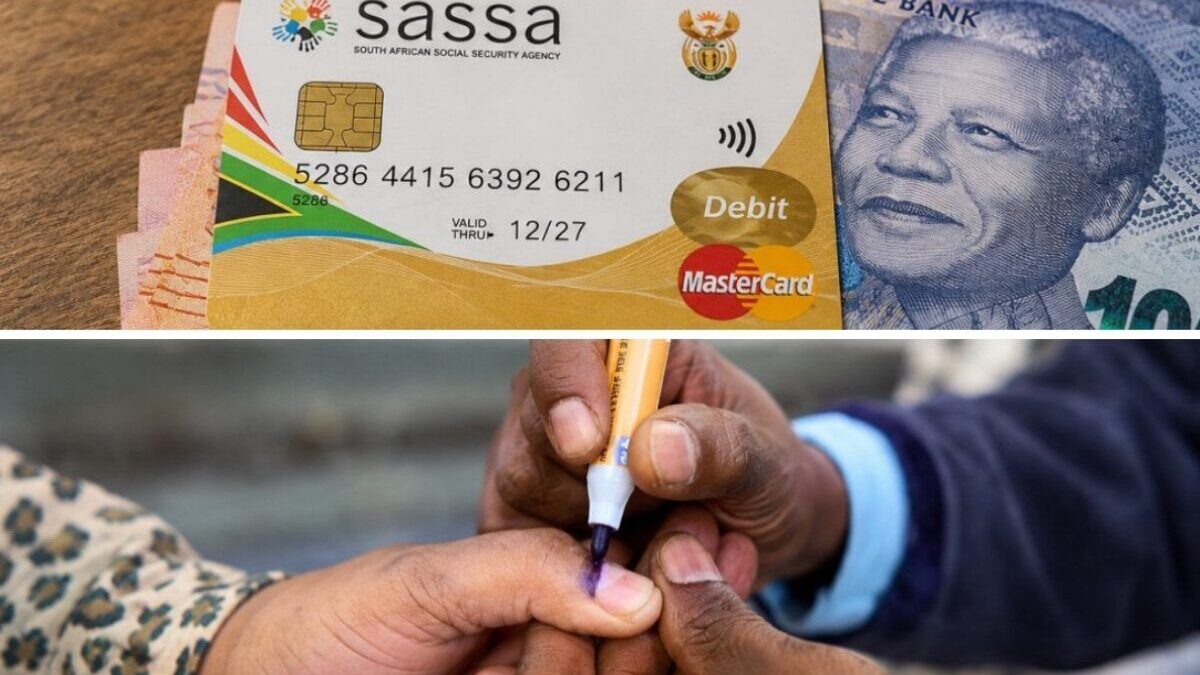
SASSA grant recipients versus 2026 local election voter turnout in South Africa, Digi Mart USA News (South Africa): The latest count shows 26 million residents receive SASSA grants, including the temporary eight-million-recipient R370 Social Relief of Distress grant. Against Stats SA’s mid-2026 population estimate of 63.5 million, that is about 45 percent of the population receiving some form of social welfare.
Roughly 15 million South Africans voted in the local government elections held on 4 November. The Independent Electoral Commission (IEC) reports 29.2 million registered voters and turnout of about 52 percent.
Grant payments therefore outnumber ballots cast by nearly two to one, a gap of about 42 percent.
Official results published on Sunday, 8 November 2026, showed the ANC with 30.76 percent and the DA with 24.64 percent. That is 15 percentage points down on the ANC’s 2021 local result.
ANC Secretary-General Fikile Mbalula called the result “catastrophic.” Voter apathy is among the factors cited for the ANC’s decline.
Turnout of about 52 percent is higher than the roughly 46 percent recorded in the 2021 local elections, but below the 58.6 percent recorded in the 2024 general election, which led to the formation of a Government of National Unity (GNU). Grievances over the state of South African Social Security Agency (SASSA) grants are another possible explanation.
Beneficiaries saw no October top-up for the first time in two years. The 2025 increase for core recipients was 5.9 percent, but in 2026 it was 4.8 percent due to treasury pressure.
Nearly 57,000 SASSA grants were suspended between April and June, and the Medium-Term Budget Policy Statement (MTBPS) signaled further reviews.
SASSA grants fall under a national competency, while local elections focus on municipal services such as water, electricity, refuse collection and infrastructure. The article notes, however, that dissatisfaction at the micro and macro levels appears to run in parallel.
Recipients of the R370 Social Relief of Distress grant are mostly unemployed working-age adults. If many of them stayed home on election day, they represent a large non-voting bloc, and government data suggest this group is the least tied to the ANC’s traditional voter base.
The article also highlights the roughly 4.2 million Old-Age Grant recipients, who generally turn out more reliably thanks to special voting allowances. If they are apathetic about the grant increases, the effect could be considerable.
The question raised is whether SASSA dependence translates into party loyalty. Nearly half the country receives grants, yet the ANC still lost 15 percentage points, suggesting voters do not view a SASSA grant as a reason to remain loyal.
Mbalula summarized the issue at the results announcement: “The ANC successfully liberated black South Africans and gave them the right to vote. But that is not enough to get their votes any more.
The ANC needs to ensure that it governs well and provides people with quality services to maintain their support.”
The publication asks readers whether unhappiness over SASSA grants plays a role in voter mindset.