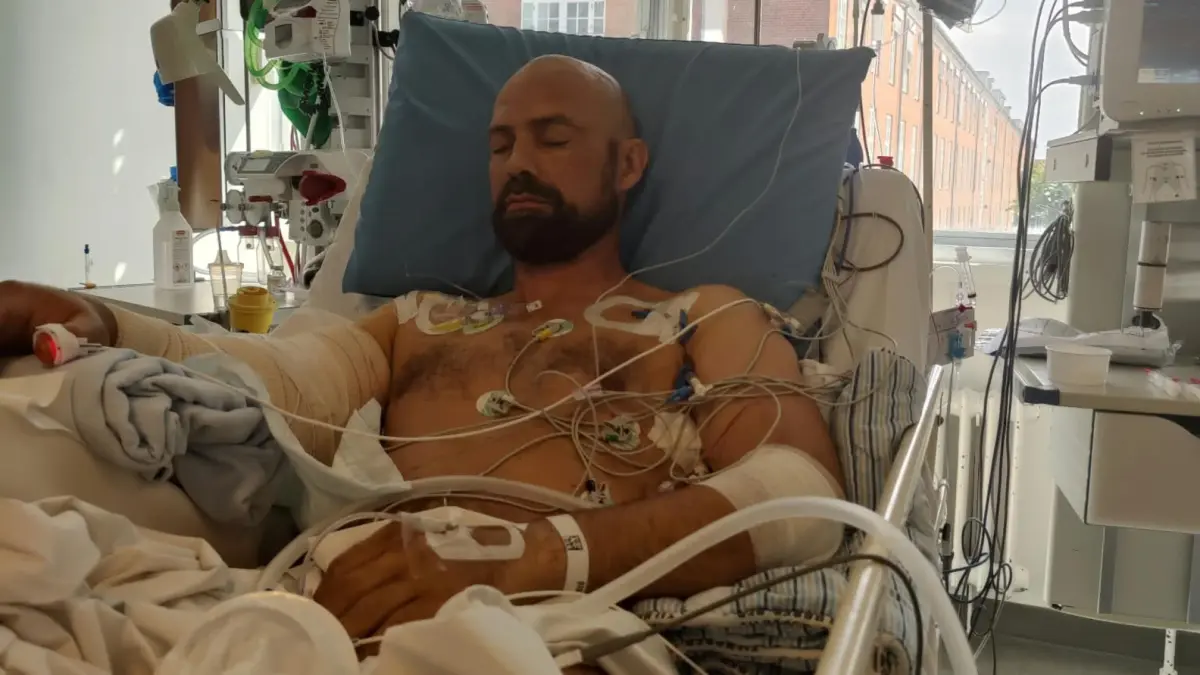
Silkeborg worker arm amputation and reattachment after gravel pit accident, Digi Mart USA News (Silkeborg, Denmark): Three months ago, Frank Wejgelt’s life was turned completely upside down. He says it is a matter of luck that he is still alive.
“If my colleagues had not been there, I would have died. I lost almost five liters of blood,” he said.
It had been a relatively normal workday at Tandskov Grusgrav near Silkeborg, where Wejgelt serves as assistant chairman. However, a conveyor belt had broken earlier that morning.
When it was due to restart after lunch, Wejgelt discovered that one of the rollers it runs on had collected a large amount of sand.
“I got the clever idea to put my hand between the belt and pull out the sand. It turned out to be a rather bad idea.
The belt caught my glove, and it took about two seconds for it to pull my entire right forearm off,” he said. Although blood was pouring out, the 48-year-old from Silkeborg managed to call for help.
He also applied a tourniquet to his remaining upper arm with his left hand.
“For some reason I thought the arm also needed to be above heart level, so I ran over to my colleagues 30 meters away and lay down flat in the sand,” he said. His colleagues called 112 and took over applying pressure to his right upper arm.
Four minutes later, police and an ambulance were ready at the gravel pit. Fifteen minutes after the incident, a helicopter was ready to take Wejgelt to Odense University Hospital.
“The sound of the helicopter is one of the last things I remember. I just managed to tell the doctor where the rest of my arm was, and it was still by the conveyor belt.
But it was supposed to go to the hospital with me,” he said. A colleague was asked to retrieve the arm.
“That is one of the things I feel most sorry about. That I caused my colleagues the pain of experiencing all that.
I have struggled with a great deal of guilt over it.”
He later learned from colleagues that they were very impressed by his composure in the situation. One colleague has, however, been placed on sick leave as a result of a reaction following the episode.
“While I was lying there bleeding heavily, I also told them that I was terribly sorry on their behalf. But I cannot recall feeling any pain myself.
The doctors say it was the adrenaline that kept me so present,” Wejgelt said.
At Odense University Hospital, doctors succeeded in reattaching Wejgelt’s forearm. About six hours passed from the time of the accident until it was reattached.
“They say that is the maximum that can pass so the arm’s muscles do not die. According to the doctors, I am a special case in Denmark, where a forearm torn off at the elbow has been reattached.
So I have become something of a ‘star’ for them,” he said with a laugh.
His mood is slowly improving, and he is doing well under the circumstances. However, he still cannot talk about the episode without tears, and he must pause several times during the interview.
The period after the accident has been especially difficult, not only for him but also for his partner Helene and their three children. “It has been a shock for them too.
We have talked a lot about it, because it is life-changing for them as well,” he said.
He did not only spend several days in intensive care to be stabilized after both the procedure and the significant blood loss. Three weeks later, a home nurse discovered that the skin around the wound on his arm had begun to die.
“I went to Odense for another operation, and just as they were taking me into the room, they said that this time they did not know whether they would have to amputate the arm. It was a shock for me, because I had just accepted the situation and that I still had an arm,” he said.
Fortunately, Wejgelt woke up with his right forearm still attached. However, doctors had to take extra skin from his thigh, and the operation lasted many hours.
“It was severe. At first I could only walk a few meters because I had so much pain in my legs.” Since then, his time has been filled with checkups and rehabilitation intended to keep the arm from becoming completely stiff.
“I no longer have an elbow, so I cannot pull the arm toward me or lift it, so I cannot eat or scratch my neck with my right arm. I also cannot move my fingers or rotate my wrist.
However, they expect I may regain some movement in about half a year and perhaps feeling in my fingers in one to one and a half years, once the nerves have grown together more,” he said. As a result, what he can do in everyday life is severely limited.
He is temporarily not allowed to drive, and he can barely help with household chores.
“I have always enjoyed cooking, but I cannot even do something as basic as peeling a potato. We also had to buy a different vacuum cleaner so I would not have to drag the hose with my other arm, so that I can vacuum.
I need to feel useful when I am at home.”
Wejgelt has received crisis support, which has helped him stop a lot of racing thoughts. “I had really blamed myself.
It was important that I moved away from those thoughts of guilt and shame, because otherwise it would have eaten me up,” he said. He still needs to work through the episode, partly because he expects it could take up to a year before he can return to a job, which he is determined to do.
“I have decided not to think negatively. And I want to be connected to the labor market again.
I cannot just stay at home. The gravel pit has promised there is a place for me when I am well enough, but there are no guarantees right now,” he said.
In the meantime, he would like to spend time with others in similar situations. He recently sought people on Facebook who have also been involved in accidents, because he needs to share thoughts about how to move forward.
He hopes to be able to meet in person in groups at his home in Silkeborg.
“I know I am not alone. I really want to hear how they manage everyday life, how much they can do, and what they fill their days with.
But it is not a grief group.” He acknowledges there are bad days, but says the group would start from a positive standpoint, helping one another get the most out of the situation and meet its challenges. “Life has taught me that it will be fine,” he emphasized.
“I do not see myself as sick, because I am not. I was involved in an accident, and that is something else.
Now I am just left-handed, and that is something I will and want to find peace with.”