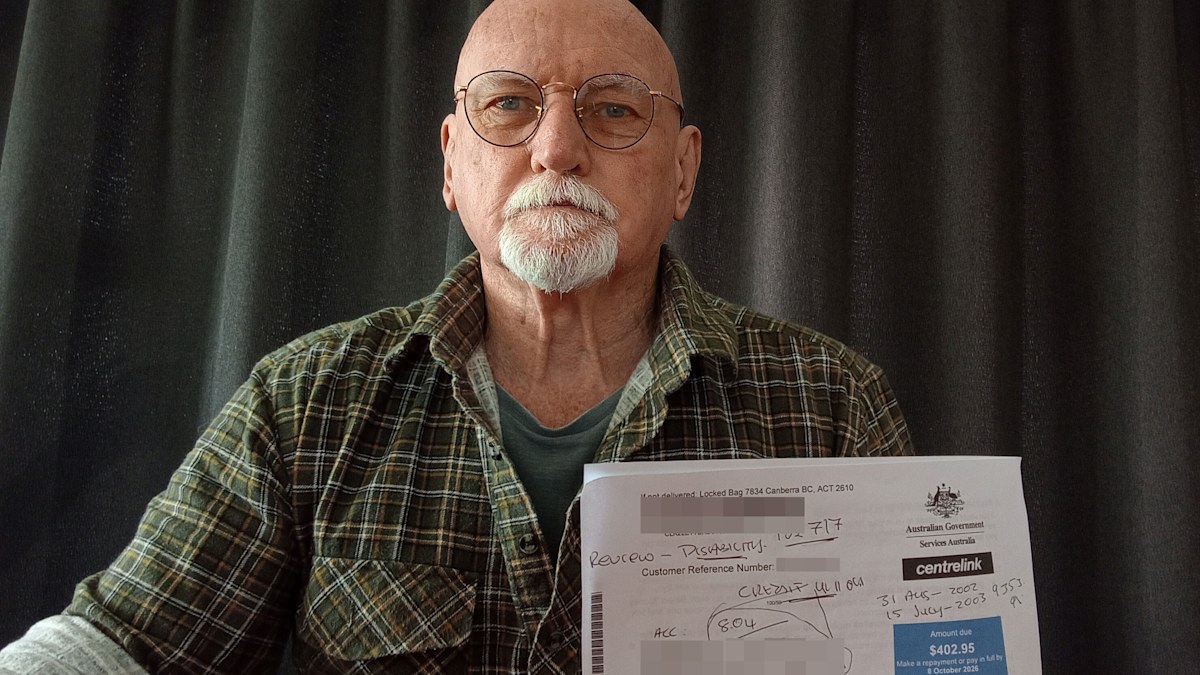
Centrelink debt recovery of decades-old debts, Digi Mart USA News (Kaitangata, New Zealand): When Iain Milne checked his letterbox in September in the small historic town of Kaitangata, on New Zealand’s South Island, he was mildly surprised to see a letter from Centrelink. “I thought, oh, Centrelink, it’s from Australia,” Milne said.
For the former Queensland police officer, the letter was a distant link to a past he thought he had left behind decades ago. The 72-year-old pensioner found that it was a debt recovery notice claiming he owed $400 on a debt that was being unpaused.
Milne said he initially was not too worried, since the amount was manageable. However, the news quickly became much worse.
“Opening that letter was the beginning of my nightmare,” he said.
Puzzled by the debt, he called Centrelink and began the confusing process of trying to recall his very distant financial past. The debt related to alleged overpayments of the Newstart allowance he had briefly received while living in Australia in 2005, some 21 years ago.
Centrelink then revealed that it was not his only debt. According to Services Australia, Milne also owed $6,200 for disability support pension payments he received in 2002.
Milne said he had received the disability support pension for less than a year, decades ago, due to PTSD he suffered from his 12 years as a Queensland police officer. In 2002, a tumultuous year in which he split from his wife of 19 years and moved back to New Zealand, Centrelink continued to pay his Australian disability support into a joint account.
“Centrelink continued to pay my Australian disability into my joint account, which I no longer had access to, but my ex-wife did,” Milne said.
Milne said he did not believe his ex-wife deliberately kept the payments. He acknowledged that he should have informed Centrelink that he was leaving the country, but said he was too overwhelmed by the major changes in his personal life at the time.
Four months after returning to New Zealand, his mother died, and the following years were marked by a serious struggle with depression, including periods of hospitalization.
After many hours on the phone with Centrelink in recent weeks, Milne said he was able to piece together some of what happened but was far from understanding the whole story. He moved back to Australia for two years between 2005 and 2007, during which he received Newstart payments briefly before finding work as a caretaker at a Queensland retirement home.
It is believed that Centrelink raised the Newstart and disability support pension debts during his return to Australia, and Milne had his wages garnished to make some repayments. He said he was completely unaware of the disability support pension debt.
Milne said he had always tried to report his income correctly and was “flabbergasted” that Centrelink was now pursuing a debt stretching back 24 years. “Surely 24 years is just beyond the pale, it is ridiculous,” he said.
“Why me, now, as a pensioner? I could die tomorrow.
Are you going to chase me to my grave?”
Milne’s $400 Newstart debt is one of 147,000 current Centrelink debts calculated using a method called income apportionment, which was later found to be unlawful. The debts had been on pause for six years, first due to the pandemic and then due to questions about their legality.
Income apportionment was a potentially inaccurate practice in which Centrelink averaged a recipient’s earnings across fortnightly periods rather than using exact pay dates. The government used it to raise millions of debts from the late 1990s to 2020.
In December 2025, legislation was passed to retrospectively validate the sums, allowing Centrelink to continue collecting on the debts. Centrelink began unpausing and gradually calling in the debts in June.
“We recognise the time taken to resolve income apportionment has led to uncertainty and frustration for some customers,” Services Australia General Manager Hank Jongen said. “At each stage of the income apportionment pauses, we’ve kept customers informed directly through letters and other notifications, and through our website.”
Milne later discovered why he had suddenly come to the attention of Australian authorities after decades in New Zealand. In January, New Zealand’s Department of Work and Income, which administers his local pension, asked him to complete a form applying for an Australian part-pension based on the years he had lived and worked across the Tasman.
That cross-border paperwork was enough to flag his file with Services Australia. While his file was matched early in the year, the debt remained frozen until September, when the agency unpaused it along with other income-apportioned arrears.
Milne is now joining calls from legal advocates urging Centrelink to stop pursuing debts more than six years old. Advocates, legal services and the Commonwealth Ombudsman have repeatedly raised concerns about the fairness of pursuing welfare debts that stretch back decades.
Critics argue that requiring people to produce decades-old payslips, bank statements or employer records is virtually impossible, and they urge the federal government to implement a firm statute of limitations or waive debts older than six years.
The scale of historical debt on Services Australia’s ledger is significant. According to its own data from October 31 this year, Centrelink is pursuing 1.34 million outstanding debts totaling $5.02 billion.
About 600 of the debts date back more than three decades, while the oldest is 40 years old. There are almost 77,000 debts between 15 and 30 years old.
Before 2017, Centrelink could pursue only debts less than six years old. That limit was removed during the Robodebt era, allowing the department’s debt raisers to go further back.
The Robodebt royal commission’s final report recommended reinstating the six-year time limit. A spokesperson for the Department of Social Services said the government had “accepted-in-principle” the recommendation.
“We will continue to explore our options to implement this recommendation,” the spokesperson said.
Nine.com.au has been contacted by dozens of distressed Australians whose historical debts, many dating back more than 15 years, have suddenly been unpaused. Michael, an 81-year-old pensioner who asked that his surname be withheld, said the sudden revival of two Centrelink debts belonging to his wife had caused great stress.
His wife, Joan, is now on the disability support pension, but her two debts totaling $8,400 date back 17 years to 2009 and 2010, when she was on Newstart. “My wife has two debts resurrected from the dead…
raised because my wages were allegedly under-quoted,” Michael said. “But we don’t have records stretching back 17 years, so challenging this is difficult, and my former employer is now out of business.”
Joan discovered the debts had been unpaused last month when she applied for a standard advance on her pension payment, something she had done without issue many times before. She was abruptly refused and told the debts were the reason.
Michael calculated that repaying the debt at the minimum rate of $15 a fortnight would take more than 20 years, by which time he would be over 100 years old. “We have no hope of paying this off – we will take it to the grave, and then Centrelink still misses out,” he said.