Early polar vortex disruption, Digi Mart USA News: Meteorologists said Friday they observed an exceptionally early disruption of the polar vortex, a development that increases the risk of cold waves across the Northern Hemisphere, although its consequences remain uncertain.
The polar vortex is a large system of very strong winds circulating between 10 and 50 kilometers above the Arctic during the Northern Hemisphere winter. Variations in its intensity and configuration, including its shape and temperature, can affect weather and lead to significant drops in temperature.
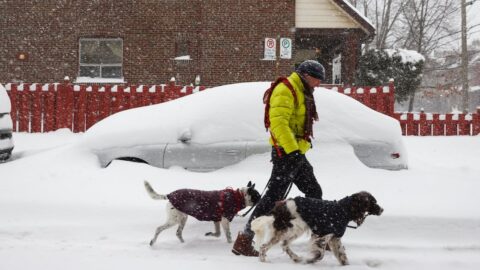
These winds strengthen in autumn and peak in January. The polar vortex can weaken in the second half of winter, generally between January and March, allowing extremely cold air to move south and reach Europe, North America and Asia.
According to scientists, however, the vortex is already weakening in early November.
“To our knowledge, this is the earliest stratospheric vortex disruption ever observed,” Tim Stockdale and Frederic Vitart of the European Centre for Medium-Range Weather Forecasts (ECMWF) told AFP. Judah Cohen, a climatologist at the Massachusetts Institute of Technology, told AFP the disruption “considerably increases the risks of cold waves in the most populated regions of the Northern Hemisphere, the United States, Europe and East Asia.”
Grahame Madge, a spokesperson for the British Met Office, said such early timing “is exceptional.” A possible explanation, he added, is “the strength of the El Niño phenomenon in the Pacific” this year. El Niño is a natural phenomenon that recurs every two to seven years, and this year it is exceptionally powerful.
Stockdale and Vitart said they did not know where this early polar vortex disruption originated but also pointed to El Niño. A November disruption has been recorded only three times since measurements began in the 1950s: in 1958, 1968 and 2025, all on November 28.
Because the disruption is occurring so early, its effects could nonetheless be “less pronounced” than if it occurred in midwinter, Cohen said, since “temperatures in the source regions of these air masses, such as Siberia or the Arctic, are not yet as low as they will be in February.” Cohen also said El Niño, which tends to soften winters, could help by “moderating or altering” the impacts of an early polar vortex disruption, while noting that this remains uncertain.
For now, Météo-France considers the consequences for French weather “very uncertain” and dependent on how the disruption evolves. The agency said the phenomenon could over several weeks widen temperature differences between northern and southern Europe, with colder weather in the north and warmer weather in the south.
Cohen added that climate warming may also play a role, although no study has established a link.