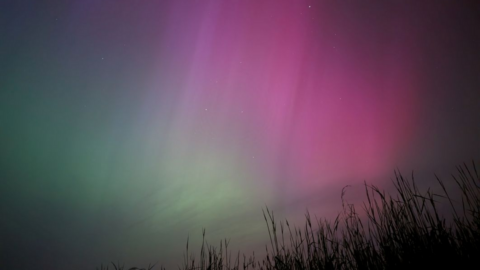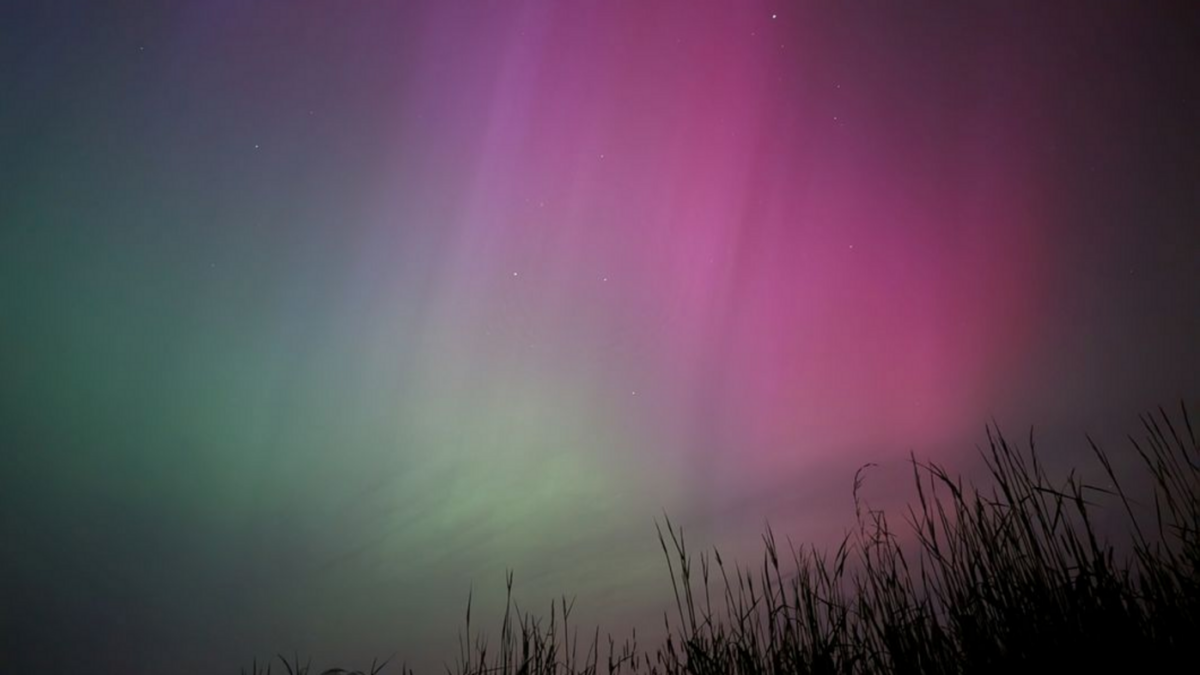
Aurora red northern lights mystery, Digi Mart USA News: The May 2024 solar storm was the second-strongest such event ever reliably measured, producing red and green northern lights that were clearly visible far to the south on the night of May 10 to 11. While green auroras of this kind are well explained, the red ones have remained puzzling.
New photographs of the phenomenon now offer clues about how these auroras form.
Forecasts had predicted that auroras would reach mid-latitudes across Europe that night. Several experts in Göttingen and Braunschweig therefore took their cameras outdoors.
Sami Solanki, director of the Göttingen Max Planck Institute for Solar System Research, said he had seen many auroras at higher latitudes, but they are rare over Göttingen. He initially did not intend to use the images for science.
Philipp Schulz of the Fraunhofer Institute for Surface Engineering and Thin Films IST, Ingo von Borstel of the Institute for Geophysics and Extraterrestrial Physics at TU Braunschweig, and Klaus Reinsch of the Institute for Astrophysics and Geophysics at the University of Göttingen also observed the display. Together with other researchers, they now analyze the phenomenon in the journal Annales Geophysicae.
Their photographs show a reddish glow above the green light close to Earth, and bright rays extend from the upper red into the lower green.
“Rays that continuously extend from the red aurora to the green aurora had not been described in any scientific publication before,” said lead author Bruce Tsurutani, formerly of NASA’s Jet Propulsion Laboratory. “They helped us understand how the red glow forms.”
Generally, auroras occur when clouds of electrically charged particles travel toward Earth after eruptions on the Sun. Earth’s magnetic field guides them toward the poles.
In the upper atmosphere, these particles strike air molecules and cause them to emit light.
Particularly strong solar storms can produce auroras visible at mid-latitudes. Light colors vary depending on the type of excited gas and altitude.
Red auroras occur during intense solar storms at mid-latitudes, usually at altitudes between 200 and 800 kilometers. Green auroras frequently appear in polar regions, usually at altitudes of 85 to 130 kilometers.
The mechanism behind the red glow has been debated for years, and the May 2024 photographs now help address it. “That the bright rays continue from the red to the green northern lights suggests that the same physical process is at work in both cases,” said co-author Yasuhito Narita of TU Braunschweig.
According to the researchers, both red and green auroras can result from electrons descending from the Sun that strike oxygen ions. The altitude, and therefore the increasing density of the atmosphere toward the bottom, determines the color of the emitted light.
Solar activity generally follows an roughly 11-year cycle of quieter and more active phases. The latest peak was roughly placed at the end of 2024, and solar activity is currently declining.
To further study the phenomenon, researchers at TU Braunschweig ask the public to provide photographs of auroras in the future. Exposure times should not exceed six seconds, as only then can the revealing rays be seen.