Bromo volcano eruption November 5, 2026, Digi Mart USA News: Indonesian volcano observers had a busy day on Thursday, November 5, 2026. Earlier in the day, Semeru produced pyroclastic flows, and a VONA warning was issued from the Tengger Caldera, though it was initially unclear whether Bromo, which lies within the caldera, was the source of the ash cloud.
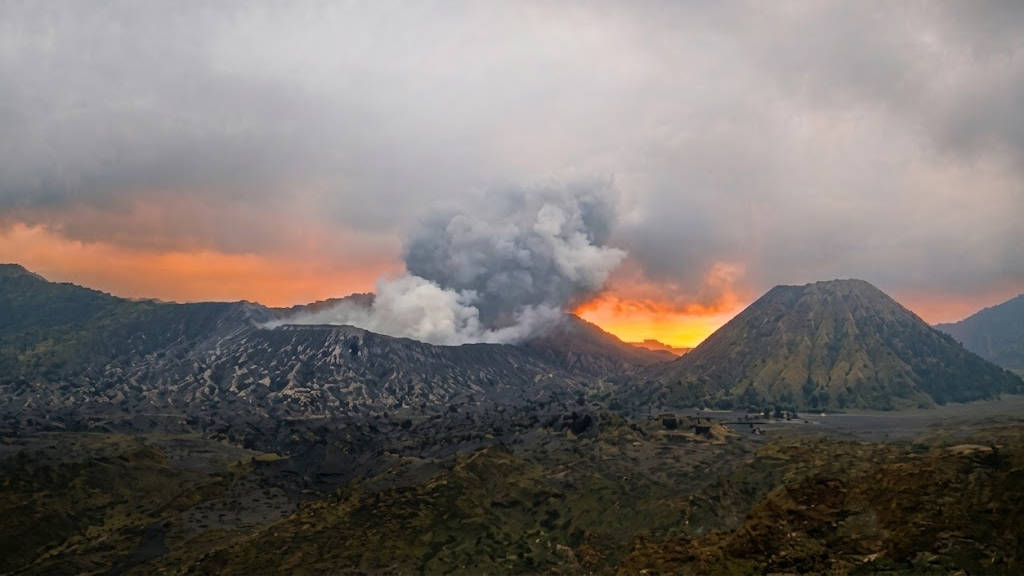
Indonesia’s volcanology agency PVMBG has now confirmed that Bromo erupted explosively on Thursday, November 5, 2026. The eruption began at 5:11 p.m.
local time. A gray ash cloud rose about 500 meters above the crater rim and reached an altitude of 2,829 meters above sea level.
The ash was described as varying in density and drifted west with the wind.
The event was also recorded by a seismograph, which registered a maximum amplitude of 23 millimeters and lasted 46 seconds. This confirmed the ash cloud that the Darwin Volcanic Ash Advisory Center (VAAC) had reported earlier in the morning in a volcanic ash advisory for the Tengger Caldera.
That advisory described ash emission up to flight level FL090, or roughly 2,700 meters. The differing height figures may reflect the VAAC’s modeling, since the ash was only partially identifiable on satellite images and briefly mixed with weather clouds above the crater.
The eruption was preceded by a phase of slightly elevated seismic and thermal activity, which the publisher had already reported at the end of October. Although it is Bromo’s first eruption since 2019, it was not entirely unexpected.
From November 4 onward, the observatory registered five low-frequency earthquakes and nine hybrid earthquakes, which may indicate the movement of magmatic fluids beneath the surface. A continuous tremor signal and three distant tectonic earthquakes were also recorded.
White water vapor was observed at the crater, rising between 50 and 600 meters above the summit, and a thermal anomaly was visible inside the crater.
The alert status remains at Level 2 (Waspada). Visitors, hikers and residents are asked to maintain a safety distance of at least one kilometer from the active crater.
The volcanology agency also warns of phreatic explosions that can occur suddenly without clear volcanic warning signs.