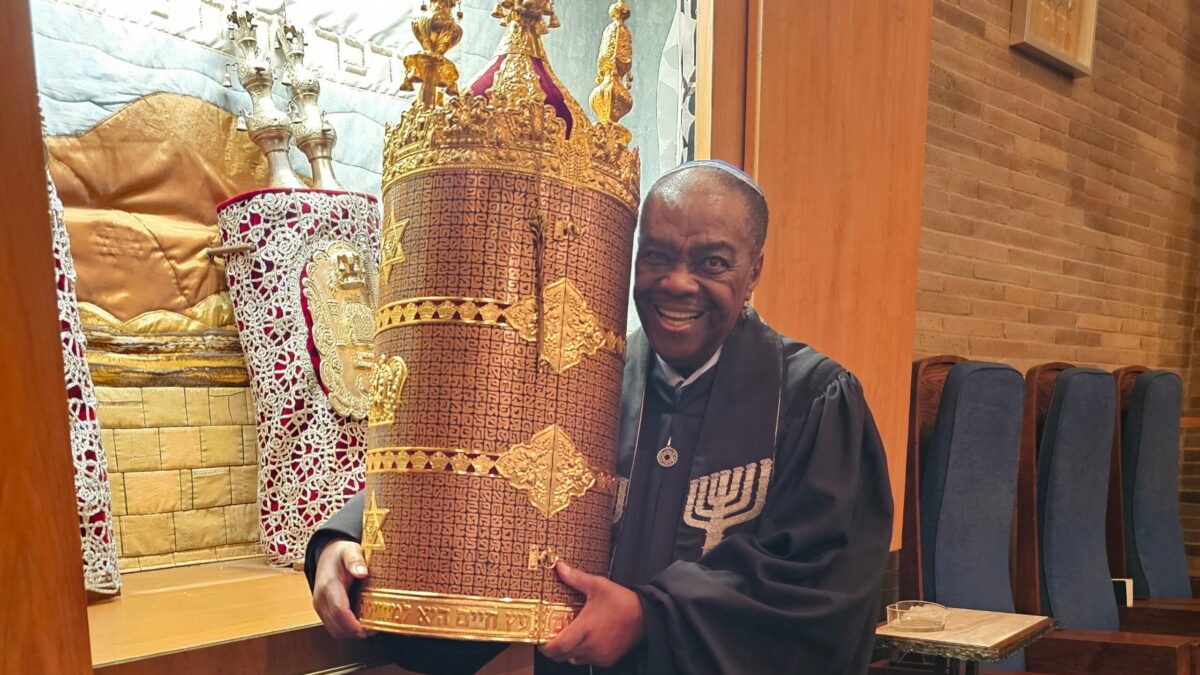
Rabbi Capers Funnye death and legacy, Digi Mart USA News: Rabbi Capers Funnye was known for a good-humored approach when he addressed mostly white Jewish audiences. He often recounted visiting local synagogues on his travels around the United States to pray the morning Shacharit service.
Upon entering an unfamiliar shul, he expected a congregant to eye him suspiciously and ask whether he was Jewish. His reply, while he wore a kippah, tallit and tefillin, was that he had found these items at the entrance and thought it would be fun to try them on.
The joke reflected the equanimity with which Funnye, one of the most prominent Black Jews in the United States, approached his work promoting diversity and inclusion in American Jewish communities. He died Monday at age 74, according to an announcement from Beth Shalom B’nai Zaken Ethiopian Hebrew Congregation in Chicago, which he had led since 1985.
A memorial service is scheduled at the synagogue on Friday.
The author first met Funnye nearly 20 years ago, when both worked with the Jewish diversity nonprofit Be’chol Lashon. Over the years the author heard him speak many times, interviewed him for articles about Jews of color and Hebrew Israelites, and regularly attended services at his synagogue via livestream.
Funnye was a multifaceted figure. He grew up in segregated South Carolina and in Chicago, and he was an Israelite who was also a Jew according to halacha, or traditional Jewish religious law.
He formally converted to Conservative Judaism as an adult to facilitate his work with white Jews. He was educated at both Israelite and traditional Jewish institutions, including the Israelite Academy in New York City and the Spertus Institute for Jewish Learning and Leadership in Chicago.
Many knew him as “Obama’s rabbi” and as a cousin of Michelle Obama. He was also a sought-after speaker at synagogues and conferences and took part in programs such as the recent PBS series “Black and Jewish America: An Interwoven History.” Others called him “Chief.” Since 2015 he had served as chief rabbi of the International Israelite Board of Rabbis (IIBR), a century-old, Torah-observant branch of Black Israelism.
In the last decade much of his work focused on strengthening the IIBR and its member congregations in the United States, the Caribbean and Africa.
He welcomed women into the rabbinate, aligning the IIBR more closely with liberal Jewish denominations. In 2021 he ordained Tamar Manasseh, a female rabbinical student and mentee.
He also encouraged the hiring of Israelite clergy at a Conservative synagogue in New Jersey, where Rabbi Eliyahu Collins became the first Israelite rabbi hired to lead a mainstream synagogue in the United States. Collins still works at Ahavas Sholom in Newark.
Funnye led a mixed Israelite-Orthodox congregation in Chicago in the 1990s as a volunteer.
Funnye and Rabbi Baruch Yehudah became the first Israelite rabbis admitted to the New York Board of Rabbis. The author notes this was significant for the IIBR’s legitimacy in the Jewish world, particularly since the board had decades earlier rejected Rabbi Wentworth Arthur Matthew, one of Funnye’s predecessors as IIBR chief rabbi.
Several more Israelite rabbis have joined the board in recent years.
Israelite and white Jewish communities have historically operated independently, and Funnye’s background made him uniquely suited to fostering dialogue and collaboration between them. He repeatedly condemned the openly antisemitic groups often called “Black Hebrew Israelites” in the press.
“We do not and will not ever speak in disparaging terms about any group,” he once told the author about the IIBR.
Funnye had many friends and allies in the mainstream Jewish world, as shown by the outpouring of grief on social media after his death. However, he was unable to bring the establishment fully around to accepting Torah-observant Israelites as fellow Jews.
He was angered when leaders of the United Synagogue of Conservative Judaism wrote a 2023 op-ed arguing that some IIBR-associated Israelites are not Jews and that Israelite clergy are not suited to lead mainstream congregations. “It was extremely racist,” he told the author earlier this year.
“There was no investigative work.” Rabbi Jacob Blumenthal, CEO of USCJ and the Rabbinical Assembly, told the author the organization was concerned about “maintaining the halakhic standards that define Jewish lineage.”
Funnye maintained that Israelites represent a unique but legitimate denomination of Judaism with its own halacha and customs. He held out hope that the rest of the Jewish world would recognize this.
The author concludes that the easiest way for white Jews to honor his legacy is to avoid asking a person of color praying beside them whether they are Jewish, and to simply assume that they are.