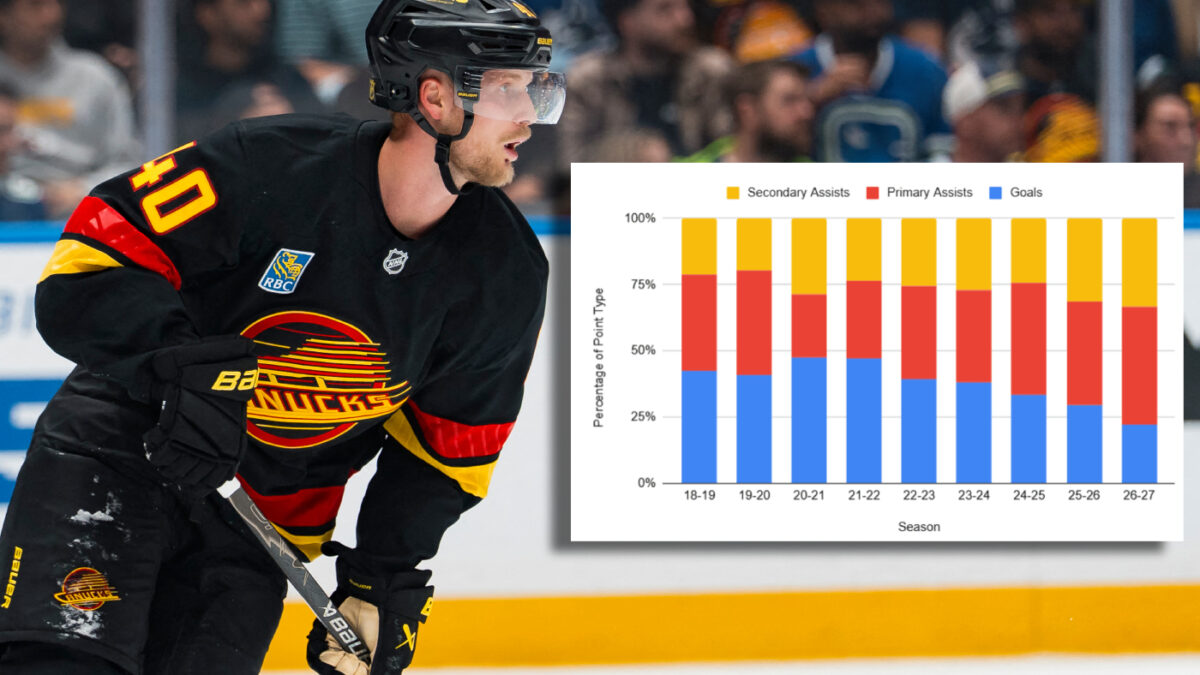
Elias Pettersson Vancouver Canucks underlying statistics analysis, Digi Mart USA News: Elias Pettersson has gotten off to a flying start to the NHL season and is once again producing at the same pace as in his best years with the Vancouver Canucks. Behind the point production, however, lie worrying numbers.
The question is whether the Swede is truly back or whether his strong start is the result of chance.
Pettersson made a strong NHL debut in 2018-19, recording 28 goals and 66 points in 71 games, and earned the Calder Memorial Trophy as the league’s best rookie. He added 66 points the following season and then broke out in 2022-23 with 39 goals and 102 points, placing tenth in NHL scoring and finishing 18th in Hart Trophy voting.
He had also developed into a far more consistent defensive player.
The decline began shortly after he signed an eight-year contract with an average annual value of $11.6 million on March 2, 2024. Over the last 20 games of that season he managed only five goals and 14 points, and he had just one goal and six points in 13 playoff games.
The following season he scored 15 goals and 45 points in 64 games, and last season he had 15 goals and 51 points in 74 games.
This season he has recorded points in five straight games and has produced at more than a point per game for the first time since signing his contract. Through Vancouver’s first 17 games he has four goals and 18 points.
Canucks shooting percentage with him on the ice at five-on-five is 16.9 percent, and his own shooting percentage is 16.7 percent, well above his career average.
His underlying numbers, however, remain at their lowest levels of his career. His shots on goal and shot attempts per 60 minutes at five-on-five are the lowest of his career, and his expected goals for per 60 minutes are the second-lowest.
His power-play underlying numbers have also declined markedly. He has also benefited from an unusually high number of secondary assists, with six so far this season.
In the author’s assessment, the numbers suggest Pettersson has not returned to his former form. His point production is in line with his two best seasons, but his underlying figures remain at the same low levels as in the two disappointing seasons before.
If he does not raise his game, a drop in production is more likely than a sustained pace. That said, his point production can still raise his trade value, and Vancouver could find a strong return on the trade market before the deadline.