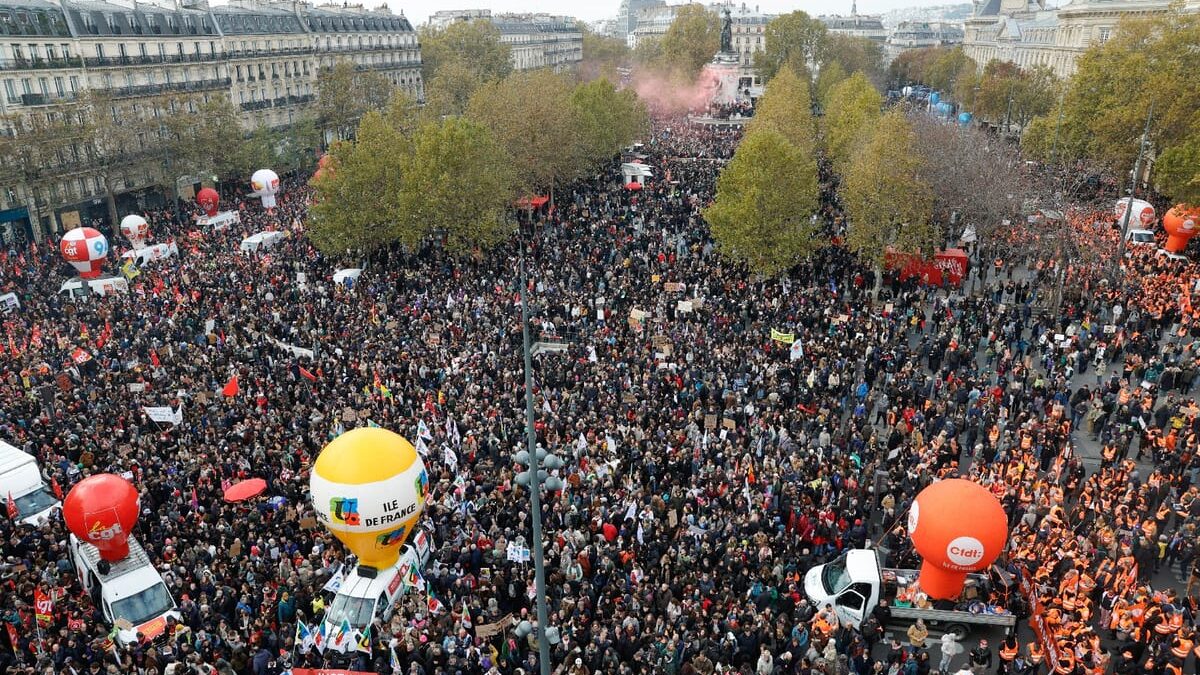
France social protest fourth mobilization ahead of government announcements, Digi Mart USA News (France): Between 575,000 people, according to the authorities, and 1.6 million, according to the CGT union, marched Thursday across France to demand higher purchasing power. The new mobilization planned for Saturday aims to maintain pressure two days before a social conference with unions and employers convened for Monday morning at Matignon, the seat of the prime minister’s office.
Meetings with high school and student organizations are also scheduled for Monday afternoon. In a letter sent Friday to social partners, Prime Minister Sébastien Lecornu, facing a very tense social autumn, said he “hears the expectations expressed on wages and purchasing power” as well as the “concerns” of employers.
He stated that the conference “will allow the presentation of concrete responses to the expectations of the French people.”
The youth intersyndicale (Union étudiante, Fage, Unef and USL) and regional union bodies (CGT, FO, FSU, Solidaires, CFDT) have called for a rally Saturday “against high living costs and for youth” along an authorized route identical to Thursday’s, linking the Place de la République to the Place de la Nation. The yellow vest coordination has decided to act independently, clearly distancing itself from the unions.
It calls for a separate gathering at Place de la Concorde, which has been banned by the authorities.
“We will go to Concorde at 2 p.m. and remain there until 7 p.m.,” said Benjamin Ball, a member of the coordination, outside the Paris police headquarters, which banned the action.
“We call for mass disobedience,” he warned. Lawyer David Libeskind, representing the yellow vests, explained that Concorde is “an emblematic place, near the National Assembly, a seat of power, since our demands are political.”
The yellow vests plan roughly 120 actions nationwide on Saturday, according to their interactive map Friday evening, far fewer than the approximately 1,700 actions they claimed for their first mobilization on October 17. Thursday’s mobilization was described as having “generally gone well” by the Interior Ministry, but authorities are determined to avoid a repeat of the rioting and looting seen on October 17.
The massive security arrangement in place since then will be maintained, with 70,000 police officers and gendarmes deployed nationwide, Interior Minister Laurent Nuñez announced Friday.
“The risk is exactly the same as for the previous Saturdays,” he said, urging prefects “not to lower their guard against more scattered or sporadic phenomena whose level of violence will not decrease in intensity.” He added: “City centers tomorrow will be systematically protected. Prefects have issued orders banning demonstrations in city centers so that no spontaneous gathering can take place.”
In Rennes, for example, the prefecture of Ille-et-Vilaine judged that “the conditions are not met” for gatherings in the center, notably because of the “serious violence” that occurred Thursday in the city. The next phase of the movement will depend largely on the responses the government gives at Monday’s social conference.
The intersyndicale grouping the eight main national unions has already indicated it will take a position as early as Monday evening.
“The only thing that will stop the mobilization is a response to the demands raised for several weeks by employees, civil servants, young people and retirees,” the organizations (CFDT, CGT, FO, CFE-CGC, CFTC, Unsa, FSU and Solidaires) wrote Friday. The scale of Thursday’s demonstration “should prompt the government to understand that it cannot wait for the presidential election,” said Marylise Léon, general secretary of the CFDT, France’s largest union, which is calling for a 100-euro net monthly increase in the minimum wage (SMIC).
The government has suggested for several days that it is open to a measure on the minimum wage, but its size will probably fall short of union demands.