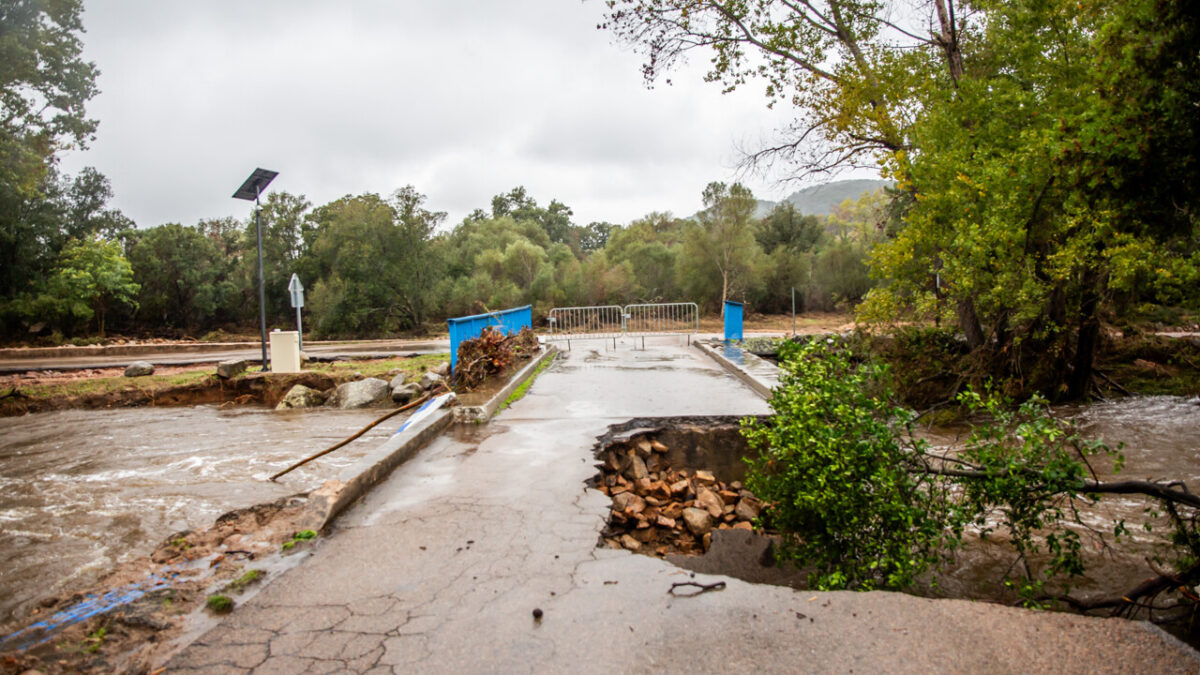
Corsica floods, Digi Mart USA News (Corsica, France): Storms in Corsica have claimed their first victims. On Friday, November 6, 2026, the prefecture of the island announced the deaths of two people who drowned in the floods and torrential rain sweeping the territory, according to the prefecture of Corse-du-Sud, as cited by Corse-Matin.
According to the publisher, the two people drowned in their car on the RT10 road between Bonifacio and Porto-Vecchio around 1 a.m. Three people were in the vehicle.
One passenger managed to get out and was rescued by the SIS and evacuated by helicopter to the clinic in Porto-Vecchio, the authorities said. The other two, trapped inside, were found dead by firefighters.
Rainfall totals have been heavy. Since Wednesday afternoon, 150 to 250 millimeters of rain have been recorded along an axis between Figari and southeastern Corte, with localized totals of 300 to 350 millimeters over higher terrain.
Conca recorded 283 millimeters, La Chiappa near Porto-Vecchio recorded 205 millimeters, and Figari recorded 157 millimeters.
By Friday morning the rain had weakened considerably and was not expected to intensify in the following hours, with most of the rainfall now falling over the sea. Météo-France maintained an orange vigilance alert for both Corsican departments, citing difficult traffic conditions caused by local flooding of the road network, particularly in the Bonifacio and Porto-Vecchio area.
The torrential rain, which intensified Wednesday evening over eastern Corsica as well as Languedoc and the lower Rhône valley, fell on areas already weakened by the episode of October 19 and 20. Meteorologist and oceanographer Yann Amice, speaking to actu.fr, said the Mediterranean sea remains warm after months of heat waves, which favors strong evaporation.
A humid, subtropical air mass is expected to approach France over the weekend of November 7 and 8, 2026, in connection with Storm Bruna. It is likely to bring heavy rain to many regions of France next week, with the possibility of further Mediterranean-type episodes in the southeast.
More information is to come.