European bomb threat wave targeting flights and broadcasters, Digi Mart USA News: A wave of bomb threats across Europe has sown panic at airports and newsrooms over the past week. The consequences have included flight diversions, emergency landings and the suspension of some broadcasts.
So far, the threats have proven unfounded, and no explosives have been found. However, the wave of hoaxes, which has affected several flights, airports and, since Friday, media outlets, is causing concern.
It is not yet known whether the incidents are linked, but the false bomb alerts follow other disruptions in Europe, including attacks on grocery refrigeration systems and drone incursions.
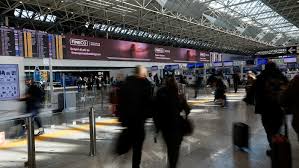
A coordinated-looking wave of bomb threats targeting European air traffic began on Tuesday. At least seven flights and a cruise ship received false bomb threats, leading to emergency landings, escorts by fighter jets and temporary airport closures in countries including Poland, Bulgaria, Italy and Spain.
A second wave affecting at least 27 flights was reported on Thursday. On Friday, Prague Vaclav Havel Airport said nine flights had been threatened, including flights from Denmark, Spain and Britain, and flights bound for the Netherlands, Cyprus, Romania, Italy and Britain.
On Friday, newsrooms in Ireland and Bulgaria received bomb threats by email from a person calling himself Mikhail Andropov, who claimed responsibility for a growing wave of false threats disrupting passenger flights across Europe. The messages, sent to Bulgarian broadcaster Nova TV and Irish public broadcaster RTE, were titled “Message to the West” and presented the threats as the prelude to a series of attacks on transport across Europe.
RTE evacuated its offices and suspended its programming. British broadcaster Sky also said it had received a similar threat.
Reuters could not establish the identity of the sender or the origin of the emails, nor determine whether they came from the same source as the threats targeting some or all of the dozens of flights affected since Tuesday.
Bomb threats against aircraft are often communicated to airlines, airports or authorities through anonymous emails and phone calls claiming an explosive device is on board. Authorities do not always disclose how threats are transmitted, as they say doing so could encourage imitators and compromise investigations.
A representative of Prague airport told CNN on Thursday that it had received an anonymous email threat addressed to the airport, and Czech police said similar emails had been sent to other European airports.
Eric Schouten, director of aviation security group Dyami, told Reuters that an airline’s security department first analyzes a report. It then alerts authorities, who may scramble fighter jets or divert the aircraft to a designated airport for a full search.
The vast majority of bomb threats are hoaxes, but all must be treated as real until an investigation is conducted, meaning authorities must mobilize to rule out any danger. No explosive devices were found aboard the aircraft targeted this week, but each airline must determine whether a threat is credible and act accordingly.
A British government spokesperson described this week’s incidents as malicious hoax threats and said the country had one of the most robust aviation security systems in the world.
Airlines are no strangers to bomb threats, but aviation security experts note that the apparent coordination and timing of these incidents are unusual. All aircraft, including those targeted on Friday, landed safely.
Authorities have not attributed the threats to any group or state actor. These incidents come at a time when many European officials have accused Russia of conducting a campaign of hybrid or grey-zone disruption, which is generally inexpensive to carry out, easy to deny and not expected to trigger an armed response.
Countries affected by such disruptions, including Denmark, Poland and Romania, have accused Moscow of being behind them. Russia denies any involvement.
On Thursday, an airport source in Italy said bomb threats sent to several airlines and airport operators in Rome and Milan may have come from fighters of the “Male State,” an anti-feminist far-right movement banned in Russia. Reuters could not confirm the sender of that email.
Vladislav Pozdnyakov, a Russian blogger who founded the Male State in 2016, said the organization no longer existed and that he was in no way associated with it.
Rhys Jones, head of analysis production at aviation risk consultancy Osprey Flight Solutions, said bomb threats can stem from a wide range of motives, including political claims, activist campaigns, criminal activity, online groups or state-linked hybrid operations.
European Commissioner for Technology Henna Virkkunen said that since 2022 Europe has faced a series of hybrid operations, including sabotage of critical infrastructure, drone incursions, cybersecurity breaches and election interference. “We are constantly the target of attacks,” she told Reuters.
“These operations aim to destabilize our societies and sow distrust among our citizens.”
Not all of these hybrid operations are carried out by Russia, she said, but it is often the case. Russia categorically denies rumors of its involvement in this wave.
Overall, the threats have caused minimal disruption to the aviation sector, according to Eurocontrol, the European air traffic control agency. A false alert can nonetheless disrupt airline operations, aircraft diversions and thorough security inspections, causing delays for passengers.
Carriers generally bear additional costs, including fuel, rebooking passengers, crew disruptions and aircraft diversions. Schouten explained that a search involves offloading passengers and baggage, inspecting the aircraft, then boarding everyone again.
This can push crews beyond their duty-time limits and lead to missed connections and cancellations.
Air France-KLM chief executive Ben Smith said Thursday he had never before seen threats reported in such a coordinated way. “We are fully confident that we have the means to ensure this has minimal, if any, impact on our operations,” Smith told reporters.
“So we have nothing to ask of our governments today to change how they handle these situations.”
Bomb threats worry pilots and create unnecessary tension, but crews are ready to respond professionally, said Paul Reuter, vice president of the European Cockpit Association. Pilots review procedures with cabin crews, identify airports they could divert to, and can take on extra fuel, he added.
Reuter called the use of civil aviation for geopolitical disruption or hoaxes “absolutely unacceptable.”
Source: CBC News reporting by Sara Jabakhanji.