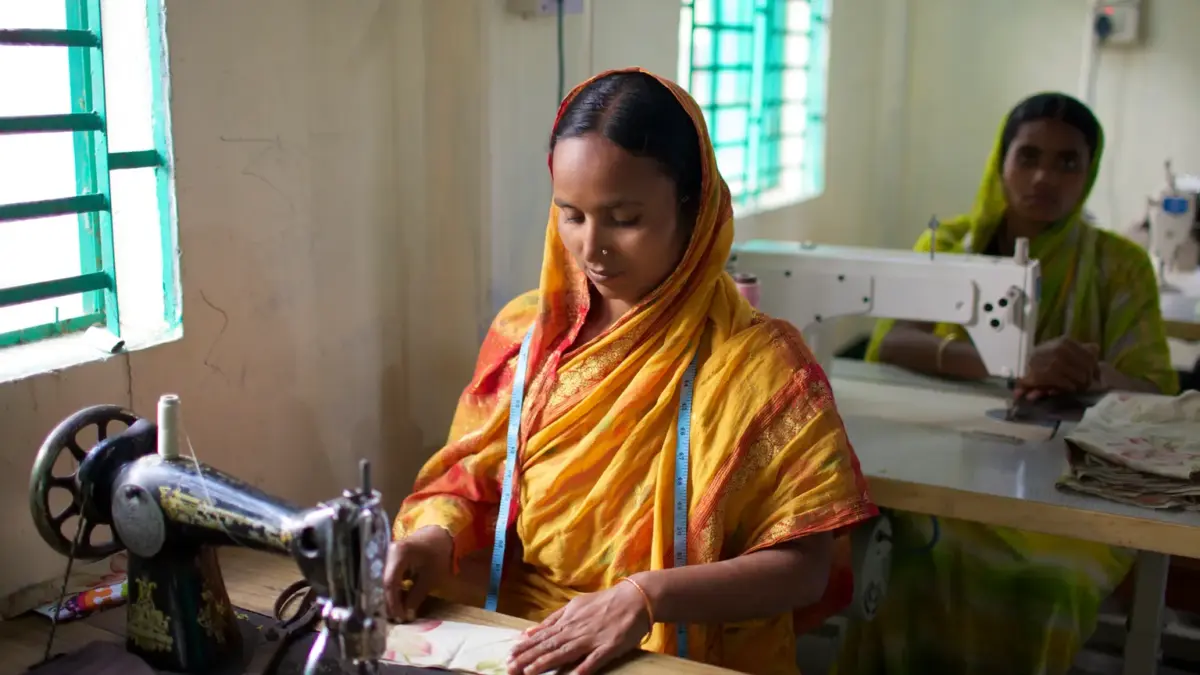
Bangladesh garment workers minimum wage protests, Digi Mart USA News (Dhaka, Bangladesh): Amena, a 27-year-old garment worker who has made clothing for major foreign brands for seven years, says she has never faced such difficult month-end finances. She earns about 12,500 takas (about 90 euros) per month, which barely covers her rent and supports her parents.
Her highest pay ever reached 26,000 takas (about 185 euros) per month, but that was years ago.
Amena, who asked to be identified only by her first name for fear of retaliation from her employer, said her pay fell when she left the quality control department of her workshop to operate a sewing machine. She noted that her current monthly salary barely exceeds the retail price in Europe or North America of one of the leggings or jeans produced at the factory where she works in Gazipur, on the outskirts of the capital, Dhaka.
Bangladesh is the world’s second-largest clothing exporter, employing about 4 million workers in roughly 4,000 textile factories. Garment exports bring in more than 80 percent of the country’s foreign currency earnings.
Since Saturday, many of these workers have grown dissatisfied with their pay. In an economy weighed down by high inflation, above 8 percent in September, and worsened by rising global oil and gas prices linked to war in the Middle East, they have stopped work to demand higher minimum wages.
On Sunday, the government set up a committee to negotiate wage increases, but workers’ anger has not subsided. Thousands are marching in the streets, and violent clashes with security forces are increasing.
Protesters argue that only a substantial increase, from an average of 12,500 takas (about 90 euros) today to 30,000 takas (about 215 euros), would allow them to keep up with the costs of food, housing, transport and healthcare.
Amena said she pays 4,500 takas in rent each month and sends another 5,000 takas to support her parents, who live in Dinajpur district in northwestern Bangladesh. That leaves about 3,000 takas (about 21 euros) for everything else.
“I have no savings,” Amena said. “My bones hurt, and I have to take medication.
So I cannot afford to buy fish or meat regularly.”
“It is no longer possible to live like this, but I have no choice,” Amena continued. “It is a kind of forced labor, even though no one is forcing us.
But we have to work, and the textile factories are our only option.”
Industry leaders, the government and financial institutions all stress the central role of textiles in the economic progress Bangladesh has made since its independence in 1971.
Although working conditions have improved since the collapse of the Rana Plaza garment building in 2013, which killed more than 1,100 people in Dhaka, wages have not kept pace.
Sabbir, 18, left school to help support his family and works in a small workshop in Ashulia district for a monthly wage of 12,000 takas. After paying for his room near the factory, he says he keeps 1,500 takas as pocket money and gives the rest to his mother.
“The price of cooking gas has gone up,” he said, “and we are always afraid of running out.”
His colleague Nupur, 30, believes the government has no choice but to quickly meet the workers’ demands. “Those who work in the public service do not have to ask for it, they benefit automatically,” she said.
“Why should we have to fight to enjoy the same things?”