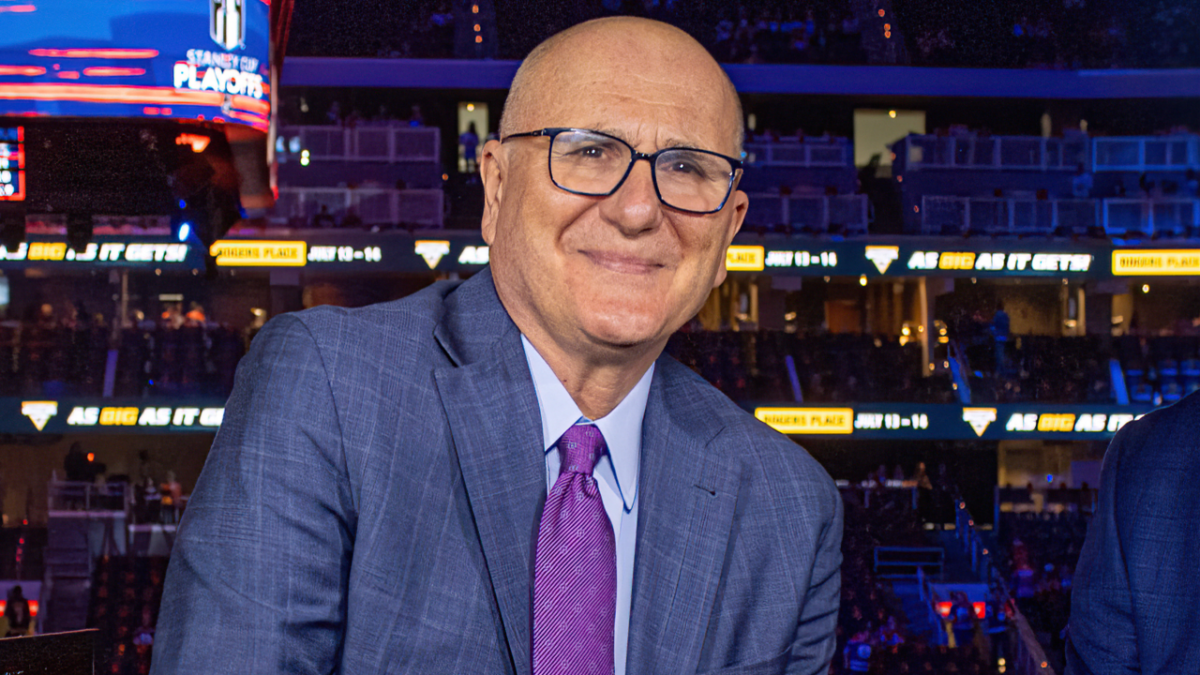
Chris Cuthbert Foster Hewitt Memorial Award, Digi Mart USA News: Broadcasting icon Chris Cuthbert says winning the Foster Hewitt Memorial Award, the Hockey Hall of Fame media award named after the legendary Canadian broadcaster, is the ultimate honor for an NHL broadcaster. Cuthbert, this year’s recipient, will be honored at the Hockey Hall of Fame media luncheon in Toronto on Nov. 9.
“It’s overwhelming and it’s the ultimate honor for an NHL broadcaster for sure,” the 69-year-old told NHL.com. “I may be one of the last of the recipients who grew up listening to Foster Hewitt.
He was the first guy to set the dream in motion. I’d go to bed at night with Foster Hewitt on the radio under the pillow listening to him.”
Cuthbert has become a Canadian broadcasting icon in his own right as the play-by-play voice for a generation of hockey fans. His call of Sidney Crosby’s overtime winner against the United States at the 2010 Vancouver Olympics has been compared to Hewitt’s call of Paul Henderson’s winning goal for Canada against the Soviet Union in Game 8 of the 1972 Summit Series.
Cuthbert was 15 when Hewitt famously exclaimed, “Here’s a shot, Henderson made a wild stab for it and fell. Here’s another shot, right in front, they score!
Henderson has scored for Canada!” More than 37 years later, Cuthbert had a famous line of his own: “Crosby scores! Sidney Crosby, the golden goal and Canada has a once-in-a-lifetime Olympic gold!”
Like Hewitt’s famous call, Canadian hockey fans remember where they were listening to Cuthbert in the gold medal final. “I don’t think there will ever be anything like the ‘Golden Goal’ and Sidney Crosby and that moment,” Cuthbert said of his favorite call.
“My memory of that was after throwing it back to the panel and they were discussing whether it compared with Paul Henderson’s goal and I was thinking, ‘No way; it can’t be.’ But for a generation, as you digest it and you start to think about it, winning gold to cap an amazing Olympics in Vancouver, and what it meant to people, it’s at least in the discussion.”
Cuthbert’s broadcasting career began at Queen’s University in Kingston, Ontario, where he called football and hockey games on campus radio in the late 1970s. From there, he became the voice of the Yorkton Terriers of the Saskatchewan Junior Hockey League, honing his craft and making hockey contacts that have lasted to this day.
“The story I always tell; the first road trip, a 15-year-old kid sits beside me and introduces himself and says, ‘I’m Ken Daneyko and I’m going to play in the NHL,'” Cuthbert said. “Kenny and I, we couldn’t imagine how far that Terrier bus was going to take us.
Things happened quick from there. I went back to Kingston briefly and then I got a job offer at CJAD in Montreal.
I went from covering the Yorkton Terriers to covering the Montreal Canadiens in short order.”
As a young broadcaster, Cuthbert sat in the famous seat in the press box at the Montreal Forum, once occupied by Hewitt himself. “I remember the first time I called a game at The Forum with Dick Irving alongside me and Dick kind of reminded me who had been in that seat before me,” Cuthbert said.
“Not that I needed reminding, so that was kind of your ‘Welcome to the NHL moment’ for sure.”
From Montreal, Cuthbert was hired by CBC Sports to host games in Edmonton for Hockey Night in Canada. He got an opportunity to do play-by-play when head broadcaster Don Wittman was not available.
He arrived in Western Canada just in time to watch the Edmonton Oilers win the Stanley Cup five times in seven years (1984, 1985, 1987, 1988, 1990).
“In Montreal, I used to talk to (journalist) Red Fisher and he would always entertain me with stories of the great Canadiens teams and I thought, what an experience to be able to cover one of the greatest teams in the history of the League,” Cuthbert said. “Then shortly thereafter, I ended up covering one of the all-time greats, if not the all-time greatest team in the Edmonton Oilers.”
Cuthbert was well known throughout Western Canada for his Oilers coverage but came into national prominence in April 1988. During a playoff game between the Canadiens and Boston Bruins, he was in Washington, D.C., for a playoff game between the Washington Capitals and New Jersey Devils.
The Canadiens and Bruins were the national broadcast on CBC, and cut to Cuthbert during intermissions to drop in on the Capitals and Devils.
However, a power outage in Montreal that night left CBC in the dark, and they turned to Cuthbert to fill the airtime, broadcasting the game from Washington while handling the intermissions on his own. “They just came to me at one point late in the first period and I thought I was just doing my drop-in hit during the intermission and I called about three minutes and then we threw to commercial and I thought that was it,” Cuthbert said.
“Then they said I had to keep going.”
“Halfway through the second period, I started giving scores of the Boston-Montreal game and I was really uncomfortable because I’m thinking if people know that game’s on, they’re going to be upset they can’t watch because it was obviously the marquee game,” Cuthbert said. A generator at The Forum allowed the game to continue, but it was not strong enough to power a national broadcast, leaving Cuthbert and his producer to carry the entire show that evening.
“I ended up doing about two-and-half hours of play-by-play and hosting the intermission and analysis, so it was kind of a one-man show plus a producer in a small truck that was helping out,” Cuthbert said. “It was a chaotic night and when we left the rink to get back to the hotel in Washington, I remember asking the producer if our careers had ended that night?
His answer was, ‘I’m not sure,’ so that wasn’t very reassuring.”
Cuthbert’s career did not end but instead took off after that night. He has gone on to cover the NHL and Olympics and was the voice of the Canadian Football League for nearly three decades.
“He’s just one of the best of the best,” said longtime broadcast partner Ray Ferraro. “Everything about Chris, working with him so many times, watching him in the biggest game, I was sitting next to him for the ‘Golden Goal’ and I was watching him do his thing and how he came up with the line ‘the golden goal,’ and he just seamlessly puts things together in the broadcast.”
Cuthbert is known by colleagues for the meticulous notes he keeps preparing for a broadcast and for documenting his pregame conversations with players and coaches. Ferraro recalled that at the 2010 Vancouver Olympics, United States general manager Brian Burke called Joe Pavelski a Swiss Army knife before the tournament, and Cuthbert quickly wrote the phrase down.
“Nobody said anything, but it was a race to see who could use ‘Swiss Army knife’ first,” Ferraro said. “They drop the puck and the game is not 15 seconds old, and he gets ‘Swiss Army knife’ into the broadcast, and I look up and he gives me a fist pump.”
Cuthbert became the lead NHL broadcaster for Sportsnet shortly after joining the network in 2020, following the retirement of Jim Hughson, and now works predominantly with former NHL forward Craig Simpson. “There’s people that you associate the game with and he’s so respectful of the long lineage of the great play-by-play men like Foster Hewitt and all the way though the greats in Canadian history,” Simpson said.
“He treats every moment in the booth like it’s the most important moment of his life.”