Grêmio Copa do Brasil final history, Digi Mart USA News: Grêmio is back in the Copa do Brasil final. After eliminating Atlético-MG on the night of Saturday (7), the Rio Grande do Sul club secured its 10th appearance in the competition’s decider, a record it shares with Flamengo.
In total, the club has five titles and four runner-up finishes. Grêmio is the second-most successful club in the tournament, tied with Flamengo and behind only Cruzeiro, which has lifted the trophy six times.
Grêmio first reached the Copa do Brasil final in 1989, in the competition’s inaugural edition, when it beat Sport in the decider. Its most recent final came in the 2020 edition against Palmeiras, where the club finished as runner-up.
Those finals were played in early 2021 because of the Covid-19 pandemic.
In the first edition, the tournament was made up of the champions and runners-up from every state. Grêmio won the title unbeaten, defeating Sport in the final.
The first leg at Ilha do Retiro ended 1-1, leaving the tie open for Porto Alegre.
At the old Olímpico Stadium, Assis and Cuca scored as Grêmio won the second leg 2-1, securing the championship. After the final whistle, celebrations filled the stands.
Facing Felipão early in his coaching career, Grêmio finished as runner-up in the competition’s second final. Two draws were enough for Criciúma under the competition’s rules.
The first leg ended 1-1, giving the Tigre the advantage through the away-goals tiebreaker. In the return match, a 0-0 draw confirmed the first major title of future Grêmio idol Luiz Felipe Scolari.
In the club’s third final, its opponent was Cruzeiro. After a 0-0 draw at the Olímpico, the Minas Gerais side won 2-1 at home and left Grêmio in second place, in a match remembered for a historic blunder by goalkeeper Eduardo Heuser.
The club’s second title came after a controversial 1-0 win over Ceará. Following a 0-0 draw at the Castelão, Nildo Bigode gave Grêmio an early lead at the Olímpico in the third minute of the first half.
In the 31st minute of the second half, Ceará’s Sérgio Alves went down in the area after a challenge from defender Paulão and appealed for a penalty. Referee Oscar Roberto Godói did not award it, a decision Ceará supporters still regard as a serious injustice.
With another Ceará player sent off late in the match, the visitors could not equalize, and Grêmio lifted the trophy before more than 49,000 fans.
In the year of the club’s second Copa Libertadores title, Grêmio suffered a notable setback against Corinthians before its later triumph. The team lost both legs and again finished as runner-up.
Goals from Viola and Marcelinho Carioca gave the São Paulo club a 2-1 win in the first leg after Luís Carlos Goiano scored for Grêmio. In the second leg, Marcelinho scored the only goal, leaving Grêmio with the silver medal.
Grêmio’s third title came in grand style. After a 0-0 draw at home, more than 100,000 people packed the Maracanã for the final.
João Antônio gave Grêmio the lead, but under Romário’s direction, Flamengo turned the match around. In the 39th minute of the second half, Carlos Miguel met a cross from Roger Machado and silenced Brazil’s most famous stadium.
The 2-2 result gave the title to Grêmio on the away-goals tiebreaker.
Under coach Tite, Grêmio won another title while again playing away. In the first leg, Corinthians led 2-0, but Luis Mário scored twice to level the tie.
At a sold-out Morumbi, Grêmio produced an outstanding performance to win 3-1. Marinho, Zinho and Marcelinho Paraíba scored for the champions, while Ewerton pulled one back for Corinthians.
During a turbulent period for the club, which had gone 15 years without a major title, Renato Portaluppi gave supporters hope by leading the team back to a major final. After beating Athletico, Palmeiras and Cruzeiro, Grêmio’s final opponent was Atlético-MG.
The first leg at the Mineirão was defined by Pedro Rocha, who scored twice and was sent off. Gabriel pulled one back for Galo in the second half, but Everton Cebolinha, after a dazzling run and a precise cross from Pedro Geromel, scored Grêmio’s third goal and extended the advantage for the return leg at the Arena.
The final was postponed because of the Chapecoense air disaster and included tributes to the victims. In a hard-fought match, Marcelo Grohe made several remarkable saves to keep the scoreboard blank.
Late in the game, Bolaños scored from a loose ball in the small area, sending the Grêmio crowd into an emotional celebration as the team lifted an important trophy after a long wait. Cazares also scored a much-discussed long-range goal, lobbing the Grêmio goalkeeper as he celebrated with supporters.
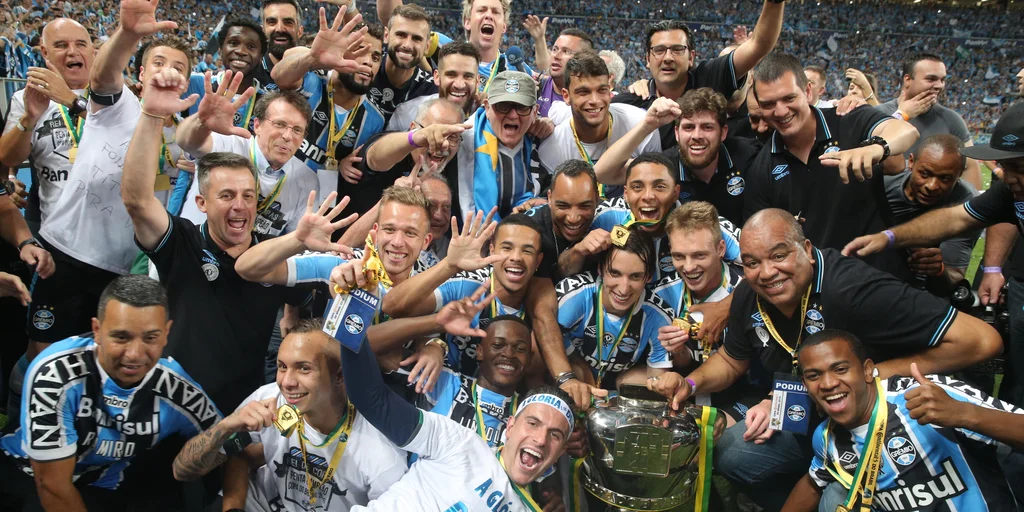
The final finished 1-1 on aggregate and sparked a carnival at the Arena with the club’s fifth title.
Grêmio last contested the competition’s final in 2021, for the 2020 edition, which was played the following year because of the Covid-19 pandemic. On that occasion, a weakened Grêmio, which would be relegated later that year, faced a strong Palmeiras side and rarely threatened.
Losing both legs, 1-0 and 2-0, the club finished runner-up for the fourth time in its history and saw its opponent match its number of titles.