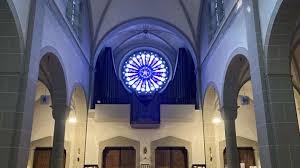
Woodworm treatment in Werl Basilica using hot air, Digi Mart USA News (Werl, Germany): The organist discovered the woodworm infestation behind the organ of the Werl Basilica. A specialist company from Lippstadt, IRT, is now combating the pests with hot air.
Since Monday, November 2, the Lippstadt firm IRT has been using hot air against the woodworm. For the pests to die, the heat must reach the interior of the thickest beams.
At the same time, the historic building fabric and the organ must be protected from excessive heat.
Preparatory work was required on Monday: part of the roof was opened so that warm air can reach the affected room behind the organ. The door to this organ room was covered with a heat-shielding special foil, which is meant to protect both the door itself and the organ from the heat.
“We need 55 degrees,” explains Hubert Herbert of IRT. What matters is not the air temperature but the temperature within the wood.
Measuring probes are therefore inserted into beams of various thicknesses, including in places that are difficult to heat. There, 55 degrees must be reached for at least one hour.
The heat alters the proteins of the wood-destroying pests and kills them.
The system uses multi-stage burner technology. Air is drawn in from outside, heated through a heat exchanger and then directed into the affected roof areas.
Initially the process starts at about 30 degrees. The temperature of the supplied air is gradually raised to 70 to 80 degrees.
According to Herbert, neither carbon monoxide nor soot particles enter the building. “Pest control, but without poison and without gas.
We do it only with heat,” he says. It is therefore not fumigation.
For the Lippstadt specialists, the procedure is routine. “We have been doing this for over 35 years,” says Herbert.
The firm focuses on protected historic buildings and specializes in the thermal treatment of churches and historic timber structures. The temperature is continuously monitored.
If necessary, humidity can also be regulated to treat the old wood as gently as possible.
The infestation was discovered by the organist. Behind the organ lies a small room housing the motor for its air supply.
Traces of the pests had been noticed there. Further investigations showed that parts of the timber framework at the arcades between the basilica and the Old Pilgrimage Church are also affected.
The organ itself was fortunately not infested, pilgrimage pastoral worker Ursula Altehenger explained.
According to Herbert, the infestation is limited to individual roof sections. The remaining area was examined without further traces being found.
The areas to be treated will be separated with foil so that the heat can act specifically there. The actual treatment normally lasts three to four days.
Afterwards, the opened roof must be properly closed. Penetrating moisture could otherwise cause new problems in the wood, Herbert warns.
The basilica remains closed during the work. Services and other offerings, including the new “Room of Mourning,” are temporarily taking place in the Old Pilgrimage Church.
Because this church cannot be heated, the pilgrimage team asks visitors to dress warmly.