US Navy aircraft carrier deployment to the Middle East, Digi Mart USA News: The U.S. Navy is preparing to reinforce its forces in the Middle East.
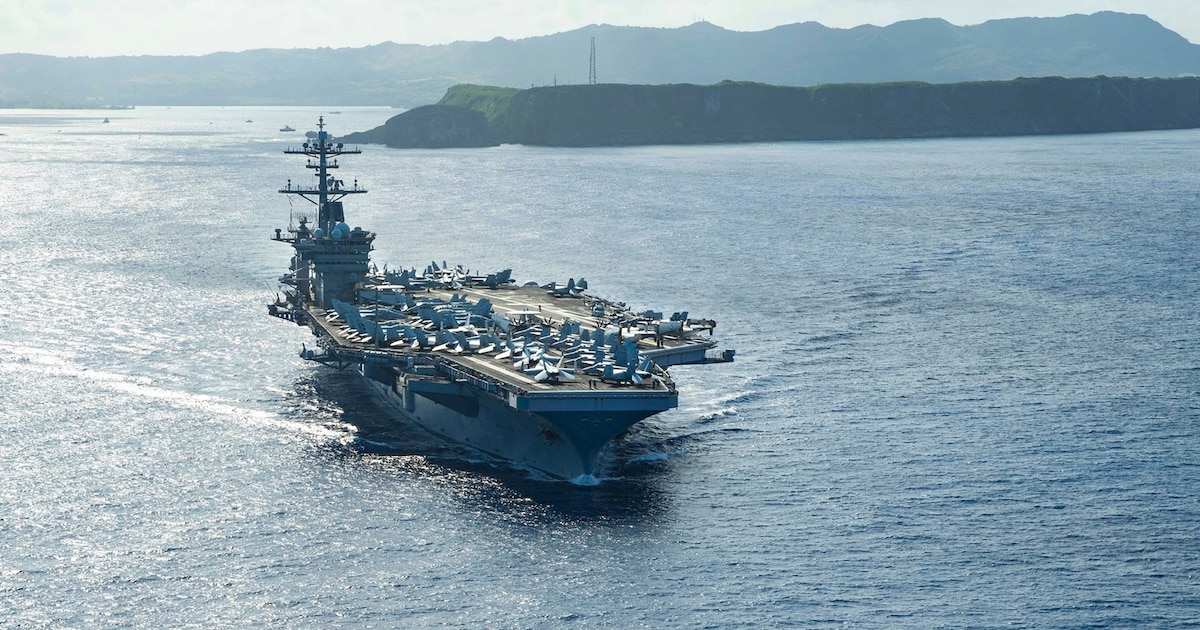
According to the specialist portal Army Recognition, the USS Theodore Roosevelt is on its way to the region after an intermediate stop in Singapore.
There, it could meet the aircraft carriers USS George H.W. Bush and USS George Washington.
That would temporarily put three nuclear-powered U.S. carriers in the operating area at the same time.
The USS Theodore Roosevelt is set to relieve the USS George Washington. The USS George H.W.
Bush arrived in the region on April 23, and the USS George Washington on August 19. Both are supporting the U.S.
naval blockade against Iran.
According to Army Recognition, the carriers carry different aircraft types. F/A-18E/F Super Hornets handle strike missions.
E-2D Advanced Hawkeye aircraft provide airspace surveillance and coordinate operations. EA-18G Growlers are equipped for electronic warfare.
MH-60 Seahawks can, among other tasks, monitor ships, search for submarines and transport supplies.
Army Recognition describes the additional aircraft as support for the entire naval force. Controlling trade traffic and inspecting or diverting suspicious ships remain tasks for destroyers, cruisers and their crews.
Aircraft carriers do not replace these ships.
More carriers do not automatically mean a permanently higher number of operational aircraft. Maintenance, munitions, fuel and spare parts limit operations.
Crews also have to be relieved after long deployments.
The USS Abraham Lincoln returned to San Diego on October 8 after 322 days of deployment. Of those, 265 days were spent at sea without a port call.
The USS Theodore Roosevelt’s stop in Singapore gives its crew a break before continuing onward. A carrier can stay at sea for long periods thanks to its nuclear reactor, but its aircraft and the other ships in its strike group depend on regular resupply.
Whether the three carriers will actually operate in the region at the same time remains open. An overlap would strengthen air cover and protection for the ships during the changeover.
The planned relief is also meant to ensure the U.S. Navy can maintain its carrier presence in the region.