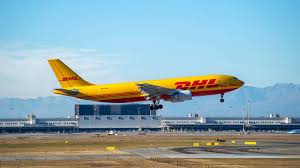
Heathrow tail strike Airbus A300 write-off, Digi Mart USA News (London Heathrow Airport, United Kingdom): Just over a year ago, an Airbus A300-600F cargo aircraft operated by European Air Transport Leipzig as part of Deutsche Post’s DHL-branded airfreight operations suffered a dramatic tail strike upon landing at London Heathrow Airport (LHR). The jet went around and landed a second time, but the damage was done, and it flew only once more before being written off.
A bulletin issued by the Air Accidents Investigation Branch (AAIB) of the United Kingdom has explored the finer details of the incident. It found that muscle memory led to reverse thrust being selected despite the decision to go around.
While the aircraft was temporarily repaired so it could be flown into storage, the cost of fully restoring it was too high.
According to the AAIB bulletin, the incident occurred on October 12, 2025, involving the A300 with registration D-AEAG. Planespotters.net lists the aircraft as 33 years old at the time, having first flown passengers in Japan in 1992. It was converted to a cargo jet in 2011. Flightradar24 data shows the flight was QY2212 from Leipzig/Halle Airport (LEJ).
The aircraft had two pilots on board and was cleared to land at 5:12 PM local time (4:12 PM UTC), having left Leipzig about an hour and a half earlier. The first landing attempt, captured on a livestream, saw the jet bounce on touchdown.
This prompted the pilot to initiate a go-around, but as the jet climbed away it suffered a tail strike, according to the AAIB.
The AAIB quoted the commander as having “increased the aircraft’s pitch, which, combined with the continued extension of the ground spoilers and their associated pitch-up effect, resulted in a tailstrike.”
The AAIB’s findings show that muscle memory seemingly took over, with the pilot selecting reverse thrust, a key component of a standard landing, without conscious acknowledgment. As a result, the co-pilot was unable to correct it.
This complicated the go-around, as the engines responded more slowly once the pilot selected takeoff/go-around thrust. The resulting drop in speed meant the jet took several seconds to become airborne again, compounding the tail strike caused by the ground spoilers’ pitch-up effect.
The aircraft landed safely on the second attempt, but the tail strike caused “damage to the lower tail section at frame 77.” The AAIB says this “included buckling of the skin inwards at the frame, the rivets joining the skin to the frame having separated from the skin, and the tail skid having sustained abrasion damage.” The repairs ultimately proved too costly.
Following its arrival in London, D-AEAG remained at Heathrow for more than three months. Because the damage was too expensive to repair to the standard needed for commercial service, the jet was patched up for one final flight.
That flight took place on January 31, when D-AEAG flew from London to Lleida, Spain, for storage and scrapping.
The temporary repairs limited the aircraft to a cruising altitude of 10,000 feet, a common restriction on post-repair ferry flights where pressurization may be an issue. The jet departed London at 8:53 AM and landed in Lleida at 12:14 PM, just over two hours later, ending its flying career at a Spanish aircraft storage facility.