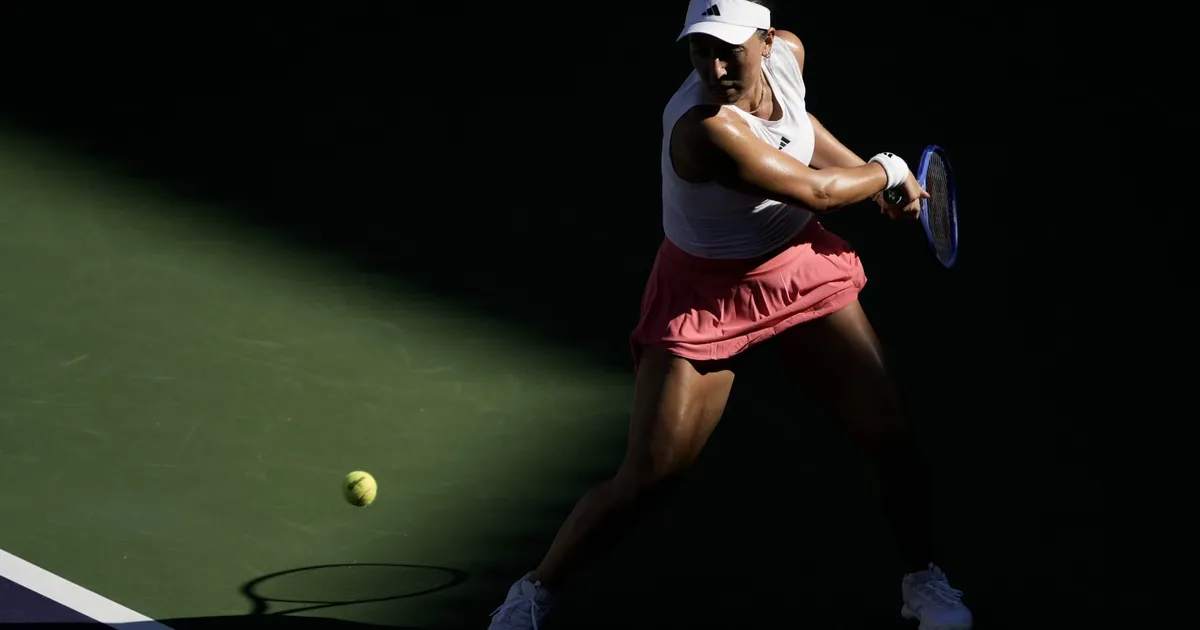
WTA Finals in Indian Wells, Sun Glare Challenges Players, Digi Mart USA News (Indian Wells, California): November in the Coachella Valley is sunny and hot, and for the first four days of round-robin play at the WTA Finals, conditions have seemed close to perfect. The weather has still caused problems for the players.
Reigning BNP Paribas Open champion Aryna Sabalenka was forced to serve blind, and home favourite Jessica Pegula has also struggled to see the ball while serving. Wimbledon champion Linda Nosková has had to move farther behind the baseline to return.
Players say the bright sun and the desert air, which makes the Wilson balls used at the WTA Finals harder to control, are causing more problems than expected. The round-robin matches have produced more errors, shanks and uneven sets than would be expected from the best eight players of 2026.
Eight months separate the WTA’s March and November visits to Indian Wells. At midday the sun sits about 15 degrees lower in the sky, casting longer shadows and directing sunlight across the stadium at different angles.
Sabalenka said she sometimes had to adjust her toss and sometimes had to serve blind, and she hit seven double faults in her opening match against Karolína Muchová.
Pegula said the sun had caught her by surprise at a venue she visits every spring. She said she preferred the higher midday sun for serving, but the first match of each day, starting at noon local time, means playing through shifting shadows that make tracking the ball harder.
On Tuesday the sun’s maximum elevation was about 39 degrees, according to calculations using the National Oceanic and Atmospheric Administration’s solar-position equations, compared with about 54 degrees at solar noon in mid-March. At solar noon, shadows at Indian Wells are nearly 70 percent longer in November than in March.
A vertical object one meter tall casts a shadow of about 123 centimetres in November, compared with 73 centimetres in March.
Visual performance coach Zöe Wimshurst, who has worked with Olympic athletes, said the eyes have physical limits when responding to intense light. “You can’t just get used to that,” Wimshurst said.
“You can’t suddenly make your pupil constrict further.”
Nosková addressed the problem mainly on return during her match against Coco Gauff’s conqueror Gauff on Tuesday, moving further behind the baseline to gain time to judge the ball. She won 6-3, 6-3 in 75 minutes to become the first player to qualify for the singles semifinals.
She said hitting a first serve and then getting a fast return was difficult because of the sun, and that moving back had helped her returning.
Matt Miller-Dicks, an associate professor specialising in skill acquisition and visual perception, said experienced players predict the ball’s trajectory from an opponent’s movements and the early stages of a shot rather than tracking it throughout. He said direct glare can interfere with the rapid eye movements players use for those predictions.
Pegula faces Nosková in Thursday’s second singles match, with a semifinal place still at stake for the American.