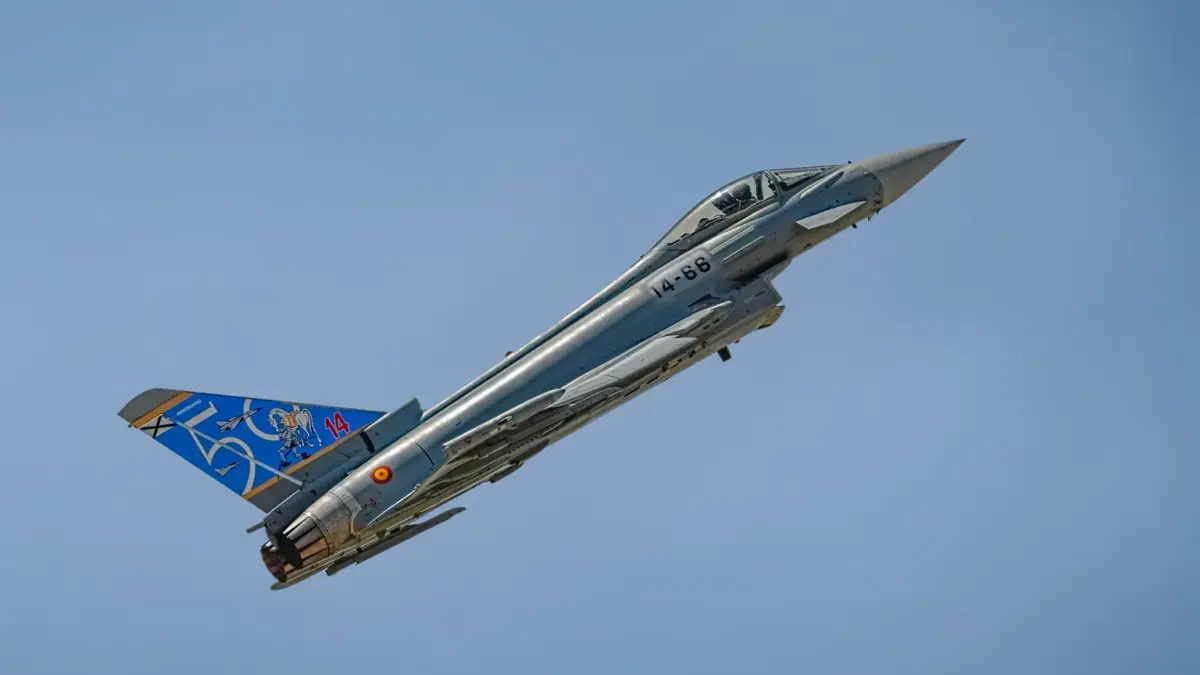
RAF Typhoon air defence over the UK against Russia, Digi Mart USA News (North Sea, United Kingdom): Sky News presenter Matt Barbet describes a flight in an RAF Typhoon fighter over the North Sea, where he sat in the back seat while an experienced pilot flew the aircraft. The pilot, known by the call sign “Stuka” after a risky diving manoeuvre early in his career, had logged more than 2,000 hours in the Typhoon and was one of the Royal Air Force’s most experienced weapons instructors.
Barbet said he had never flown any aircraft before, yet he was able to fly one of the fastest and most agile planes ever built, which is worth more than £100m. The Typhoon is a key part of the UK’s first line of defence against any potential foreign aggression, which the article identifies as Russian.
During the flight, Barbet said the pilot allowed him to attempt a barrel roll and a loop-the-loop, and the g-forces made the manoeuvres difficult to complete. The pilot took over the controls to prevent the aircraft from flying vertically into the ground.
Barbet said the exercise he observed earlier that day was serious. Scrambling jets up and down the North Sea is vital to UK security.
Sky News spent more than a year negotiating and planning for access to the flights and to RAF bases on the ground, and the article says a news organisation has not been offered this kind of access for the best part of a decade.
The RAF’s top-tier training exercise, known as Cobra Warrior, involves many personnel repeatedly launching jets on Quick Reaction Alerts, or QRAs. Before Barbet was allowed to fly the aircraft himself, the crew refuelled in mid-air, intercepted an executive jet that was simulating misbehaviour, and escorted it to the tarmac of the nearest airport in Teesside.
The RAF does not disclose how many aircraft take part or how often such scrambles happen for real. Barbet said he visited a bunker at RAF Boulmer in Northumberland, where the RAF monitors UK skies around the clock and practises constantly.
Genuine alerts are sometimes caused by civilian or commercial aircraft failing to communicate properly, hoaxes, or reports of misbehaviour on tourist flights. The RAF always scrambles to take a closer look and decide how to respond.
Barbet reported that Russian military aircraft have never flown into UK airspace without invitation, although the alert is almost constant because the airspace patrolled is much larger.
The article says 12 Squadron, with which Barbet flew, cooperates with the air forces of Qatar and recently returned from the Gulf, where it defended against airborne threats from Iran. Chief of the Air Staff Air Chief Marshal Sir Harv Smyth told Barbet that in previous years fighter jets deployed to a Baltic ally might have scrambled about once a week to check on Russian aircraft.
On a recent operation in Romania, the scrambles were practically daily. Smyth said the threat has increased and is closer to the UK than it has been for a long time.
The article also says the RAF now has roughly a third of the fighter planes and UK bases it had around 1990, at the end of the Cold War. Smyth said the ambition in the Government’s Defence Investment Plan, which had focused on the mid-2030s, has since “shifted left”, meaning it is now expected sooner.
Back at RAF Coningsby in Lincolnshire, Barbet described experiencing 4G and speeds of Mach 1.5, more than 1,100 miles per hour, in the Typhoon. He said the pilot rated the complexity of the flight at 2 out of 10, and he credited the pilots’ years of practice and muscle memory for keeping the public safe.