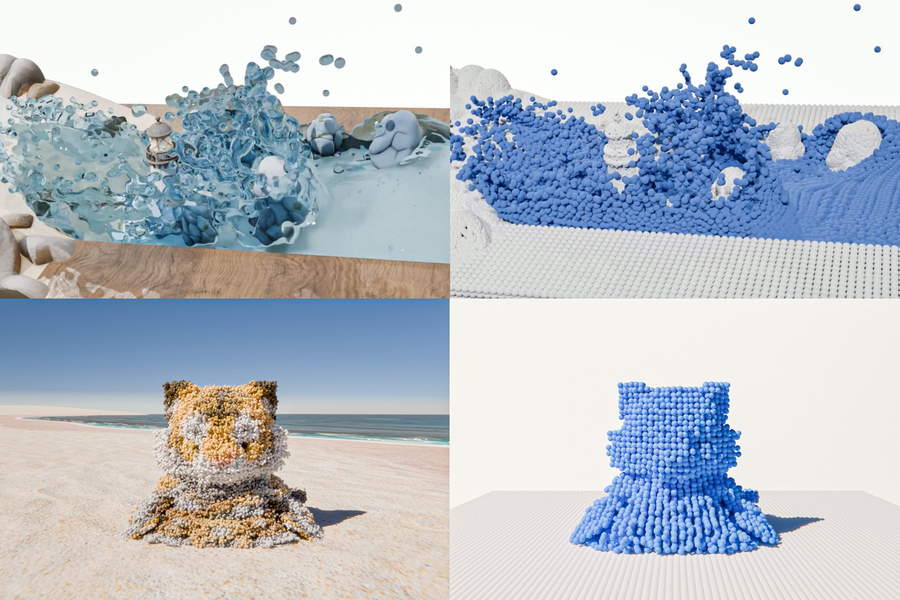
MIT WorldParticle AI physical simulation, Digi Mart USA News: Accurately simulating how objects behave in the physical world remains a difficult challenge for artificial intelligence. The publisher notes that AI video generators often struggle with this, with the report citing a test of the RefVid (Kling 4 model) in which people became stuck inside tables and laptops transformed into tri-fold devices.
According to the publisher, simulations today often require entirely different, purpose-built software programs for different applications. MIT has developed an AI system called WorldParticle that aims to simulate a wide range of materials and their physical behavior within a single model.
Rather than modeling each material with its own physical equations and custom-coded simulation method, the system breaks objects into large numbers of tiny three-dimensional particles. Each particle has a spatial position, velocity, physical properties, and interactions with other particles and or external forces.
The publisher explains that while ChatGPT predicts the next word, WorldParticle predicts the particles’ next state of motion.
The publisher reports that the model can already simulate six physical phenomena: granular materials such as sand or soil, liquids, deformable solids such as elastic objects, and proteins, modeling how molecular structures change over time. The publisher says the protein simulation was around 100 times faster than the conventional methods used for comparison.
The publisher suggests that a unified approach could reduce the need for specialized software for individual material simulations. Potential beneficiaries named include drug development and the development of products such as cars, smartphones and video games.
The article describes this as an important step toward Foundation Models for Physics, which could make dynamic processes in the real world easier to predict and test. These claims are the publisher’s characterization and have not been independently verified.