Jensen Huang Alice Huang Le espionage allegations, Digi Mart USA News: Nvidia Chief Executive Jensen Huang recently admitted to being unfaithful to his wife and publicly apologized. The private scandal quickly grew into a case with implications for U.S.
national security and the global AI industry.
After multiple media outlets reported the matter, Nvidia’s share price moved noticeably. Attention focused on a woman named Alice Huang Le, who has been accused of involvement in Chinese espionage activities.
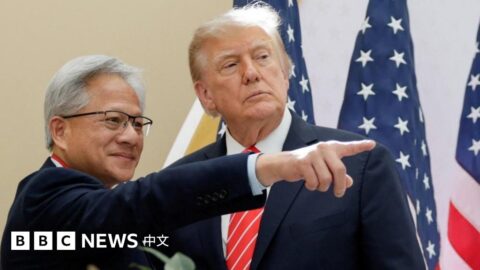
U.S. President Donald Trump said Monday, November 9, that he had called Huang, who denied knowing that Huang Le was a spy, saying he was “completely unaware.” Trump said he believed Huang’s account, praised him as “an honest man,” and disclosed that the FBI had become involved in an investigation, adding that he believed Huang should ultimately be able to clear his name.
Media reports have described Alice Huang, who is a Chinese citizen, about 42 years old and from Hunan province, as a “Chinese spy.” She earned a master’s degree at Hong Kong Baptist University and later obtained permanent residency in Hong Kong.
According to reports by The New York Times and the Financial Times, she served as managing director of Singapore data center company Megaspeed from March to November 2023, and later described herself as its chief executive. The company was spun off from Chinese gaming company Seventh Avenue, purchased large volumes of Nvidia GPUs, and rented computing power to Chinese firms including Alibaba, which prompted a U.S.
inquiry into possible evasion of export controls.
The Hong Kong outlet HK01 reported, based on company registration searches in Hong Kong, Singapore and mainland China, that earlier this year Huang Le registered several additional Hong Kong companies and served as a director of Nanjing Lingxing Technology (T3 Travel). That company filed for a Hong Kong Stock Exchange listing this year, but the application was rejected.
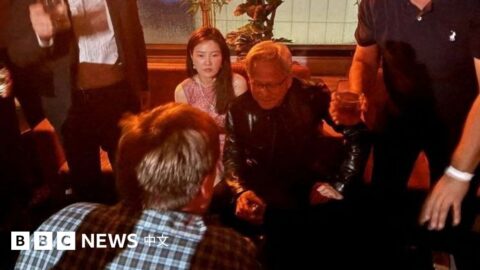
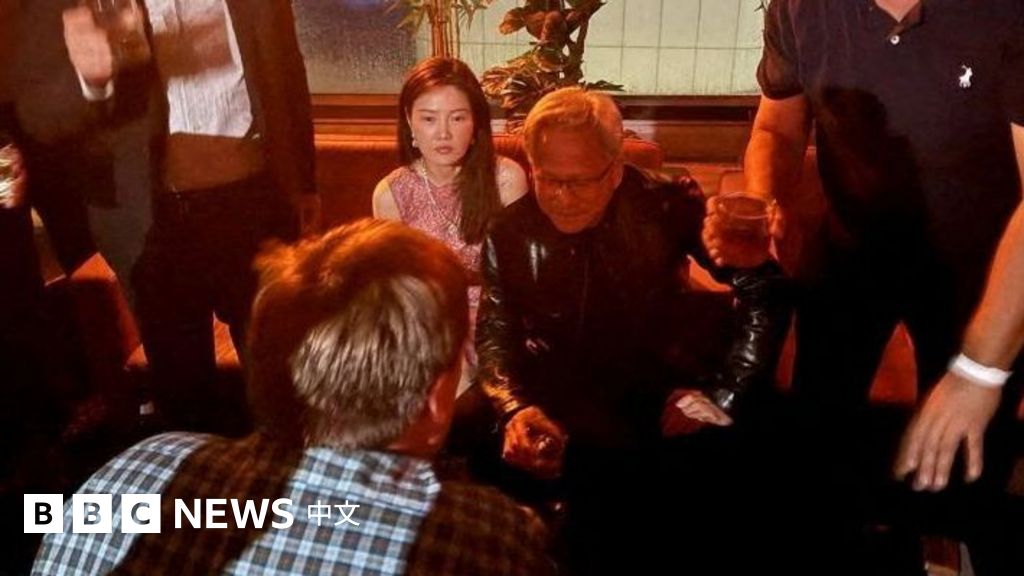
Huang Le and Jensen Huang were first publicly photographed together in June 2024 at a bar after the Computex Taipei trade show. In May 2025, the two were again seen dining together at a Taipei restaurant, where photos showed them with arms around each other and kissing on the cheek.
A CNN investigative report stated that Huang Le had entered the United States ten times on a Chinese passport since 2017.
The Financial Times, citing U.S. sources, reported that U.S.
intelligence assessed that Huang Le and Jensen Huang developed a personal relationship beyond business dealings and remained in contact through communications, and that intelligence agencies, through an unmasking process, confirmed that Huang was the communication counterpart.
A classified memorandum drafted under the supervision of Secretary of State Marco Rubio alleges that China’s Ministry of State Security had recruited Huang Le to gather intelligence on Jensen Huang and U.S. AI chips, and may have sought to influence Nvidia’s lobbying to open access to the most advanced chips to China.
Huang Le left Megaspeed before October 2025. Nvidia’s board has launched an independent investigation and stressed that there is currently no evidence that company secrets or U.S.
national security have been compromised.
It should be noted that Huang Le’s intelligence background and intelligence role remain allegations by U.S. officials and have not been determined by a court.
Some details of her career, including claims that she worked as a reporter for Hunan Satellite TV and China Central Television, have not been fully confirmed. The Wall Street Journal reported that two people who had contact with Huang Le earlier this year said she was in China at the time and her whereabouts are now unknown.
In a letter to Nvidia employees, Jensen Huang acknowledged being “unfaithful to my wife” but did not directly name Huang Le or admit that she was involved in espionage.
China has for years been accused of infiltrating and monitoring U.S. officials, lawmakers and overseas dissidents through various means.
A well-known example is the case of Christine Fang, a Chinese national alleged to have approached several U.S. politicians through social activities and political donations to gather intelligence for the Chinese government.
Recently released FBI records show former Representative Eric Swalwell told investigators he had a close relationship with Fang, but the investigation ultimately found no evidence sufficient to prosecute either of them.
More specific surveillance allegations emerged this year. On October 4, 2026, the FBI arrested Zhang Wanying, a 34-year-old Chinese-American real estate agent, at Los Angeles International Airport.
She is charged with surveilling the residence and vehicles of the son of Taiwan President Lai Ching-te while he lived in the United States last year and reporting to Chinese contacts via WeChat. She pleaded not guilty when she appeared in court in November, and the case is ongoing.
Taiwan’s presidential office condemned the case as “a typical brutal act of transnational repression.”
In New York, Linda Sun, a Chinese-American woman who formerly served as a senior aide to the New York governor, and her husband were charged in 2024 with acting as unregistered agents of China, including obstructing contacts between Taiwanese officials and state government and accepting benefits from Chinese interests. The case remains in legal proceedings.
After the scandal broke, China did not fully block discussion of Jensen Huang, and related topics even trended on Weibo. The Chinese Foreign Ministry firmly denied that Huang Le is an intelligence officer.
Hu Xijin, former editor-in-chief of the Global Times, posted several messages defending Jensen Huang, saying “this is not an ordinary scandal, it is politics,” and arguing that U.S. Democrats and the establishment were using it to attack Huang and, through him, to constrain Trump.
Describing himself as having an intelligence background, Hu said China’s intelligence community “never specifically uses beauty traps” and “never requires female intelligence officers to sleep with targets to accomplish missions,” and he suggested Huang Le was not a Chinese spy at all and that the two more likely met through business and developed feelings.
Taiwanese scholars offered different interpretations. Hung Yao-nan, an assistant professor at Tamkang University and a China studies researcher who once served as a special assistant and core aide to former President Tsai Ing-wen, wrote in a personal Facebook column that Jensen Huang’s entanglement in espionage suspicions shows that “Beijing has always known where to place people.” He argued that Beijing does not rely on professionally trained spies but mobilizes students, entertainers and businesspeople with real identities, with targets expanding from officers and diplomats to rising political figures and technology leaders.
Hung also noted that Taiwanese society is accustomed to regarding Jensen Huang as a source of pride for Taiwan, but that the question now is: “Since semiconductors are a backbone of national security, the personal connections and conflicts of interest of corporate leaders cannot be treated as merely private company matters: the government should be involved, boards must provide oversight, and the media should not only chase celebrities.”
Regardless of the truth, Beijing’s response itself reveals its external messaging strategy. Through official denials and influential voices such as Hu Xijin, it frames the matter as a “U.S.
internal political struggle” and a “frame-up,” avoiding a narrative of successful Chinese espionage infiltration. In contrast to its strict censorship of other sensitive events, its relatively open handling of public opinion in this case suggests Beijing may still want to preserve room for dialogue with the Trump administration on AI and chips, while turning a private scandal into a tool in geopolitical contention.