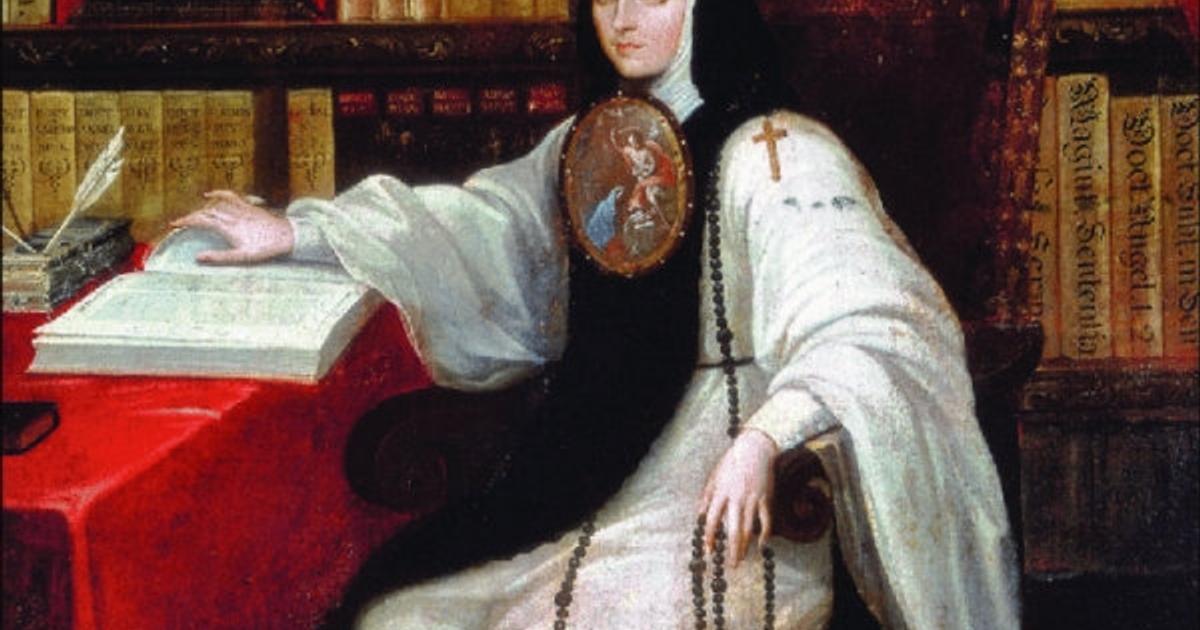
Sor Juana Ines de la Cruz 375th anniversary of birth and her defense of freedom of thought, Digi Mart USA News: On the 375th anniversary of her birth, Sor Juana Ines de la Cruz continues to pose questions to her readers. Her voice endures because the questions that shaped her life remain open: Who has the right to think?
Who can access knowledge? Who decides which voices deserve to be heard?
Commemorating her means more than celebrating her life, her work or the depth of her thought. It also means asking what we have done with the freedoms she defended.
Her curiosity was evident from childhood. By her own account, she learned to read at the age of three and sought in books an understanding of the world.
In a society that offered women only two paths, marriage or the convent, her desire to learn was an affirmation of autonomy and worth. She understood that knowledge makes it possible to doubt, question, evaluate and imagine other ways of being and living.
For her, it was the fullest form of freedom, one that enlarges who we are and gives life meaning.
In her Respuesta a sor Filotea de la Cruz (1691), she explained her vocation with a memorable phrase: “I do not study in order to write, nor even less to teach… but only to see whether by studying I become less ignorant.” To know is to recognize how much we do not know.
This lesson is urgent in a world that confuses an abundance of information with wisdom, and where the speed of answers displaces the depth of questions.
In an age of artificial intelligence, Sor Juana reminds us that thinking requires judgment, responsibility, time, silence and humility. Her defense of knowledge was also a defense of freedom.
In the Carta atenagorica she examined with rigor a sermon by the Jesuit Antonio Vieira and took part in a theological discussion reserved for men.
The reactions to her text revealed the limits that the social and ecclesiastical order placed on women’s voices. Sor Juana responded with arguments, maintaining, within the categories of her era, that the greatest benefit a human being can have is to be free.
We do not need to turn her into a 21st-century thinker to recognize her value. Her relevance lies in how she questions restrictions, imposed limits, prejudices, silencing and the interests of the world in which we live.
Sor Juana shows that freedom of expression does not consist only of defending our own voice; it requires recognizing the right of others to dissent. Punishing or censoring those who do not agree with us impoverishes coexistence and public conversation.
Her defense of women’s right to knowledge remains singularly relevant. For centuries, their exclusion was justified not only from education but from many areas of public life, on the basis of prejudices about their abilities.
Sor Juana refuted these throughout her work. In the Respuesta she also cited numerous learned women to demonstrate the legitimacy of women’s thought.
Although she spoke from personal experience, she posed a universal question: By what right are women prevented from knowing, learning and developing? Today women study, research, teach and lead institutions once closed to them.
Yet inequalities, violence and prejudices persist that limit their opportunities and seek to discredit their words. Every girl who studies and every woman who makes her ideas heard or takes part in her community carries that claim forward.
Denying knowledge or participation to a woman harms not only her but deprives society of creativity, wealth and future. Sor Juana also knew the weight of silence.
Her life obliges us to distinguish between silence chosen for thinking and silence imposed by power. How many ideas and works have we lost because many people were silenced?
Censorship does not always present itself as an explicit prohibition; it can take the form of mockery, threat, indifference or exclusion. Guaranteeing the right to speak therefore requires more than allowing someone to talk; it requires creating conditions in which that person can be heard.
In Primero sueno, Sor Juana explored another limit: that of human understanding. Her poetic intelligence imagines thought ascending toward comprehension of the universe and its encounter with what it cannot fully grasp.
The greatness of reason lies not in knowing everything but in recognizing its insufficiency and persevering in the search despite risk. In an era of technological power, this awareness of our limits is also an ethical demand: not everything we can do is what we should do.
Why read her today? Because memory acquires meaning when it illuminates the present.
Her life compels us to ask whether our schools teach students to question or only to repeat; whether our universities form free consciences; whether we know how to listen to those who think differently; and whether girls find real opportunities to develop their talent.