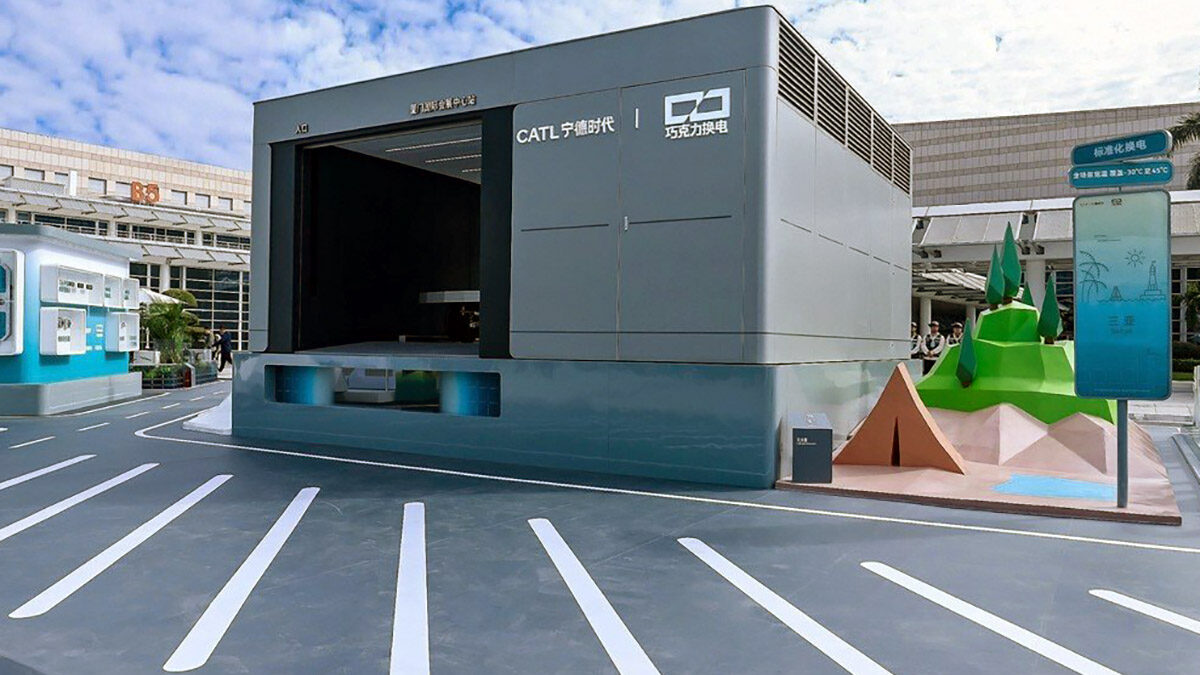
CATL sodium-ion battery swap stations, Digi Mart USA News: CATL is pairing its sodium-ion batteries with its expanding battery swap station network in an effort to address the technology’s main weakness, energy density, which contributes to range anxiety among drivers. According to a publisher report on Chairman Robin Zeng’s remarks at a Benchmark Mineral Intelligence event in Shanghai, the company argues that sodium-ion packs already suit daily urban commutes.
Under this approach, swap stations would handle the occasional longer weekend trip without requiring drivers to wait for a charger. CATL is building its Choco station network itself and leasing the batteries to customers.
Zeng said more stations are needed along highways and in cities, with swap stations currently operating in around 200 Chinese cities.
CATL’s target is more than 3,000 passenger car stations nationwide by the end of 2026. The Choco-Swap network stood at 1,020 stations across 45 cities in December 2025, so the goal implies roughly a threefold increase within a year. The report notes that CATL is usually very adept at rapid rollouts.
Sodium-ion cells are cited for cold-weather performance and for reaching cost parity with LFP cells. They are also described as inherently safer than lithium-ion technology because they do not use flammable materials in their electrolyte, and they reduce CATL’s exposure to sharp swings in lithium prices.
Energy density remains the weak point, which is why range is the sticking point.
The report cites a sodium-ion car CATL unveiled with Changan in February, whose cells reach up to 175 Wh/kg, good for more than 400 km (about 249 miles). CATL also says these cells keep over 90% of their capacity at -40°C (-40°F).
Swapping depleted packs in minutes would reduce the impact of lower energy density, and CATL’s energy services arm has said it plans to roll out Naxtra sodium-ion packs across the swap network starting this year.
Volumes remain small for now, with CATL expecting only 10,000 to 20,000 EVs using its sodium-ion batteries in 2026. The company has announced a $735 million investment in 40 GWh of sodium-ion capacity. The source article was not independently verified.