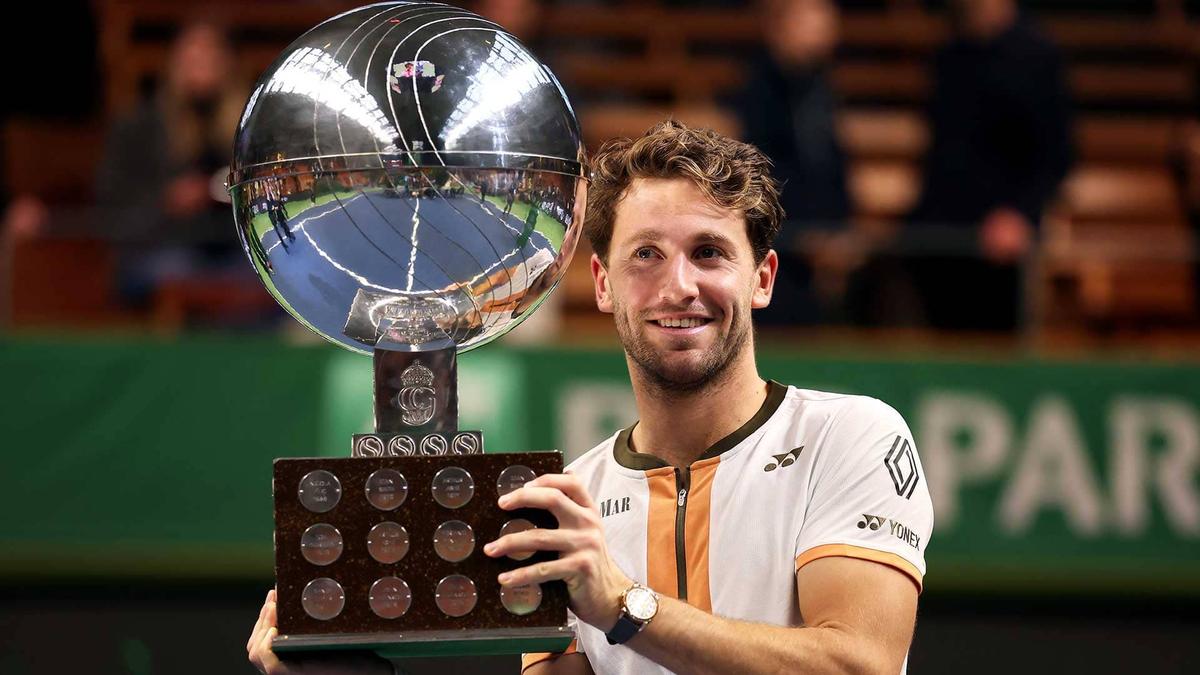
Casper Ruud mental health and motivation ahead of Paris Masters semifinal against Carlos Alcaraz, Digi Mart USA News: Casper Ruud has opened up about a difficult period in 2025 when he lost the desire to get up and train, explaining how mental health support helped him find his motivation again. Before facing Carlos Alcaraz in the Paris Masters semifinals, the Norwegian spoke to Punto de Break about the pressure of life on the tour, the tiring schedule and how he managed to overcome his struggles.
Ruud has since returned to strong form and reached the last four in Paris, where he will face Alcaraz at 9:30 pm. Ruud explained that life as a professional tennis player can become difficult because the daily routine rarely changes.
Players spend hours training, travel from one country to another and compete in many tournaments, and although matches can be exciting, they also demand a great deal of mental energy.
“Last year, I had some mental problems, I wasn’t feeling well psychologically. But I sought help, it worked, and I got a quick response.
I started to feel much better, so it really helped to have someone to talk to about certain things. I think the hardest thing is that it’s a very monotonous and repetitive life.
We train for hours, whether in Miami, at Wimbledon, or anywhere else. It’s always the same.
Training can be enjoyable, but also exhausting.”
“Matches are exciting, of course, but they also represent a huge expenditure of mental energy. We have so many mandatory tournaments that it prevents us from enjoying long training periods, which are precisely the ones that allow you to truly improve.” Ruud said the busy schedule left little time for players to work on their games, which affected how he felt about tennis.
“When you play so many tournaments, it’s hard to find time to improve as a tennis player. Training becomes very repetitive and you end up wondering whether you can still improve, how to become a better player.
It’s complicated because you don’t have time to breathe, to go home for a month or two and really train, working on specific aspects of your game.” He noted that the only real opportunity for that work comes between seasons, and that a player competing at the ATP Finals must be ready to start again in Australia in early January.
“All of this brought me to a point last year where I no longer wanted to get up to go to training when the alarm went off in the morning. Until then, I had always trained because I wanted to.
During that period, however, I did it because I had to.” Ruud said constant travel, packing, and catching flights had also become too much during that time.
“I don’t want to complain, because I know many people have repetitive tasks, but you are constantly packing and unpacking your bags, going from one airport to another, catching flights and organizing your travel… Sometimes, all of that becomes too much of a burden.
That’s what I felt last year. I did everything I could to get out of that state, and this season, things are going much better.” He added that he had realized his career would not last forever and that he wanted to enjoy the years he has left on tour.
“Few people love their job every day of the year, but it was the first time I needed to turn off my alarm in the morning. I was training because it was my job, not because I wanted to improve.
I was afraid to feel that way. It wasn’t pleasant.
I sought help and tried to manage the situation as best I could. We found a solution as well as several techniques I can use if that feeling ever overwhelms me again.
But I hope it won’t happen again.”
Ruud also spoke warmly about Alcaraz, whom he described as a wonderful person and a pleasure to play against. He acknowledged that the Spaniard has beaten him in several important matches, but said Alcaraz has taught him valuable lessons.
Ruud said he feels physically good and has been playing good tennis for several weeks, crediting a few weeks of rest over the summer, between his wedding and the grass-court season, with helping him approach this period with less physical and mental fatigue. “I’m playing good tennis and I hope I can keep it up against Carlos,” he said.
Having overcome a difficult period and rediscovered his enjoyment of tennis, Ruud now has a chance to reach the Paris Masters final. His remarks underscore how attention to mental well-being and time to rest can matter for a long tennis career.