Trump Iran nuclear mountain strike, Digi Mart USA News: Following Donald Trump’s defeat in the midterm elections, many observers are asking whether he will resume military strikes against Iran and, if so, how severe they would be. On the night of the Republican Party’s defeat, the US President acknowledged that the war had damaged his party but hinted that further strikes could be coming.
“We have to do something large,” he said, adding that it could involve a “heavy hit.” Days earlier, he had warned that the US was “going to have to give them the hammer,” but he later told the Financial Times that he had no immediate plan to strike Iran. Trump has said the war could resume after the midterms while also suggesting a peace deal is possible.
Following the results, Vice President JD Vance publicly condemned the war, arguing that voters had turned against Republicans because of the military action, which led to a sharp rise in fuel prices and added to the cost of living crisis. In his first speech after the midterm defeat, Trump insisted he had no choice but to launch the conflict.
“You can’t let Iran have a nuclear weapon,” he said.
Amid fears that he may seek to reassert his authority, some Washington insiders have raised alarm about the unthinkable: that Trump could use a nuclear weapon. Tucker Carlson, a former Fox News host and former close ally of the President before a bitter split, said the Trump administration “may be within days of launching a nuclear strike on Iran,” citing “informed” sources.
Trump biographer David Cay Johnston told The i Paper that the President’s erratic behavior led him to believe “it is not beyond reason that he will toy with the idea of actually using nuclear weapons.”
Jon Wolfsthal, a former top US official for nuclear weapons and proliferation, said in April that Trump’s apocalyptic threats against Iran had raised concern among “very serious, sober” nuclear experts, noting that a US president has total authority over the use of nuclear weapons. Trump’s earlier statements have at times been highly aggressive, including an April social media post stating “a whole civilisation will die tonight, never to be brought back again,” which some took as a veiled nuclear threat.
Despite the unpredictability and the costly stalemate in the war, many nuclear specialists and former officials say they are confident Trump will not become the first leader to break a taboo that has held since 1945, when Harry S Truman authorized the use of atomic bombs against Japan. The Trump administration has refused to rule out the use of “tactical” nuclear weapons against Iran’s buried nuclear sites, telling Fox News that no options were “off the table” before a strike on the country’s Fordow facility in 2025.
The President has suggested that Iran’s so-called Pickaxe Mountain site could be a target, following reports that the country is using it for clandestine nuclear activities. Military experts, however, believe the facility could survive an attack from the most powerful conventional munitions in the US arsenal, including the 10-tonne “Mother of All Bombs” that the White House is reportedly considering.
Mick Mulroy, the US Defense Department’s top Middle East official during Trump’s first term, told The i Paper: “The issues with targeting this facility are substantial. The mountain itself is composed of extraordinarily hard granite.
And the layout of the facility itself is not known.” He added: “Our largest massive ordnance penetrator munitions may not be able to destroy the facility 100 metres below. And there is the problem of confirming whether the facility is destroyed.”
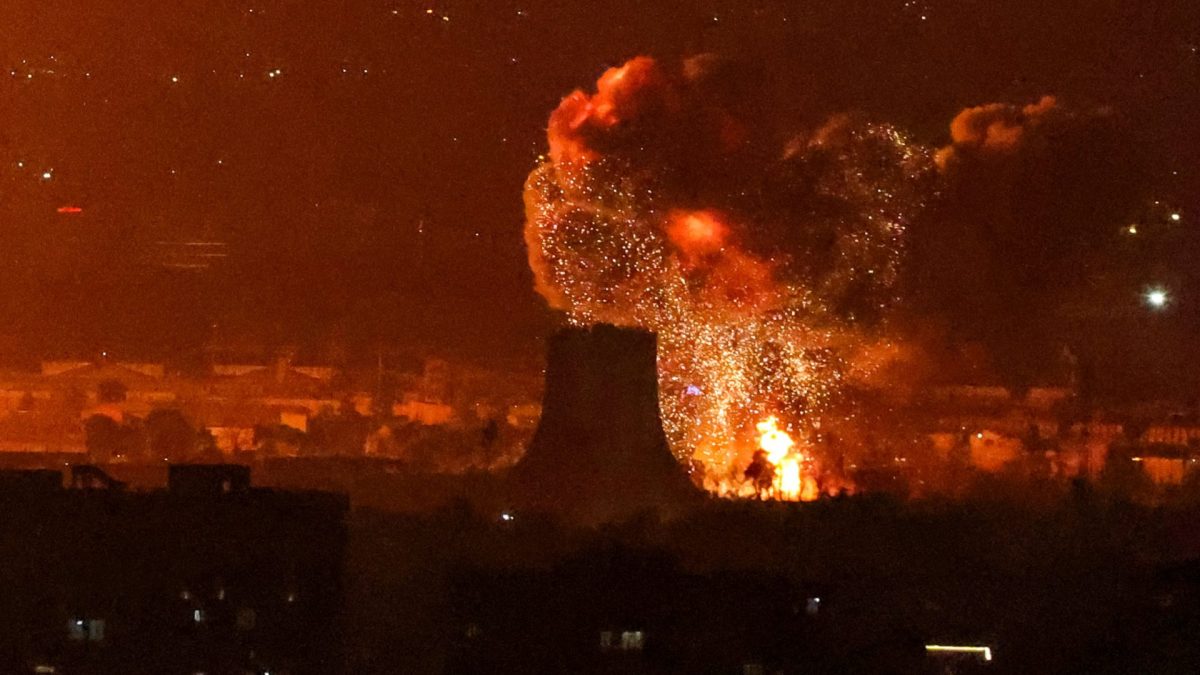
Specialists at the military news outlet The War Zone suggest the only sure way to destroy the facility would be a nuclear weapon, specifically the B61 bomb, which could deliver a 400-kiloton blast. The US military has carried out “defensive” air strikes on southern Iran this week as low-level hostilities continue with little prospect of resolution.
Trump said Tuesday that overnight attacks on Iran were minor. “It wasn’t war,” he told Fox News.
“I’m not looking to kill lots of people, but if we have to, we’ll have to. And we’re very strong right now.”
Iran is demanding reparations for war damage and recognition of its control over the Strait of Hormuz, among other conditions for a peace deal, which the US has rejected. The White House insists Iran must give up its nuclear fuel and future enrichment, which Tehran will not consider.
Israel’s Prime Minister Benjamin Netanyahu is pressing for a war to bring down the Iranian regime, and White House officials say civilian infrastructure in Iran, such as power plants, could be targeted.
Mulroy said he expects military action to resume if there is no imminent peace deal, with “economic targets” in the US crosshairs. Although Trump has alternated between threats toward Iran and predictions of an imminent deal, he has consistently ruled out a nuclear attack.
“We don’t need it,” he said in April. “A nuclear weapon should never be allowed to be used by anybody.” He reiterated that position in August: “They’re totally defeated militarily, so I defeat them, and now I should use a nuclear weapon on top of them?
What a stupid question.”
Pavel Podvig, a senior researcher in weapons of mass destruction at the UN Institute for Disarmament Research (UNIDIR), said a move as momentous as a nuclear strike would require preparations. “At the very least, I would expect that any consideration of nuclear use would be preceded by a change in rhetoric,” he said.
“We haven’t seen this, so I read it as a sign that nothing nuclear is being considered.” Podvig added that the nuclear taboo works partly by setting the “initial conditions” of a conflict, and that “the default option is not to use nuclear weapons.”
Mulroy also believes Trump would stop short of a nuclear attack. “The idea that the US could use a lower-yield, ‘tactical’ nuclear weapon would be a massive escalation, and cross a threshold that would have major consequences and potentially spread radioactive material throughout the region,” he said.
Carlson noted that US use of nuclear weapons could set a precedent that might lead nations such as Russia or North Korea to follow suit, which could serve as a deterrent to Trump.
Hans Kristensen, director of the Nuclear Information Project at the Federation of American Scientists, told The War Zone: “There is nothing at all in Iran that justifies breaking the 81-year absence of nuclear weapons use. It would be a violation of the international Laws of War, have devastating consequences for US foreign policy and the efforts to prevent proliferation and the use of nuclear weapons.” He added: “It would be the kind of act where one would hope the people in the nuclear chain of command would refuse to carry out the President’s order.”