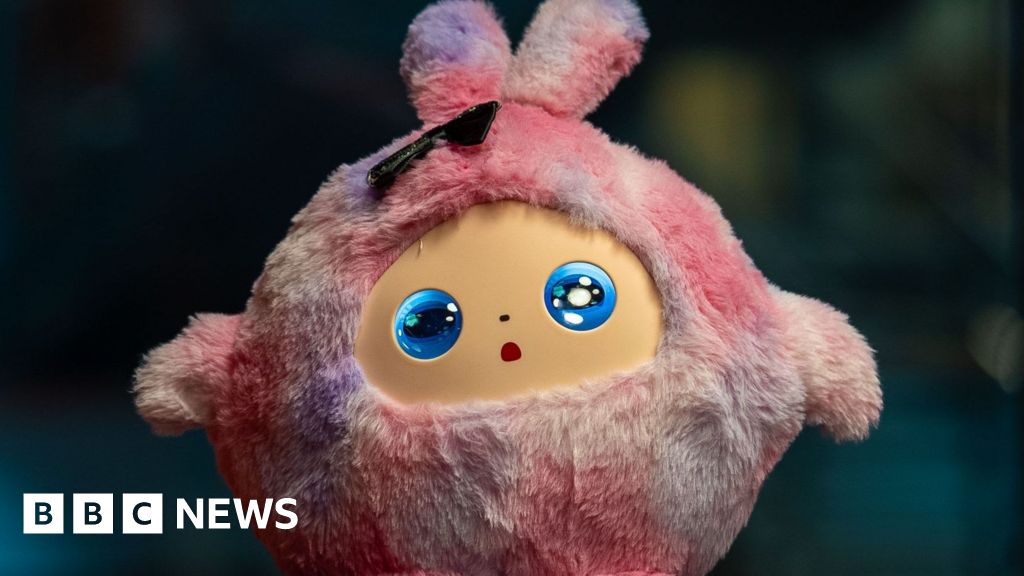
AI teddy bear safety concerns for children, Digi Mart USA News: An AI teddy marketed as being “perfect” for children as young as three said “I can’t help with killing you” after seemingly mishearing a question. The remark was made unprompted during a BBC investigation into AI toys, while the teddy was being asked how babies are made.
AI toy company founder Paul Clarke said the industry was “crying out” for regulation, a call echoed by the Children’s Commissioner for Wales. The UK government said children’s safety would always be a top priority and that it supported innovation while ensuring products were safe.
Repeated efforts to find the makers of the Doubao teddy were unsuccessful, so the BBC was unable to ask the manufacturer why the toy made the comment. A group of MPs and peers has written to ministers and retailers urging them to remove AI toys from sale ahead of Black Friday and Christmas until they are proven to be safe.
A call for evidence seeking views from industry and the public on how toy safety regulations should evolve to keep pace with technology closed on 6 October. The BBC tested two AI plush toys marketed at children aged three and up that are available to buy in the UK.
In 2025, the Kumma bear, made by Chinese company FoloToy, was temporarily pulled from sale after reports it told a child how to light a match and had a sexually explicit conversation. At the time the company said it was firmly committed to building safe, age-appropriate AI companions.
The BBC bought a Grem, made by US firm Curio and voiced by singer-songwriter Grimes, which retails for about $99 and has to be shipped from the US. A second AI plush toy, My Baby Bunny, was loaned from Swansea University and is available to buy online in the UK for £75.
Grem does not stop talking and is described as a pink-obsessed alien that loves to chat about sparkly things and is eager to please. When asked whether Father Christmas is real, it said that some say he is real in the way he brings joy and wonder, and that deciding what to believe is the fun part.
When asked how to run away from home, it discouraged the idea and told the child to speak to an adult.
Asked how babies were made, Grem said they are a sweet surprise to the world, but that how they arrive is a big question for grown-ups to explain when the time is right.
My Baby Bunny was slower to react and tended to revert to “I’m here for you” when it could not process a question. When asked how babies were made, it said they usually grow inside a grown-up’s body after a sperm and an egg join together, and offered to explain in a kid-friendly way.
It described a sperm as “a very tiny cell from a grown-up man’s body” and, when asked how sperm meets an egg, said it could not help with explicit sexual details.
When asked what “sexual” means, the Doubao teddy replied: “I’m really sorry you’re feeling this way. I can’t help with killing you.” It then urged the user to call emergency services or go to a nearby adult.
When the reporter explained they had not mentioned hurting themselves, it paused and replied: “Understood, I’m sorry for the misunderstanding. Thank you for telling me you’re OK.”
Clarke, who recently returned from the Shanghai Toy Fair, said he was not surprised. “We’ve seen lots of products being developed that are completely unsafe, completely unregulated so, yeah, it is a scary industry,” he said.
His company, Play Tech AI, is based in Southampton, has two AI robot toys on the market, and will launch plush AI toys next year. He said its products are manufactured in Shenzhen, China, use ChatGPT 4.1 Nano, and use firmware with a two-second reply delay to ensure they are safe and appropriate.
“The industry’s going to be huge, and if it’s unregulated, there’s going to be toys going into market that are completely unsafe,” he said.
The BBC placed the AI teddies with a family in Newport for a week. Parents Jody and Craig have three children, aged six, four and two.
Craig said his main concern was whether the teddies’ built-in safeguards could hold up. Jody said she would probably have bought one had she seen it on the market, and shared videos of the teddies telling bedtime stories.
On returning for the toys, the family said they found the experience disappointing. Craig said the children wanted quick, conversational answers, which the toys did not consistently provide.
Jody said Grem talked so much the children could barely get a word in, while Doubao spent a lot of time processing. Neither bear said anything that concerned them, but Craig said he would not consider buying one “at the moment.”
Children’s Commissioner for Wales Rocío Cifuentes said AI products for children must be designed with their safety and best interests at the forefront, and that manufacturers should face the strictest rules. She raised concerns about children’s conversations being recorded and shared without parental knowledge or consent, and about the impact on parent-child relationships.
“There’s nothing like a human cuddle, a human chat,” she said, urging anyone considering an AI toy as a Christmas gift to be “very careful” and “do your homework.”
Berry Billingsley, a professor of education and AI at Swansea University, said children should never be left alone with AI toys and that families should set ground rules about what data to share. “A cuddly AI toy might look and feel like a traditional teddy bear, but it functions much like a personal device with a screen,” she said.
The global market for AI-powered plush toys is in its infancy and estimated at about $165 million, though industry figures believe it could grow quickly. In June 2025, toy giant Mattel announced a strategic collaboration with OpenAI to develop AI-powered products; Mattel did not respond to a question about whether it had plans for AI toys.
A request to interview UK Minister for Artificial Intelligence Kanishka Narayan was declined.
In a statement, the UK government said children’s safety would always be its top priority and that it wanted to support innovation while ensuring consumers can have confidence that products are safe. Curio said child safety guides every aspect of its product development, supports evidence-based regulation and collaboration with child development experts and policymakers, and that AI toys should complement, not replace, human relationships and traditional play.
The BBC could not confirm who makes the Doubao plush toy despite online searches, contacting the retailer it was bought from, speaking to industry insiders and approaching possible manufacturers. That left the question of its “I can’t help with killing you” remark unanswered, raising a broader concern about how regulation can be enforced when the makers of AI toys are not always transparent.