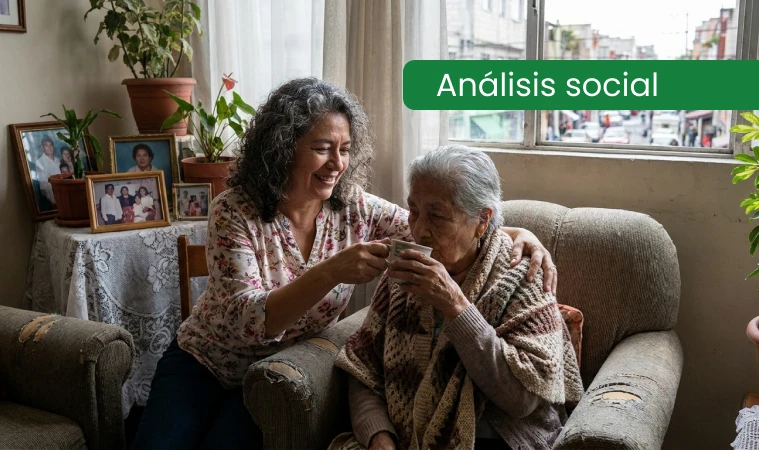
Mexico unpaid care work and family caregiving, Digi Mart USA News: Someone prepares a special breakfast for a person who can no longer eat alone. Another person leaves work to accompany their mother to a medical appointment.
A father rearranges his schedule to look after a child with a disability. These tasks rarely appear in employment indicators, yet they sustain millions of Mexican households every day.
The country has begun to name this reality: care is work, even when it often goes unpaid.
It is also a human relationship that demands affection, patience, knowledge and time. Recognizing the value of care does not mean turning every family bond into an economic transaction.
It means preventing this responsibility from being carried in isolation.
According to the 2022 National Survey for the Care System (ENASIC) by INEGI, 31.7 million people aged 15 and older provided care to members of their own household or other households. Three out of every four were women.
The same survey identified 58.3 million people who could potentially receive care due to age, disability or dependency. This figure groups very different situations and does not mean that all of them require continuous assistance.
In 77.8% of households there was at least one person belonging to these groups.
Another data point helps illustrate what remains largely invisible. INEGI’s Satellite Account of Unpaid Household Work estimated that unpaid domestic and care work represented a value equivalent to 23.9% of gross domestic product in 2024.
These are not resources that circulate as household income; they are an economic valuation of the work carried out by household members, and it includes domestic activities beyond direct care.
The 2024 National Survey on Time Use (ENUT) showed that women devoted an average of 39.7 hours per week to domestic, care and volunteer work, compared with 18.2 hours for men. The indicator combines several unpaid tasks, but it nonetheless reveals an unequal distribution of time.
A family may claim to share responsibility while, without realizing it, placing almost all of the execution on one person.
On October 29, 2026, the Secretariat of Women highlighted the inclusion of care work in budget tracking through Transversal Annex 31. This is a step toward identifying actions and resources, but it does not by itself demonstrate that sufficient services already exist or that households have received new benefits.
The important question is how much concrete help reaches those who need it.
Several measures could help. A first step would be to build local information on real care needs while respecting privacy.
A second would be to provide free and accessible guidance so families know where to find services, how to distribute tasks and when to request professional help. A third would be to create temporary respite and training mechanisms for people who provide regular care.
Companies also have a role in recognizing that their workers have responsibilities outside the office, and municipalities must strengthen networks and services.
Assessing whether a care policy works will require identifying concrete needs by region. A community without early childhood education services differs from one where care centers exist but operate on hours incompatible with employment.
Reporting should verify national figures with health centers, DIF family systems and neighborhood organizations, cross-checked with verifiable testimony and visits to services, without presenting isolated cases as representative of all of Mexico.
The working conditions of people hired to provide care also matter. Their training, pay and safety directly influence the continuity and quality of support. The answer is not simply to transfer unpaid tasks to workers without protection. A system that recognizes caregivers must protect both families and the professionals who provide these services.