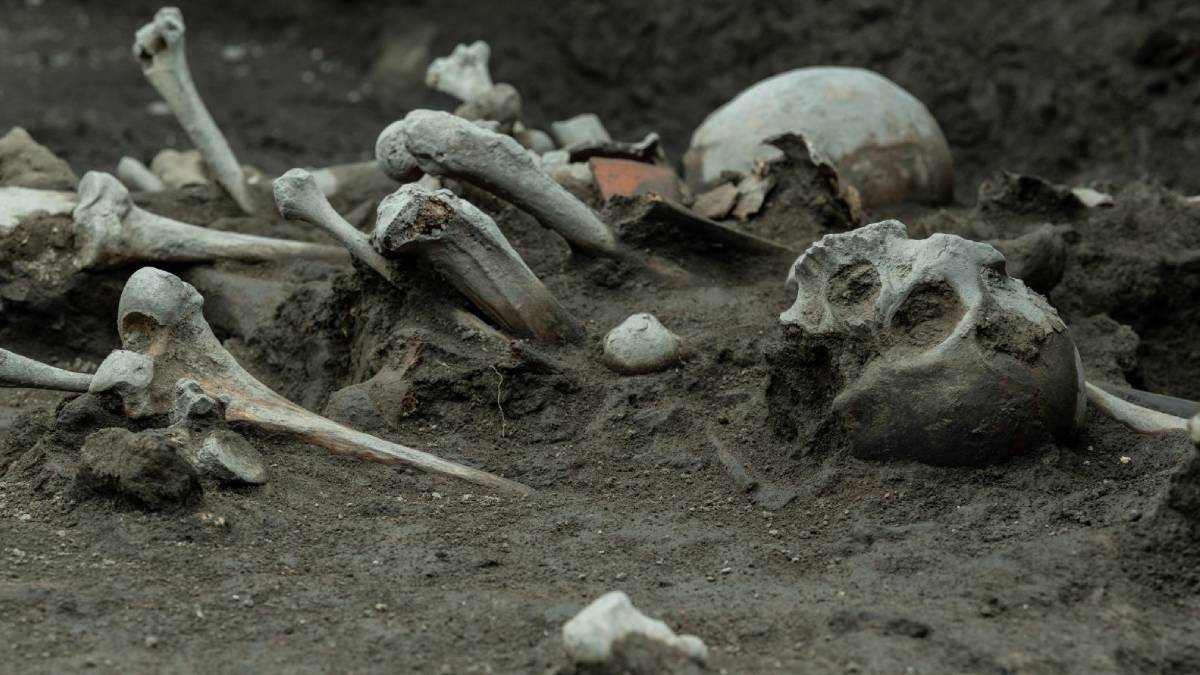
INAH prehispanic ossuary discovery Mexico-Queretaro train construction, Digi Mart USA News (Buenavista terminal, Mexico City): Specialists from Mexico’s National Institute of Anthropology and History (INAH) have discovered a possible prehispanic ossuary near the Buenavista terminal in Mexico City, during construction work on the Mexico City-Querétaro Passenger Train. So far, nine skeletons have been counted, some with cranial modifications.
Two of the skeletons show cranial modifications, along with five jaws and large bones such as radii, tibiae and iliac bones, which are in good state of preservation. An ossuary is a place, container, pit or structure intended to gather and preserve human bone remains, while a skeleton is the set of bones that form the skeleton of a human or vertebrate animal.
INAH reported that the find may correspond to the Late Postclassic period, from 1200 to 1519 AD, or to the contact period with the Spanish between 1519 and 1535 AD, according to the specialists’ first hypotheses. Specialists also found ceramic pieces and other objects that will help clarify the funerary practices of the ancient communities of the area.
Claudia Curiel de Icaza, Mexico’s Secretary of Culture, said the discovery will open new questions about how communities treated and remembered their dead during a period of historical change.
The first bone remains were located on September 17, 2026, during earthworks for the railway track in the vicinity of the Buenavista terminal. Excavations were supervised by INAH as part of an archaeological rescue project coordinated by archaeologist Víctor Francisco Heredia Guillén.
At a depth of 1.40 meters, specialists found skulls, jaws, parts of hips, femur fragments, ribs and teeth. At greater depth, they located a funerary deposit without anatomical connection between the bones, a feature that suggests it could be an ossuary, explained Josué Castillo Sánchez, the archaeologist responsible for field work.
The type of alterations, as well as the age and sex of the individuals, will be determined through studies at the Physical Anthropology Laboratory (LAF). Along with the human remains, specialists found Azteca III ceramics dating between 1350 and 1520 AD, including plates, pots and salt-making vessels used to extract salt from the former Lake Texcoco.
Crews also located seven miniature spindle whorls, two figurines and polished lithic pieces, including four fragments of metate and mortar hands, along with obsidian blades, mainly green obsidian, possibly from the Sierra de las Navajas in Hidalgo.
José Manuel Cervantes Pérez, head of the Physical Anthropology Laboratory, said the bone remains and associated objects could correspond to the final years of the prehispanic period and the colonial era between 1535 and 1821. This hypothesis also considers the location of the discovery within the former calpulli of Nonoalco, one of the 19 prehispanic neighborhoods of the Tlatelolco islet, which could provide information about the funerary practices of its inhabitants.
Another relevant element is the proximity to the Church of San Miguel Nonoalco, built in the 16th century and used as a visiting chapel by Franciscan friars of the Convent of Santiago Tlatelolco. Cervantes Pérez noted that other ossuaries found in Mexico City have been linked to the viceregal period or the contact stage, although in this case the presence of prehispanic materials also stands out.
Abril Machain Castillo, the physical anthropologist in charge of exhuming the human remains, explained that one indication that the deposit is an ossuary is the type of pieces found, since durable bones such as skulls and long bones predominate rather than small or irregular fragments. She explained that such deposits could form when individuals were buried in a place later reused for other burials, so remains from earlier interments were removed and moved to another space.
After registration, the materials were transferred to the project’s physical anthropology, lithic and ceramics laboratories, located in Tula de Allende and Tepeji del Río de Ocampo, Hidalgo. There they will undergo cleaning and restoration before being analyzed and safeguarded by INAH specialists.