INAH human remains discovery at Buenavista during Mexico-Querétaro train construction, Digi Mart USA News (Buenavista, Mexico City): Specialists from Mexico’s National Institute of Anthropology and History (INAH) discovered a deposit of human remains beneath the Buenavista terminal in Mexico City during construction of the Mexico-Querétaro train, according to a report by Publimetro México. The remains could shed light on how the dead were buried roughly 500 years ago.
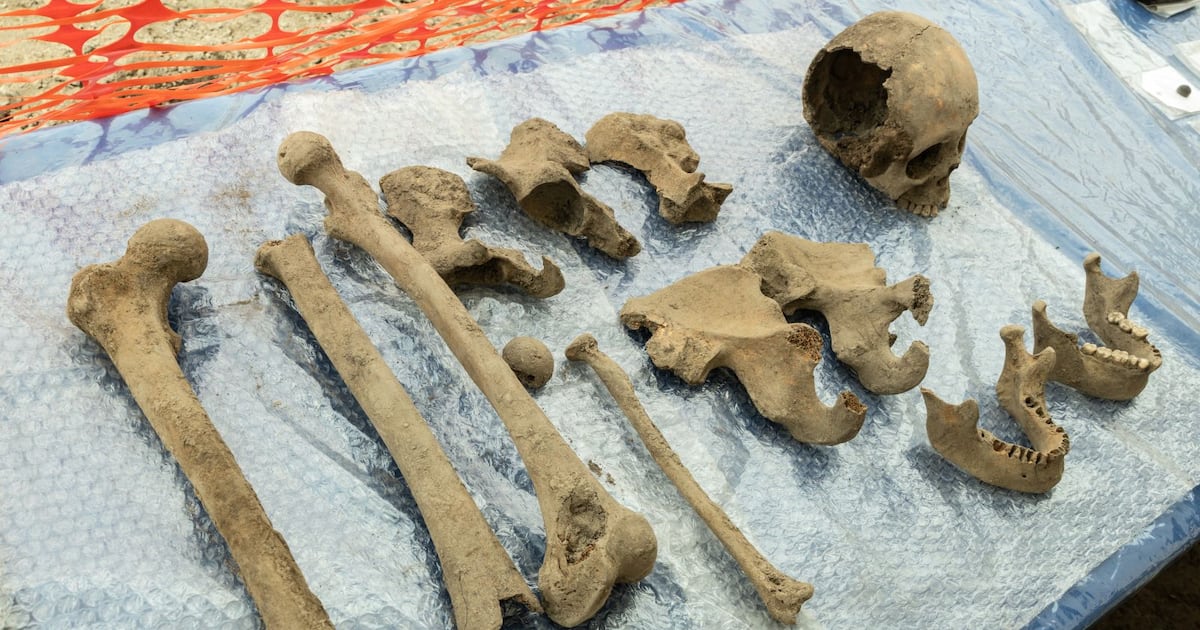
The discovery was made on September 17, 2026, but was made public on November 4. Archaeologists identified nine skeletons, five jawbones and various bones that may have formed an ancient ossuary, meaning a place where human remains moved from other burial sites were deposited.
The materials may correspond to the Late Postclassic period (1200–1519 CE) or to the early years of contact with the Spanish (1519–1535 CE), when Indigenous communities began to undergo profound cultural and religious changes. INAH has clarified, however, that further studies are needed to determine the remains’ age more precisely, as well as their age at death, sex and other characteristics.
The first bones appeared during earthwork for the railway line at a depth of 1.40 meters. They included skulls, jaws, fragments of hips, femurs, ribs and teeth.
As excavations continued, specialists found a deeper funerary deposit where the remains no longer retained their original anatomical positions.
Archaeologist Josué Castillo Sánchez reported that two of the nine skeletons show cranial modifications, whose characteristics still must be examined. Long bones such as tibias and radii, in good condition, were also recovered.
For physical anthropologist Abril Machain Castillo, who is in charge of the exhumation, the absence of small bones and the concentration of skulls and large pieces are signs that the site may have functioned as an ossuary. Her explanation points to a funerary practice in which remains of previously buried people were removed and placed in another space, possibly to make room for new burials.
This interpretation, however, must still be confirmed through study of the recovered materials.
The location is especially significant. The deposit was found on land that once belonged to the calpulli of Nonoalco, one of the 19 pre-Hispanic neighborhoods of the Tlatelolco islet.
The remains were also located near the San Miguel Nonoalco church, built in the 16th century and used as a visiting chapel by Franciscan friars from the Convent of Santiago Tlatelolco. This proximity, combined with the presence of pre-Hispanic objects, raises questions about the continuity or transformation of funerary customs during the early years of colonization.
José Manuel Cervantes Pérez, head of the project’s Physical Anthropology Laboratory, explained that other ossuaries found in Mexico City have been linked to the viceregal period or the early contact era with the Spanish. However, materials of pre-Hispanic tradition also appeared at Buenavista, so it is not yet possible to establish whether all the elements belong to the same historical moment.
Among the recovered objects are Aztec III phase ceramics (1350–1520 CE), including plates, pots and salt containers used to extract salt from the former Lake Texcoco. Archaeologists also found seven miniature spindle whorls used for spinning, two figurines and fragments of grinding tools.
Green obsidian blades, possibly from the Sierra de las Navajas in Hidalgo, were also found.
The discovery occurred in an area whose archaeological value had been flagged before this stage of railway work began. According to an agreement published in the Official Gazette of the Federation (Diario Oficial de la Federación) on August 4, 2026, INAH’s Directorate of Archaeological Rescue warned in a February 25 memorandum that the land earmarked for the Buenavista railway expansion had high archaeological potential.
Although no archaeological materials were visible on the surface during inspection, the institute required that any excavation or removal of sediment be supervised and monitored by authorized personnel at all times.
The archaeological rescue project is coordinated by Víctor Francisco Heredia Guillén, who also oversees research linked to other finds along the railway route. In a report published October 19, INAH said it had registered about 140 sites with archaeological remains along the Mexico-Querétaro route.
That report also noted the custody of remains belonging to 121 individuals recovered at various sites in Hidalgo and Querétaro as part of research accompanying the construction.
After their location and characteristics were documented, the materials from Buenavista were transferred to specialized laboratories in Tula de Allende and Tepeji del Río de Ocampo, Hidalgo. There they will undergo cleaning, restoration and analysis to determine their characteristics and establish a more precise chronology.
Research will also seek to clarify the cranial modifications identified and the relationship between the bones and the archaeological objects recovered.
Meanwhile, the Mexico-Querétaro train remains one of the federal railway projects under development. On October 31, the Government of Mexico reported that construction had reached 32% progress.
INAH has not stated that the discovery has caused any changes to the railway project. What remains open is the study of the remains found beneath Buenavista, whose characteristics could offer new clues about how the residents of ancient Tlatelolco treated their dead during one of the greatest transformations in their history.