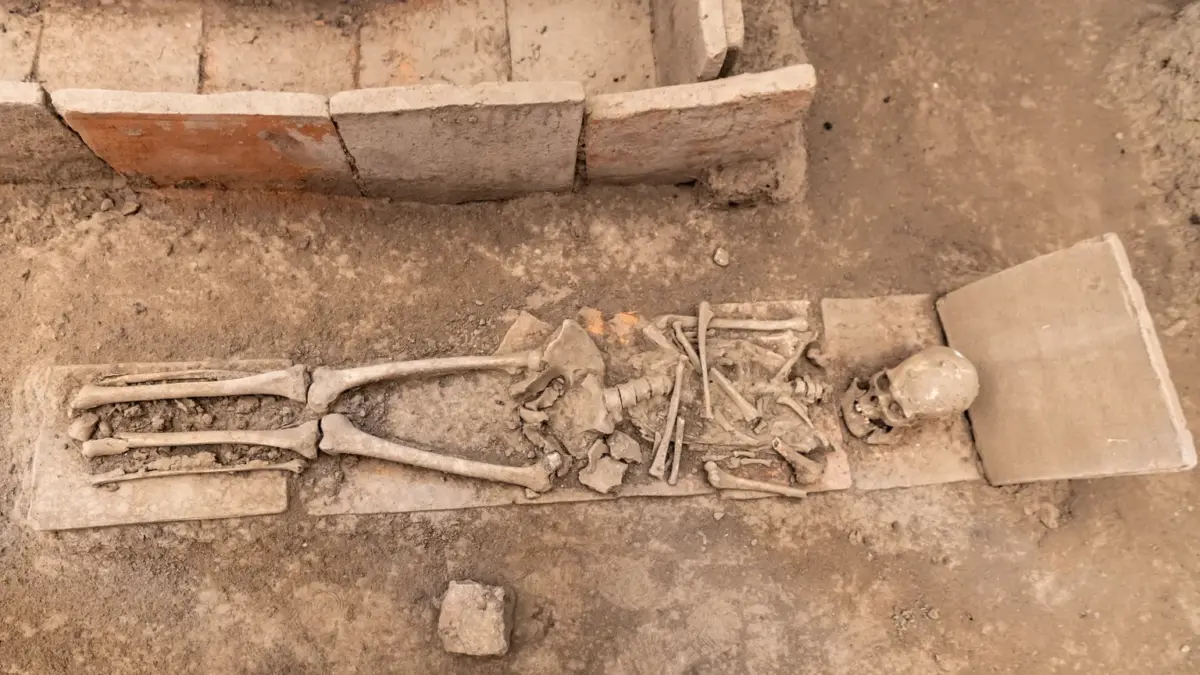
Human remains and ceramics found near Buenavista station in Mexico City, Digi Mart USA News (Mexico City, Mexico): Salvage archaeological work along the route of the Mexico City-Querétaro Passenger Train has revealed a deposit of human bones that specialists from the National Institute of Anthropology and History (INAH) believe may be an ossuary. According to the publisher’s report, the deposit could date to the Late Postclassic period (1200-1519 AD) or to the early contact period with the Spanish (1519-1535 AD).
Mexico’s Secretary of Culture, Claudia Curiel de Icaza, said that a possible ossuary offers insight into how ancient communities treated and remembered their dead during a time of profound change. She said INAH would study the materials rigorously and explain what they reveal.
The first bone remains were located on September 17, 2026, during earthwork for railway track installation near the Buenavista terminal in Mexico City. Excavations were carried out under INAH supervision as a salvage project coordinated by archaeologist Víctor Francisco Heredia Guillén.
After excavating to a depth of 1.40 meters, workers found skulls, jaws, parts of hip bones, femur fragments, ribs and teeth. Lower down, the ossuary was found, described as a funerary deposit without anatomical connection, according to field archaeologist Josué Castillo Sánchez.
So far, nine skeletons have been counted, two of which show cranial modifications, along with five jaws and large bones such as radii, tibias and ilia in good condition. The type of alterations, as well as the age and sex of the individuals, will be determined after analysis at the Physical Anthropology Laboratory (LAF).
Ceramics of the Aztec III period (1350-1520 AD) were found with the bones. They include domestic items such as plates, pots and salt vessels used for extracting salt from the former Lake Texcoco.
Also recovered were seven miniature spindle whorls, a pair of figurines, polished stone tools including four metate and mortar fragments, and blades, mostly of green obsidian, possibly from the Sierra de las Navajas deposit in Hidalgo.
José Manuel Cervantes Pérez, head of the LAF, said the elements may correspond to the final years of the pre-Hispanic period and the colonial era (1535-1821). He noted that the find occurred within the former calpulli of Nonoalco, one of 19 pre-Hispanic neighborhoods of the Tlatelolco islet, which could provide information on funerary practices of the period.
The remains were also located near the 16th-century church of San Miguel Nonoalco, which served as a visiting chapel for Franciscan friars from the Convent of Santiago Tlatelolco.
Anthropologist Abril Machain Castillo, in charge of exhuming the remains, said one feature that identifies the site as an ossuary is that no small or irregular pieces were found, only preservable elements such as skulls and long bones. She explained that individuals were originally buried in a place used for earlier burials, and that remains were removed and placed in a separate location, the ossuary.
After in situ recording, the materials were transferred to the project’s physical anthropology, lithic and ceramic laboratories in Tula de Allende and Tepeji del Río de Ocampo, Hidalgo, where they will be cleaned, restored, analyzed and stored.