Quimper Armistice Day ceremony and national remembrance, Digi Mart USA News (Quimper, France): Amid criticism from some national education unions, who denounce a drift toward the “militarization of youth,” residents gathered in Quimper for the November 11 ceremony emphasized the importance of passing on memory and expressed a desire for unity.
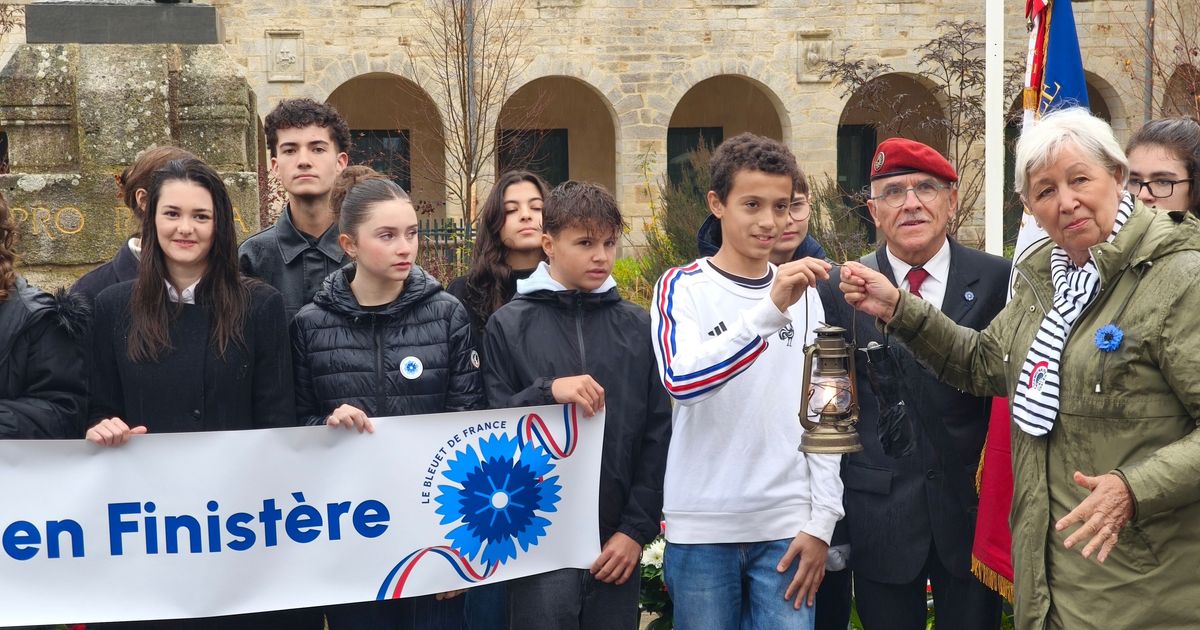
While the traditional November 11 ceremonies honoring French soldiers who fell in combat took place, the city of Quimper hosted the final stage of the Flame of Remembrance route. Carried for three years by the Finistère department, the initiative allowed high school students to collect the flame beneath the Arc de Triomphe in Paris before carrying it through about a dozen communes in Finistère.
The gathering takes place in a particular context. Since last summer, a ministerial circular has directed schools to organize commemorations honoring the “morts pour la France” (those who died for France).
Several education unions have criticized the measure, warning of a risk of confusion between “memory and history,” but the hundreds of citizens gathered in Quimper showed little sign of controversy.
Among the crowd were many families who came to share the solemn moment with their children. One spectator, who came to support her nephew recently enlisted in the Navy, said she was there to explain to her children what November 11 and the commemoration mean, so that those who died for France are not forgotten and a conception of democracy is defended.
Marc-Antoine, attending for the first time with his children, said the effort answers a civic duty: “I thought it was important to show the children what November 11 represents, the commitment of the French of that generation to defend the country.”
Chloé, who attended with her four-and-a-half-month-old baby, stressed the need to pass on to new generations “what our elders did for us, what we fought for and our values.”
Matthéo, a first-year high school student at the Saint-Louis lycée in Châteaulin and a winner of the national Resistance and Deportation competition, traveled to Paris to collect the flame at the Tomb of the Unknown Soldier before reading the official speech in Quimper. Asked about the school’s role in transmission, he said it is essential to awaken younger people: “It’s important to talk about it so they understand that something happened, and later they can study it and understand what these ceremonies are about.”
His classmate Arthur saw the ceremony as a force for national cohesion: “It’s something that brings people together at a time when I think we are very divided. If those people had not fought in 1914 or in 1939–1945, French history would not be the same.”
Students in the Défense class at the Sainte-Thérèse middle school presented their research on a Quimper war godmother who was eight years old during the conflict. Their documentation teacher, Anne, stressed the nature of the lesson: “It’s not at all about the military side, but truly about support and awareness.”
Retired military personnel in the audience welcomed the involvement of younger generations with relief. Sabine, a former servicewoman with 37 years of service, underlined the demand of remembrance: “We must keep this, we must respect our elders.
It is the memory, the duty of remembrance for all those who stayed behind and thanks to whom we have a more comfortable life today.” Michel, a retired career soldier, praised the presence of engaged young people: “We still have a wonderful youth, young people who believe in it… We must preserve this duty of memory because we don’t know where we will be in a few years.”
Facing debates over the school’s role, one participant summed up: “The priority remains first to build the nation” around shared values.