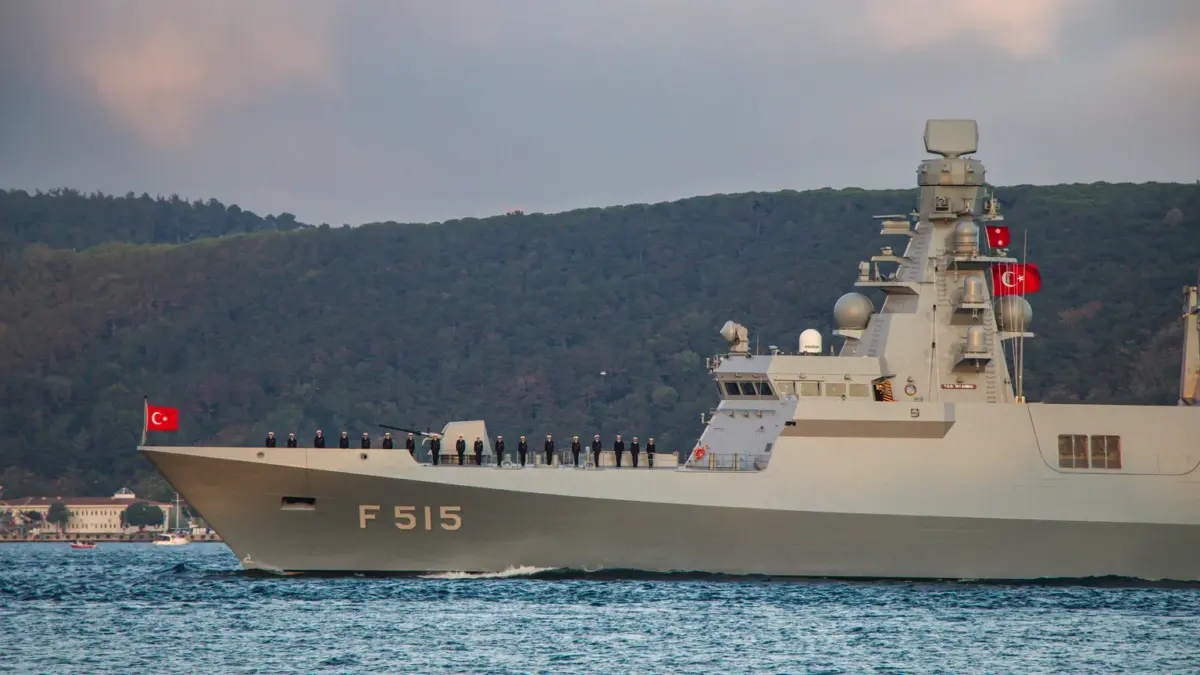
French Navy ex-frigate Latouche-Tréville underwater explosion shock trials, Digi Mart USA News: France’s Direction générale de l’armement (DGA) carried out a first underwater explosion shock test on the hull of the former anti-submarine frigate Latouche-Tréville on October 27. The frigate was decommissioned in 2022 after 32 years of service.
The operation is part of the CORTEX-BS project, which aims to better understand what a naval mine actually does to a surface ship and its equipment. Preparation took several months, with studies and instrumentation work carried out by DGA Techniques navales in collaboration with the French Navy, the Combat Naval management unit, DGA Techniques aérospatiales, Naval Group and Safran Electronics & Defense.
Sensors installed aboard the vessel are intended to track how the shock wave propagates through the ship to its equipment. Because the ship is decommissioned, it can be fitted with instruments and subjected to increasing loads, allowing observation of what breaks, something a test on an active warship would not permit.
According to the agency, the trials aim to better control the effects of underwater shocks caused by naval mines on the French Navy’s surface vessels in an increasingly tense international context. The stated goal is to strengthen protection of equipment and crews so that ships can continue fighting after absorbing a blow.
The agency explained that a mine detonating at a distance may not pierce the hull but can shake the ship, tearing equipment from its mountings, severing cables and detaching electronic circuit boards, which can put a vessel out of action. Trials were designed to be progressive, starting far and at low intensity, measuring results, then moving the charge closer and measuring again, in order to build a behavioral curve rather than a single breaking point.
The DGA expects four outcomes from the campaign: an updated technical reference for shock resistance of surface ships, validated numerical simulations that could reduce testing costs and timelines, shock verification of modernized equipment and new technologies under real conditions, and strengthened national expertise in shock qualification. Validated simulations could allow equipment to be qualified through calculation rather than explosions, changing the cost scale for future naval programs.
Naval mines are described as a low-cost, hard-to-detect weapon that can deny access without being carried into combat. Modern ships are considered more vulnerable to shock than older vessels because they rely heavily on electronics, sensors and data links.
In February 2025, the Navy conducted a shock test on the active frigate Courbet, detonating a naval mine at a safe distance to assess resistance and train its crew.
The source does not disclose the explosive charge power, the firing distance, the number of planned tests, or the final fate of the hull. The report also notes that the number of available hulls for such exercises is limited, since the Navy does not decommission one frigate per year.