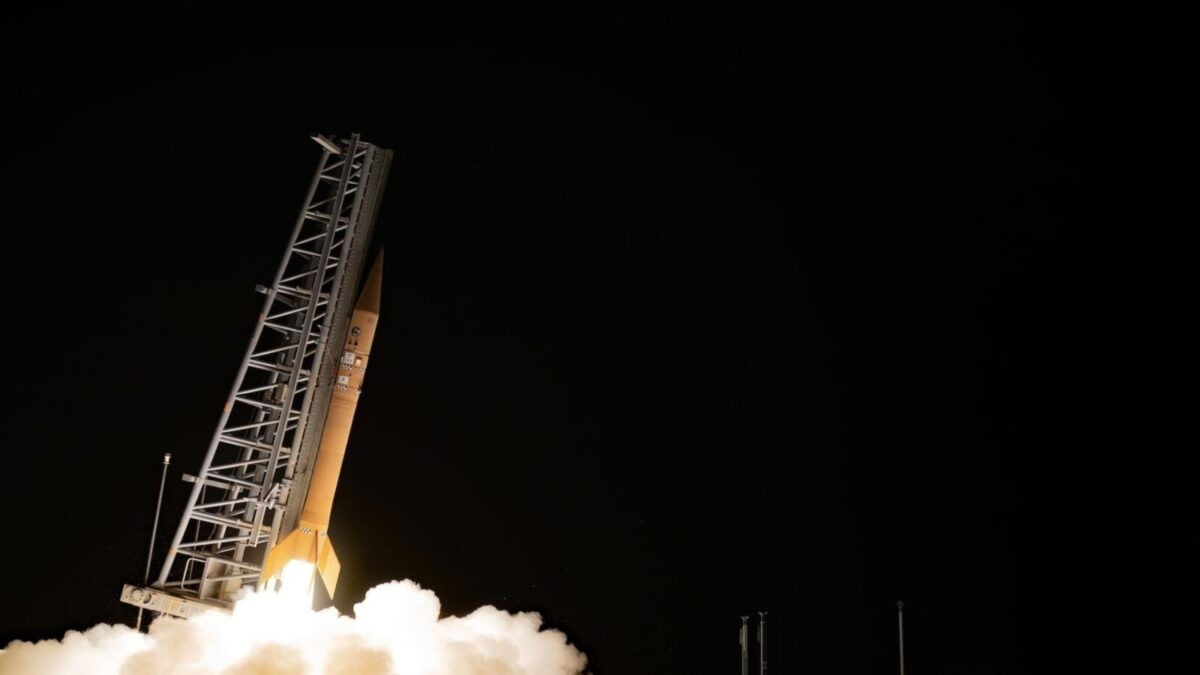
France SyLEx sounding rocket test, Digi Mart USA News (Biscarrosse, Landes, France): A bright orange glow crossed the sky over Biscarrosse overnight, as France tested an element of its future nuclear arsenal using a rocket much lighter and less expensive than the missile it is helping to prepare.
Barely a month after the M51.3 ballistic missile test on October 6 off Finistère, the Direction générale de l’armement (DGA), France’s defence procurement agency, announced the success of the second test of SyLEx (Système de lancement d’expériences), a sounding rocket designed by ArianeGroup that launched on an exo-atmospheric flight. In development for five years, it had previously flown on its qualification flight on the night of November 27–28, 2025.
This second launch took place overnight on November 3–4 from the DGA missile test site at Biscarrosse in the Landes department. Between the two tests, SyLEx changed roles: after proving it could lift off and be tracked in flight, it carried equipment beyond the atmosphere for the future M51.4 ballistic missile, also developed by ArianeGroup and intended to equip France’s current and future nuclear-powered ballistic missile submarines (SNLE).
A submarine-launched strategic ballistic missile (MSBS) launch is extremely expensive, which is why SyLEx was developed. The future M51.4 will need a propulsion system capable of sending it thousands of kilometers, as well as a payload carrying thermonuclear warheads and devices designed to deceive adversary defenses.
These two parts can be tested separately, which is the main advantage of SyLEx. It can carry up to 600 kg of equipment to altitudes between 200 and 400 km in its two-stage configuration.
That version has not yet flown; tonight’s launch used the single-stage version, which reaches between 140 and 200 km.
After liftoff, the rocket climbs, releases its nose cone once outside the atmosphere, and the onboard equipment continues on a bell-shaped trajectory before falling back to Earth. During this flight of a few minutes, DGA engineers can verify in real conditions how a specific component reacts before it is integrated into the future M51.4 missile, such as a separation mechanism, sensor, onboard electronics or decoy device.
If a defect is found, it is better to discover it on SyLEx than during an MSBS launch.
The DGA did not make public the exact payload content of last night’s launch. It said on X that the flight had “allowed several experiments essential to the development of the future M51.4 missile” to be conducted.
Armed Forces Minister Catherine Vautrin added on X that the national launcher allows new technologies to be tested in flight for the benefit of French deterrence, hypersonic demonstrators and civilian applications, and gives France a sovereign capability for suborbital flights and high-atmosphere testing that it had lacked for several decades.
This expertise took off in the 1960s, when General de Gaulle wanted French nuclear deterrence to depend on no ally. Test rockets designed by SEREB (Société d’étude et de réalisation d’engins balistiques) under the “Pierres précieuses” program were then used both to prepare missiles for the strike force and for the Diamant launcher, which made France the third space power in November 1965.
Just over sixty years later, SyLEx carries on the same dual military and civilian purpose from Biscarrosse, where the state had created the Centre d’essais des Landes in 1962 in anticipation of the abandonment of Saharan firing ranges.