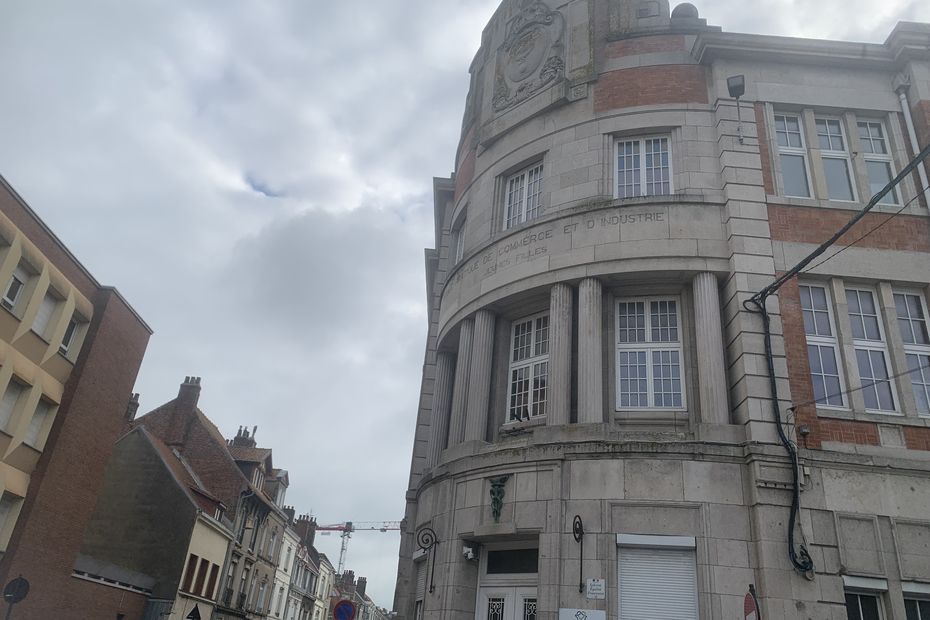
Jean-Charles Cazin high school, Digi Mart USA News (Boulogne-sur-Mer, Pas-de-Calais, France): Among the disputes shaking French high schools this autumn, including Parcoursup and teacher absences, student protests have also highlighted the deteriorating state of some school buildings, heating problems and a lack of sanitary facilities. In the Hauts-de-France region, 19 schools have been identified by the government as priorities for work.
Sigryd is a first-year commerce student at the Jean-Charles Cazin vocational high school in Boulogne-sur-Mer. Classes resumed without difficulty on Monday, November 2, but she says her discomfort persists.
In the Beaurain building, an annex housing workshops and computer rooms, about one hundred students share two toilets. “So we wait an hour to go to the toilet and get yelled at because we arrive late to class,” she said.
“Everything here is horrible, nothing is clean, and we can’t open the windows.”
Léna, a second-year commerce student who arrived at Cazin a month ago, says she has trouble concentrating in class. “The walls aren’t insulated, when you’re in class you can hear people walking by,” she said.
“When you lean against the walls, they move, and there are holes in the ceilings.” She says that despite these drawbacks, things are “okay,” but notes that computers in the IT room take an hour to start up.
With 118 reports, Cazin ranks first among the 12 schools in the Nord and Pas-de-Calais departments, and 19 across the Hauts-de-France region, targeted by the Ministry of National Education for work. Nationally, the list extends to 270 public high schools to be renovated as a priority.
According to the government, the envelope has been set at 4 billion euros through 2030.
Laurent Rigaud, vice president of the Hauts-de-France regional council in charge of education and high schools, said the region must speak more directly with students. “19 high schools are concerned in the Hauts-de-France, but in every high school there is work and investment, and we will take care of each one,” he said.
Thierry Quétu, regional secretary of the FSU teachers’ union in Hauts-de-France, said renovating high schools is a political choice. A teacher at the Branly high school, another Boulogne institution whose condition was highlighted during October protests, he said most high schools have not yet adapted to climate warming.
“During the first heat wave last May, it was hard for students and staff,” he said. “The windows only open in a tilt position, and when the sun hits, temperatures rise excessively fast.”
He said his school was last renovated 30 years ago. “The insulation system is no longer adapted,” he said, adding that replacing all the windows would be very costly but would produce energy savings.
In a statement dated October 26, 2026, the Ministry of National Education said 500 high schools, in addition to the 200 considered priorities, will receive specific support, including funding from the Fonds vert, a state subsidy helping local authorities finance ecological transition and climate adaptation work, to improve summer comfort.