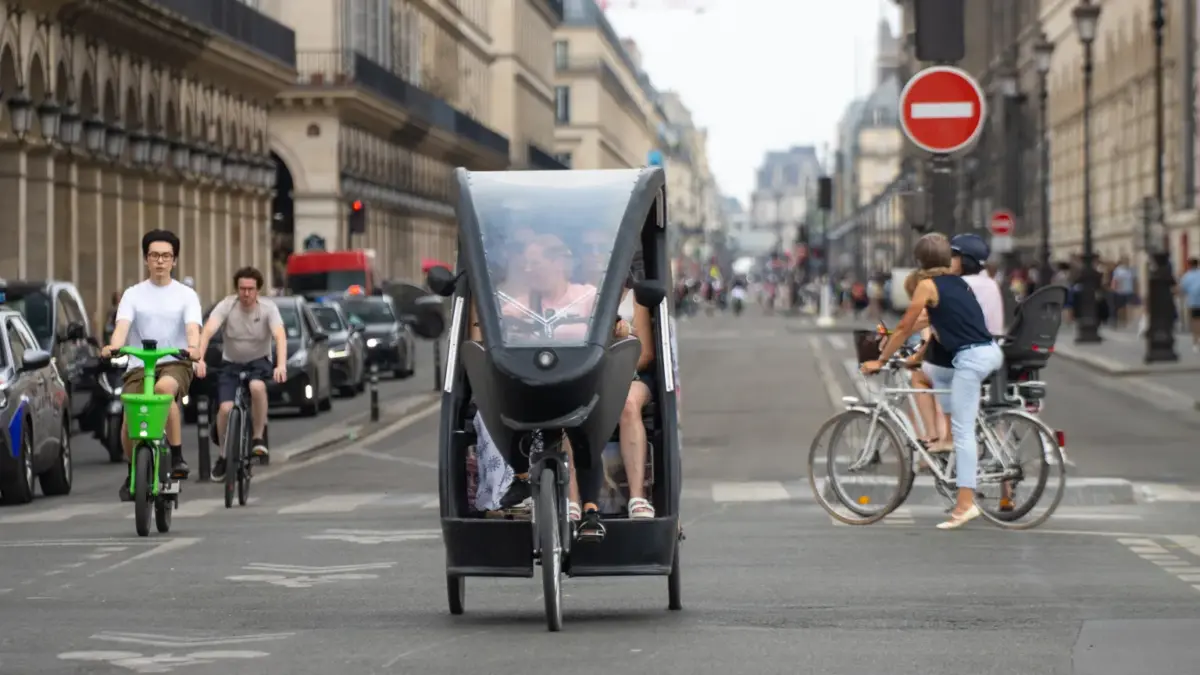
Motorized violence against cyclists in France, Digi Mart USA News (France): Nearly eight in ten cyclists said they had been victims of motorized violence in the past twelve months, according to the 2025 barometer of the Fédération française des usagères et des usagers de la bicyclette (FUB), a public survey that drew more than 330,000 responses. The FUB spokesperson Céline Scornavacca said this can involve physical assault or intimidating behavior.
She described a driver who grazes a cyclist before deliberately cutting them off while shouting insults, with the aim of showing that the cyclist does not belong on the road. Such intentional dangerous behavior can have dramatic consequences.
Paul Varry, a 27-year-old French cyclist, died on October 15, 2024, on the boulevard Malesherbes in Paris after being struck by a driver in an SUV.
In Saône-et-Loire, a 33-year-old mother of three was struck by a vehicle on September 24, 2026, while testing her bicycle in front of two of her children at the family home. The driver was placed under formal investigation at the end of October for “murder,” with a deliberate act now being considered.
Separately, a driver is set to be tried on Wednesday, November 4, in Paris for stabbing a cyclist after an altercation that caused six days of temporary work incapacity for the cyclist and two for the driver. The cyclist has also been summoned to appear.
The driver had parked a van in a bike lane in the 9th arrondissement of Paris.
Dan Lert, deputy mayor of Paris in charge of the city’s cycling plan, acknowledged that the fight against these forms of motorized violence is necessary. The city will create a specialized unit within its municipal police to address motorized violence, and its staffing will be announced at the next Paris council meeting.
Lert said the sharp rise in cycling in Paris must not mask the reality of road violence, adding that there is an unacceptable general climate of aggression toward cyclists.
Cycling use has grown sharply. According to the Réseau vélo et marche, nationwide cycling traffic rose 47% between 2019 and 2025, with particularly strong growth in urban areas.
In Paris, about 11% of daily trips are made by bicycle, compared with 4% by car, while walking accounts for 53.5% and public transport for 30%. Lyon has also seen a strong increase in bicycles and e-scooters, while cities such as Strasbourg and Grenoble have long prioritized cycling.
Both cyclists and motorists blame each other for the tensions. Scornavacca said there is a problem with road code compliance in France, but added that no study shows cyclists follow the road code less than motorists, and that the impact of violations on others is not the same.
Running a stop sign is an offense for either, but collision consequences differ greatly between a car and a bicycle without protective bodywork.
Lert said that in Paris, a motor vehicle is involved in three-quarters of serious or fatal accidents involving a cyclist or pedestrian. Data from the national road safety observatory (ONISR) show that fatal collisions with pedestrians or other cyclists remain a small minority.
In 2025, 96 of the 235 cyclists killed in mainland France died in accidents with no third party involved, a phenomenon especially marked outside urban areas. In cities, motor vehicles were involved in nearly six in ten fatal cyclist accidents in 2025, which does not necessarily mean they were responsible.
The FUB’s Baromètre vélo rates cities on safety, comfort, municipal efforts, equipment and general feeling. In 2025, Grenoble received an A (“very favorable”), Strasbourg a B (“favorable”), Paris a C (“rather favorable”) and Marseille a G (“very unfavorable”), the lowest rating.
Scornavacca said improving safety requires changing both infrastructure and behavior, and the FUB advocates generalizing 30 km/h zones, reserving 50 km/h for major roads, and building quality cycle facilities with safer intersections where roads cannot be shared.
Paris’s new cycling plan for 2027–2032, presented in October, includes the specialized police unit, 140 kilometers of additional bike lanes on top of more than 450 km existing, and securing 420 intersections, compared with 350 in the previous term. Proposed measures include removing nearby parking to improve visibility, coloring bike lanes, and staggering signal releases so bikes and trucks do not move at the same time.
Mayor Emmanuel Grégoire has set the goal of “zero deaths and zero serious injuries on the road.”