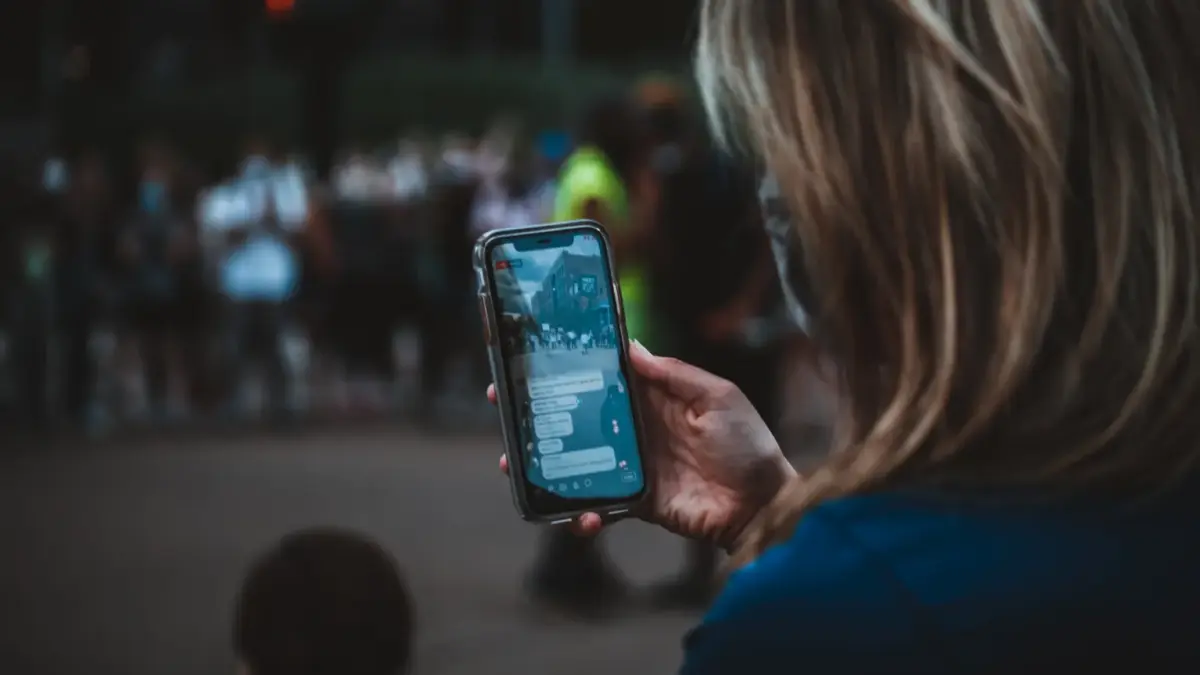
Bitchat messaging app French protesters, Digi Mart USA News (France): Bitchat, a messaging app that works without internet or mobile networks thanks to Bluetooth, is gaining popularity in France since the October 2026 demonstrations, according to Sud Radio. Its principle is to pass messages from phone to phone, beyond the reach of network outages.
For several weeks, hundreds of French protesters have been downloading Bitchat, a messaging application created in 2025 by Jack Dorsey, co-founder of X, formerly Twitter. The app allows users to exchange messages without internet or mobile networks by relaying communications from phone to phone over Bluetooth.
Unlike messaging services owned by Meta such as WhatsApp, or Telegram and Signal, the new application does not depend on a central server. It uses low-energy Bluetooth to form a “mesh network.” In practice, each user who activates Bitchat becomes a relay able to transmit messages to nearby phones.
The direct range between two devices is estimated at about 100 to 300 meters, but it increases with user density.
The more users there are, the faster and more widely messages spread. This is a notable advantage at a demonstration or in an urban area already saturated by mobile signals.
The app requires no account, phone number or email address. It also offers encrypted private messages, public channels and chat rooms.
Bitchat had already been adopted in several countries affected by digital restrictions, including Indonesia, Madagascar, India and Uganda, before France. The app has been used during protests or government internet blockades.
In Iran, which faces widespread outages and heavy online repression, it has become a daily communication tool for many citizens as well as a mobilization tool.
In Nepal, Bitchat was downloaded more than 50,000 times in a single day at the start of the “Gen Z” protests in September 2025. The app became popular in social movements because it addresses three classic problems at demonstrations: mobile networks overwhelmed by crowds, deliberate internet shutdowns and dependence on centralized platforms.
Since the October 17, 2026 mobilization, Bitchat has become the first app in the “Social Networking” category on the French App Store and entered the overall top 10 free apps. More and more French users are connecting.
Calls circulated before the October 24 demonstrations, while political officials discussed temporary social media blockages in areas of unrest. A nationwide Orange network outage on October 21 reinforced the importance of a “backup solution.”
However, Bitchat is not a magic solution. Its strength relies on the collective: without enough nearby users with Bluetooth enabled, messages cannot circulate.
Its real range therefore depends heavily on crowd density and the environment.
In addition, offline messaging is subject to state restrictions. In India, Apple and Google removed the app from their stores at the government’s request.
Bitchat is also no longer available in the Chinese App Store. Finally, like any communication tool, it does not guarantee total anonymity or absolute security: its effectiveness depends on proper use, devices and context.
An infiltrated user can connect over Bluetooth and disrupt or divert information.