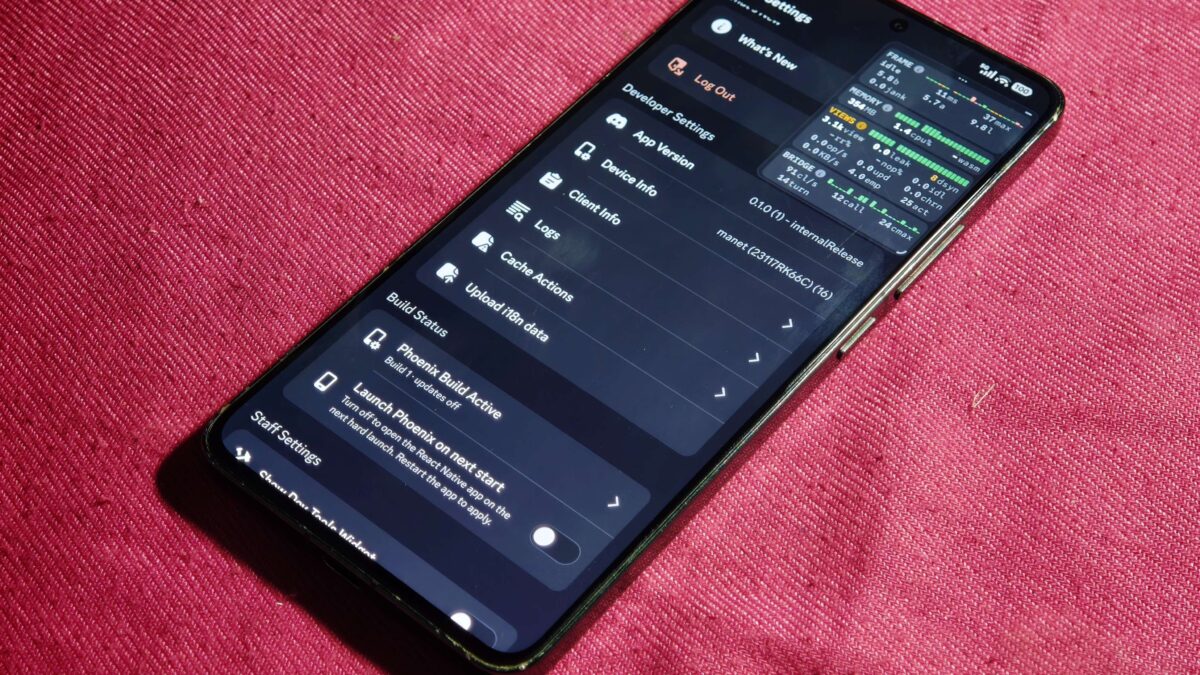
Discord Phoenix Rust client, Digimart Global: Discord’s Android alpha builds now include two clients in one package: the current React Native app and Phoenix, a native client written in Rust. Phoenix is normally restricted to staff accounts, according to the Notebookcheck report, which was published on November 22, 2026.
A community patch called phoenix-unlock, developed by mantikafasi, removes that restriction so the Rust client can run on a regular account. Notebookcheck ran the patched build, version v356.7 “Alpha”, on four devices.
The patched build installs cleanly and can use a separate package name, allowing it to run alongside the standard Discord app without replacing it.
The report describes the unlock as mostly cosmetic. Staff Settings, Developer Tools and build overrides appear in the app, but the staff options do not actually work.
Local developer tools did function, including a performance overlay that Notebookcheck used for its measurements. Discord’s servers still treat the account as a regular one.
Interface and features
The user interface looks identical to the current app on phones and tablets, including the large-screen layout. Notebookcheck said this suggests Discord is aiming to replace the underlying engine without redesigning the interface.
The most reliable way to identify the running client is the version string, which reports 0.1.0 (1) – internalRelease for Phoenix.
The patched build also includes the mobile account switcher that Discord announced for its new Rust client on November 10. According to the report, Discord demonstrated the feature on iOS, and it works the same way on Android, letting users switch accounts in a redesigned Account sheet without logging out.
Performance results
Notebookcheck described performance as strong in everyday use. On an older Xiaomi Mi 10S, which uses a Snapdragon 870, the app felt much snappier.
Memory use ranged from 440 to 550 MB depending on the screen, briefly spiking to about 690 MB before dropping back. The publisher noted these figures came from a patched build that also ran Frida, a plugin loader and the performance overlay, so they may overstate memory use in the unmodified Phoenix client.
The client stops drawing frames when nothing on screen changes, which the overlay’s lower idle frame rate reflected. Notebookcheck said this should help conserve battery life.
Scrolling and navigation were smooth, with no reported jank. The testers did record one ANR, or “Discord Phoenix isn’t responding” message, in a busy channel under heavy load.
Because the plugin loader and Frida were active in that code path, the publisher could not determine whether Phoenix itself caused the freeze.
Frame-rate issue on two phones
On two phones running HyperOS 3 and Android 16, the Xiaomi 17 and the Redmi K70 Pro, Notebookcheck reported that Phoenix rendered about twice as many frames as the display could show. The built-in overlay reported 240 fps at a 120 Hz refresh rate and 120 fps when the same phone was set to 60 Hz.
Android’s own frame statistics on the Xiaomi 17 logged more than 5,500 frames in roughly 20 seconds of scrolling at 120 Hz, more than twice what the panel could display in that time. The publisher said roughly half the rendered frames never reached the screen, wasting GPU time and battery power.
On the Mi 10S, which runs HyperOS 1, and the Oppo Pad 5, which runs ColorOS 17 based on Android 17, the frame rate matched each panel’s refresh rate. Notebookcheck suggested the problem may reflect an interaction between Phoenix and HyperOS 3 or Android 16 that Discord could address before release.
Caveats
The build tested is a modified version signed with a publicly available key, and it can include the Frida instrumentation toolkit and a plugin loader. The publisher said running a modified client violates Discord’s terms of service and could put an account at risk.
The article describes the test as a preview of where Discord is heading rather than a build for main accounts. The report has not been independently verified.