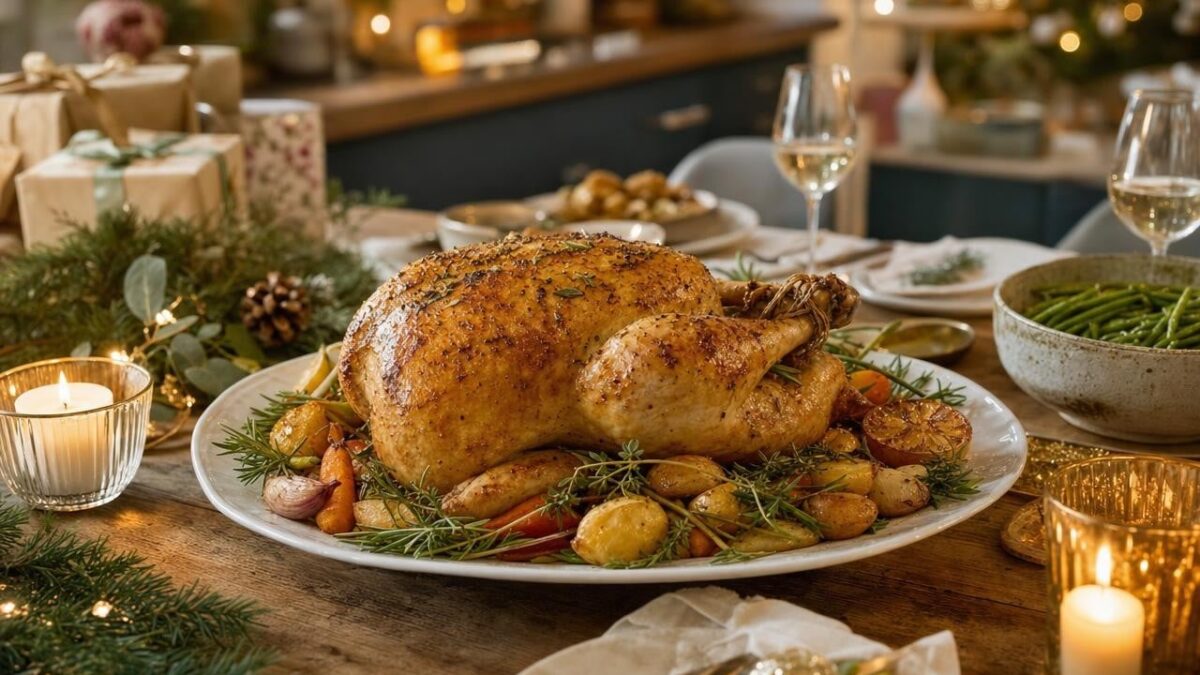
Poularde de Noël, Digi Mart USA News (Paris, France): For many people, a large turkey still takes center stage at Christmas dinner. At the Paris butcher shop of Romain Leboeuf, a Meilleur ouvrier de France based in the 15th arrondissement, however, the poularde de Noël has replaced the turkey as the holiday favorite.
According to the report, smaller households and cooks who want less stress at the oven are driving the shift. Leboeuf, interviewed by the cooking site 750g and cited by the culinary site Marmiton on November 5, 2026, clearly recommends the poularde for the Christmas Eve meal.
He points to meat that is more tender and succulent, a roughly 2.5 kg size that is easy to handle, and carving that is much simpler than with a turkey. His verdict is direct: “No debate, I would go with the poularde.”
“I sell 10 times more”: the poularde is on the rise. In his Paris shop, the butcher has seen the trend reverse.
“Last year I sold 150 poulardes compared with 15 turkeys. Turkey has the image of tradition, but that is over,” Leboeuf told 750g.
The report says this one-to-ten ratio reflects more intimate tables, where a turkey weighing several kilos seems oversized and leaves excessive leftovers. A poularde is a young hen fattened before it begins laying.
Its fattier flesh is described as rich and very tender, which appeals to diners and reassures those who fear dry poultry.
Leboeuf describes a piece of about 2.5 kg, while a turkey often weighs more. For a small group, that size is comfortable and avoids surplus meat filling the refrigerator until New Year’s.
Poularde, turkey, capon: format, budget and portions. On price, the poularde does not always beat the turkey.
Leboeuf cites 18 to 20 euros per kilo for a farm-raised poularde, compared with 15 to 18 euros for a turkey. The advantage comes mainly from comparison with the capon, which costs considerably more per kilo, and from format: a 2.5 kg poularde costs around 45 to 50 euros, which is often more accessible than a large capon.
For eight people, the butcher recommends two poulardes, each cut into eight pieces, allowing two portions per guest without a carving struggle. Diners should plan for the number of guests and whether the meal is served plated or family-style.
Ask for a ready-to-cook poularde of about 2.5 kg, and check the origin and quality labels such as Label Rouge, organic (Agriculture Biologique) or Bresse AOC if the budget allows, as recommended by the health information site Allo Docteurs.
Cooking ease and safety: tips for a successful poularde. Leboeuf notes that its fattier flesh tolerates longer cooking better than turkey and reduces the risk of drying out.
A Christmas poularde can be prepared simply with salt, pepper, a little fat and a few herbs, without a complicated stuffing.
750g relays the technique the butcher favors: gradual oven cooking, starting at a moderate temperature and then increasing it, with regular basting of the cooking juices. The U.S.
Department of Agriculture’s Food Safety and Inspection Service (FSIS) recommends reaching an internal temperature of 74 °C (165 °F) for poultry; a meat thermometer helps verify this, especially if you add stuffing, ideally cooked separately for better safety.
With these simple guidelines, the goal is golden skin, juicy meat and a Christmas Eve meal without unnecessary stress.