Exoplanet imaging starlight subtraction method, Digi Mart USA News: Exoplanet imaging is the main method for detailed characterization of planets orbiting beyond 1 au, but it requires suppressing the bright glare of the star to reveal the faint light of the planet. Sophisticated instrumentation and effective image processing are both necessary for starlight suppression, and the latter remains a substantial limitation.
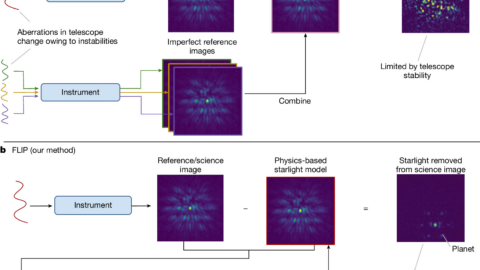
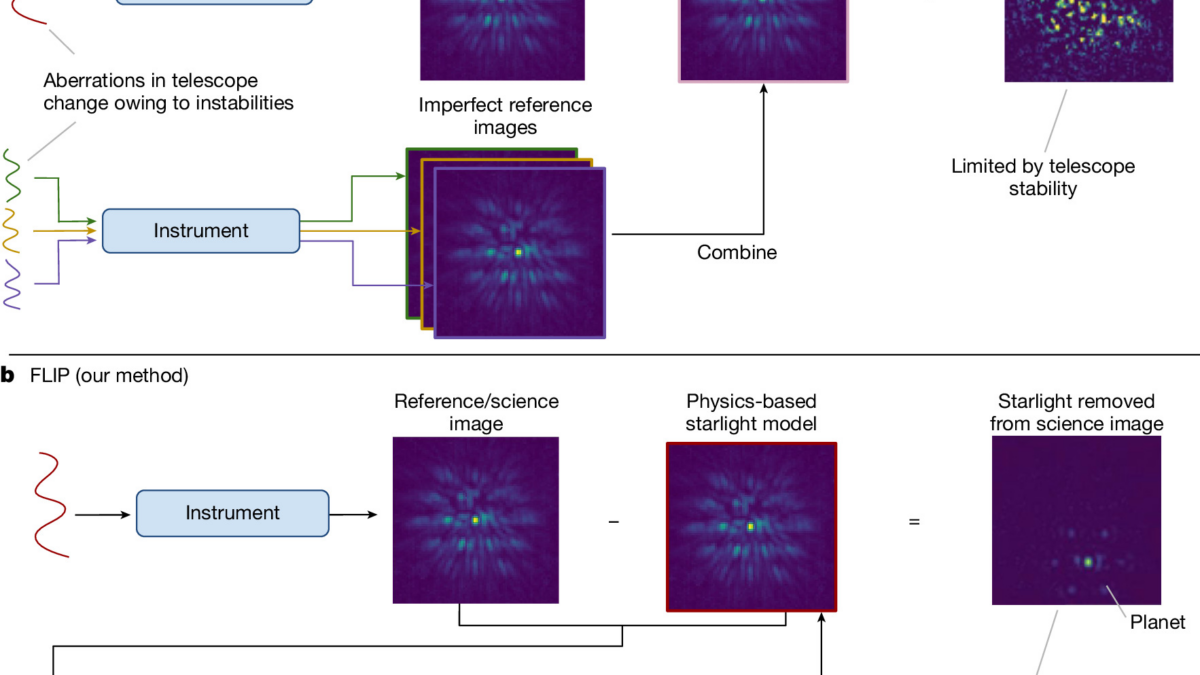
Standard algorithms rely on reference images to model starlight. Because of this, they are constrained by unavoidable telescope instabilities that change between the reference observation and the science observation.
Overcoming this challenge would increase the number of planets that can be directly imaged and would be a notable step toward imaging exo-Earths with future observatories.
The research presents a new physics-based method for starlight subtraction. The approach combines a multistep optimization with a flexible physical model to produce a starlight model, allowing the modeling and compensation of instrument instabilities.
The team used automatic differentiation to optimize millions of model parameters.
The method was demonstrated on observations from the James Webb Space Telescope Near-InfraRed Camera coronagraph instrument. According to the publication, it achieved sensitivity 2 to 15 times superior to standard techniques, including the first detection of 51 Eridani b at 4.3 micrometers.
The authors state this is the first time such an approach has shown substantially improved sensitivity on real, on-sky coronagraphic imaging.
The framework could be extended to other current and future ground-based and space-based observatories, including the Nancy Grace Roman Space Telescope and the Habitable Worlds Observatory. The authors suggest it could potentially relax the unprecedented stability requirements needed for those missions to succeed.