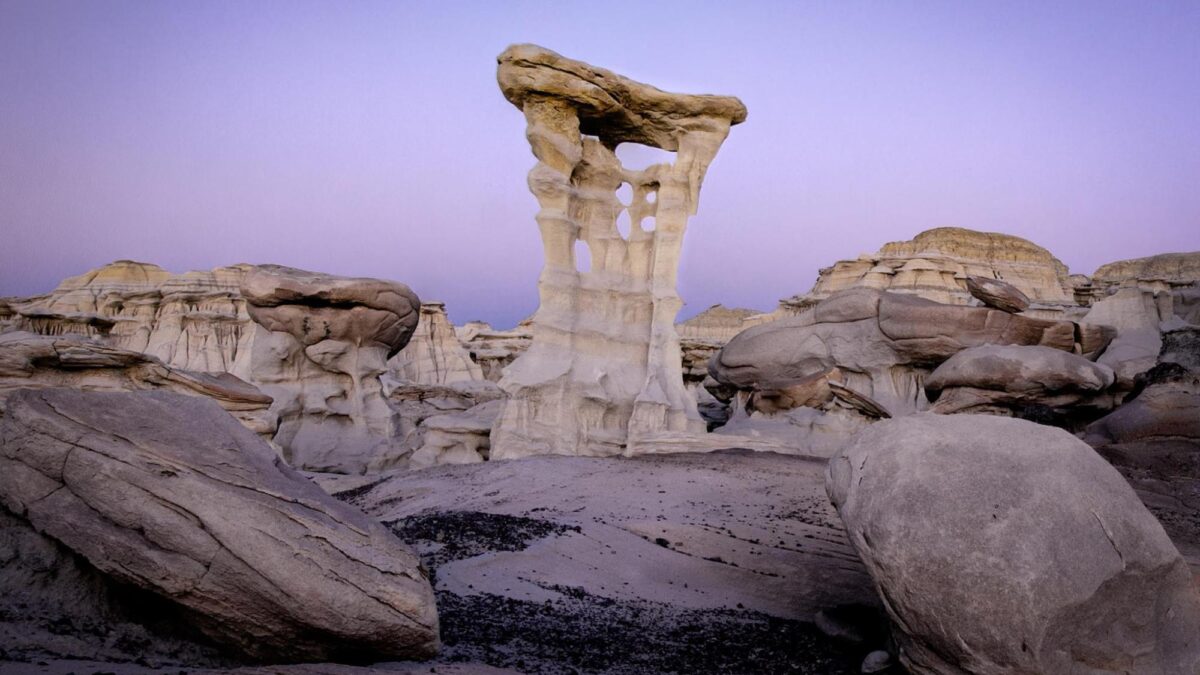
Alien Throne and King of Wings rock formations collapse in New Mexico after southwestern US flooding, Digi Mart USA News (northwestern New Mexico): There are stretches of high desert in northwestern New Mexico where wind, rain and time have sculpted otherworldly forms. Hefty planks of rock balance atop spindly clay pedestals, while some sandstone columns look like lace, elaborately eroded by the seasons.
Tour guide Kialo Winters shares this part of his homeland on the edge of the Ah-Shi-Sle-Pah Wilderness with visitors regularly. On a recent Friday afternoon, the founder of Navajo Tours USA rounded a bend and found that one of the area’s most famous features had collapsed.
The Alien Throne, known in his language as Tsé Bináká Níyol, was gone.
“It was surreal,” he told The Associated Press. “I had to sort of just pause.
A lot of things ran through my head.”
The Alien Throne and the nearby King of Wings formation collapsed within weeks of each other, toppled by the same natural forces that created them. The southwestern U.S.
has endured major rounds of storms in recent weeks, with rain falling on ground already soaked by an especially wet fall.
Parts of New Mexico, Colorado, Utah and Arizona have seen rivers crest and floodwaters course through normally dry washes, destroying homes, further saturating the soil and eroding the landscape. The water is receding and cleanup is underway, but officials estimate the damage could reach into the hundreds of millions of dollars.
Winters remains concerned for relatives on the Navajo Nation, where many dirt roads became impassable or were washed away entirely by what he described as a series of massive storm fronts. Experts have estimated that more than 20 trillion gallons (75.7 trillion liters) of rain fell across the Four Corners states and Nevada during late October and early November as tropical moisture was funneled into the region.
In early October, the collapse of the King of Wings began circulating on social media, with visitors documenting the large slab of rock on the ground near the clay mound where it once stood. It is not entirely clear when the Alien Throne came down, as poor road conditions kept Winters from visiting for a couple of weeks.
He had not seen other posts about the feature’s status until he rounded that corner on Oct. 30 and saw it in pieces.
Social media reactions ranged from people grateful to have seen the formations and photographed them to those lamenting that they never had the chance. Condolences were mixed with debates about physics and the fragility of natural wonders.
“Gravity. It’s not just a good idea … it’s the law,” one user joked.
For Winters and other Native Americans from the region, the formations are more than rock. They have served as waypoints guiding ancestors along trade routes for thousands of years and as connecting threads in stories passed down through generations.
“They are culturally relevant to our identity and our stories,” he said, adding that their legacies will live on through photographs, illustrations and the stories people share about their time in this stretch of desert.
He called on people to let the sites “rest,” meaning no climbing on what remains and certainly no taking pieces home.
The sites are far off the beaten path, down a rutted, washboard dirt road, but Alan Studt of Parma, Ohio, said the trip is worth it. He first visited in 2019 and returned last April as part of a 50-day road trip.
Reviewing his earlier photographs, he could see the formations weathering, with new holes forming in the throne and cracks along the base of the wing, making it no surprise they would not last forever.
Studt spent hours exploring and photographing the hills and washes on his most recent trip, describing being drawn in each time he spotted a new set of spires in the distance, marveling at the petrified wood along the way and the rainbow of colors in the soil. “It is really so magical to be out there,” he said.