Cristero War centenary conference Rome religious freedom Mexico, Digi Mart USA News (Rome): Historians, jurists, diplomats and theologians from several countries gathered at the Pontifical University of the Holy Cross, a short walk from the Vatican, to discuss the Cristero War openly, a subject that still generates discomfort in Mexico. The congress, titled “Viva Cristo Rey!
Centenary of the Cristero Epic” and organized by the Anacleto González Flores Chair, examined a century of questions that remain without definitive answers.
Participants described the event not as a celebration but as an exercise in rigorous memory in the city that holds the Holy See, which they said plays a significant role in understanding the conflict. If the Cristero War was, as some argue, the most important religious conflict of the 20th century in Latin America, then Rome is not a neutral setting for analyzing it, since part of the decisions that shaped its outcome were made there.
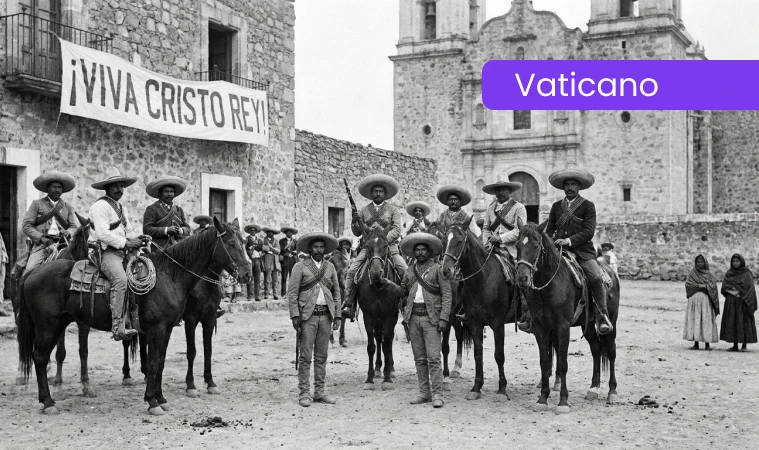
Between 1926 and 1929, the government of President Plutarco Elías Calles enforced the anticlerical provisions of the 1917 Constitution with brutality. Churches were closed, foreign priests were expelled, religious vows were banned, ministers of worship were required to register with the state, and religious instruction was suspended.
Tens of thousands of Mexicans joined the armed resistance in central and western states including Jalisco, Michoacán, Guanajuato and Zacatecas, under the slogan “Viva Cristo Rey!”
The war lasted three years and, according to varying historiographical estimates, left between 70,000 and 90,000 dead. It produced a generation of martyrs recognized by the Church, including Blessed Anacleto González Flores, and ended in 1929 with “arrangements” that divided the ecclesiastical hierarchy.
Historian Rodrigo Ruiz Velasco said the war “presents many of the conditions of the doctrine of Just War, in favor of its legitimacy, so it is a case worthy of discussion in light of the doctrine prevalent at that time.” He also argued that the Mexican people, who were then 99% Catholic, were defending not religious freedom in the modern individual sense but the freedom of the Catholic religion, which had been taken away by aggressively secularizing anticlerical legislation that led to the suspension of worship.
That distinction matters. Modern religious freedom is an individual right to choose or reject a faith.
In 1926 Mexico, what was at stake was more concrete: the ability of a people to practice the faith they held, where they had always practiced it, without submitting to state supervision by a government that had declared itself its adversary. Ruiz Velasco said the ordinary Catholic fought mainly “to resume that worship” and to reclaim the freedom of the Catholic religion.
Rodrigo Guerra López, secretary of the Pontifical Commission for Latin America, spoke at the congress. He said the Holy See played a decisive and still debated role in the war’s outcome.
The 1929 arrangements were negotiated between Church and Mexican government representatives, with the intervention of U.S. ambassador Dwight Morrow and under the attention of Rome.
Their responsibilities, scope and consequences remain subject to historical debate.
Guerra López said Catholics, bishops and the Holy See “did what they could with what they had in the context.” He warned against extrapolating the Cristero experience to contemporary conflicts, stating that it would be “very grave” to suggest the Church’s position would support violent action in a situation such as the one in Nicaragua. He said the Holy See addresses situations like Nicaragua’s through diplomatic channels, and he linked the historical reading to the teaching of Pope Leo XIV on “a disarmed and disarming peace.”
From a legal perspective, jurist José Mauro González-Luna Mendoza questioned whether the 1929 arrangements could be called agreements at all. “Legally they cannot be called agreements, because first, it was an imposition, and when there is violence there is no agreement,” he said.
He added that the two bishops who negotiated with the government did not truly represent the Church because their mandate was ad referendum, and the documents lacked formalities and were signed on plain paper without an official seal.
González-Luna also said international political and economic factors weighed heavily on the negotiations, describing the outcome as a capitulation to government demands. He called the result a “humiliating defeat,” asserting that more Cristero chiefs and officers were killed after the arrangements than during the three years of war, despite government commitments to guarantee safe conduct to those who surrendered their arms.
Holding the congress in Rome carried a significance several participants emphasized. Organizer Mauricio Román Rojas said the Cristero War contains an important testimony and that Rome has commemorated martyrs for centuries.
“We want to keep nourishing the heart of the Church with the testimony of Mexican martyrs,” he said. Ruiz Velasco noted that the international dimension of the conflict gained importance, particularly in a space that played a major role in that history.
Mexico’s ambassador to the Holy See, Alberto Medardo Barranco Chavarría, said the history should be aired openly rather than hidden, and that each side should give its version.
Román Rojas said the Church today faces fierce individualism and division, and noted that in countries such as the United States faith has become more private. He warned that subtler pressures on religious life, which are harder to identify, make reaction more difficult.
González-Luna said that in Mexico, gender ideology being introduced in schools is a subtler but more dangerous form of pressure than physical aggression.
Guerra López summarized that the Cristero experience must be understood in its own historical context and not mechanically applied to current conflicts. Today’s response from the Church, he said, depends on discernment, diplomacy and the pursuit of the “disarmed and disarming peace” proposed by Pope Leo XIV.
The lesson of the Cristero War, participants suggested, is that remembering those who defended their faith does not mean returning to arms, but preserving the right of every person to live their conscience in freedom.