French police communication during student protests, Digi Mart USA News (France): Social media videos from French police are multiplying, sometimes showing a different picture from the many citizen-posted images in which officers appear hostile or, at times, violent during social mobilizations. Over the past few weeks, the institution has strengthened a communication strategy aimed at giving its officers a human face, according to La Croix.
On the national police TikTok account, which has 1.5 million followers, five videos were posted between October 30 and 31. Three are face-to-camera posts in which Maxime, a uniformed officer carrying his weapon, answers questions about a mobilization taking place hours later.
Asked why so many officers were deployed, he said it was to secure demonstrations and protect residents and shopkeepers. Asked how viewers can know what happened in videos showing officers using force, Maxime acknowledged that the images can raise legitimate questions but said a few seconds of footage do not always explain an entire intervention.
In a video posted ten days earlier, a female officer said some police videos that went viral were misleading. She cited a recording of a young man being arrested and carried by several officers, saying he was not unconscious as the video suggested.
Another clip shows two officers leaning over a baby lying on the ground, which suggested the child had inhaled tear gas. The officer said that interpretation was also wrong: the child had reportedly fainted on public transport and officers had given first aid.
Videos alleging police use of force, including tear gas thrown into crowds, extended baton strikes and the use of defense ball launchers, have circulated widely on social media since the start of the high school student mobilization. On Tuesday, November 3, the investigative outlet Disclose published an investigation listing 15 testimonies alleging sexual violence by members of law enforcement during mobilization days, several of which are supported by videos.
Officers and gendarmes have also described violence they say they suffered during demonstrations. The commander of CRS 8 spoke to La Croix about the difficulty of the interventions they must carry out.
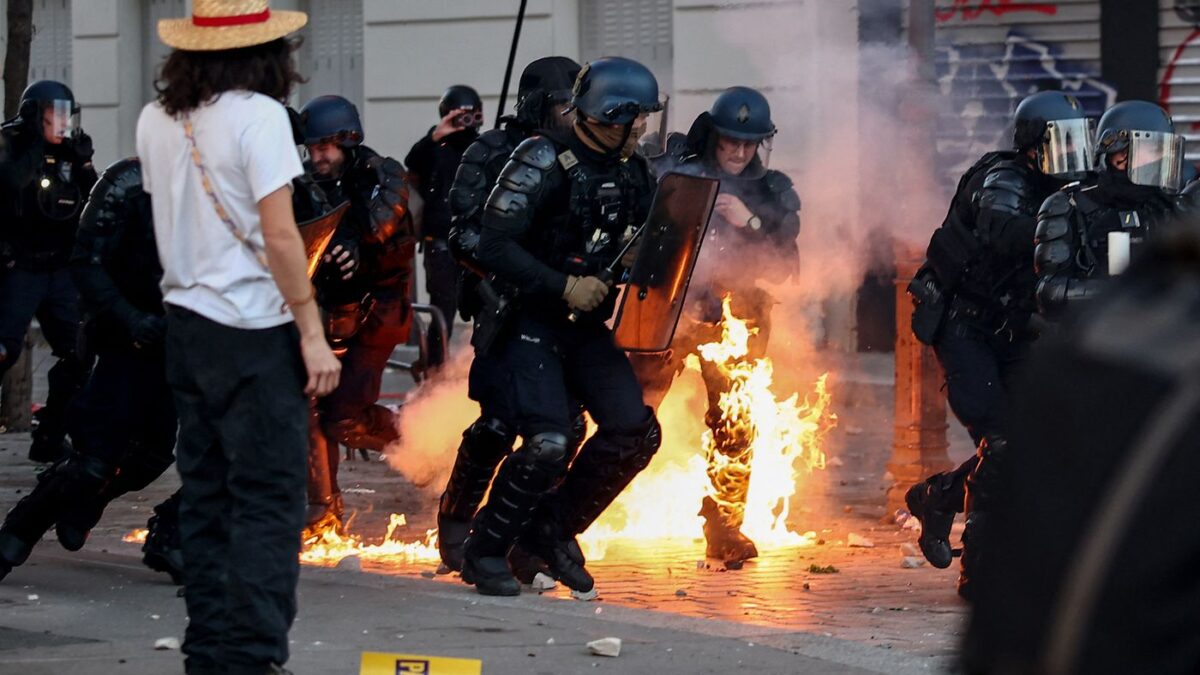
A CRS officer who spoke to the online outlet Le Crayon said he was struck on the head by a heavy paving stone thrown at him on October 31, leaving a clear mark on his helmet, and said he believed the individual intended to kill him. A CRS officer whose uniform caught fire after a molotov cocktail was thrown at him told franceinfo, anonymously, that he was also targeted by projectiles, including a stone that broke his helmet visor, fireworks, mortar fire and an incendiary device that struck his leg.
A gendarme said the videos were harder for his wife to watch than for him. An investigation for attempted homicide has been opened.
These individual media appearances contrast with the usual statements from union representatives or the institution’s communications officials, which typically appear on news channels or in press releases. Reactions to the new approach vary.
One internet user commented under Le Crayon’s video, “Strength and courage to the police,” while another wrote that it was hard to feel compassion for them after what they had done to children over the past three weeks. The battle over narratives is continuing in the comments.