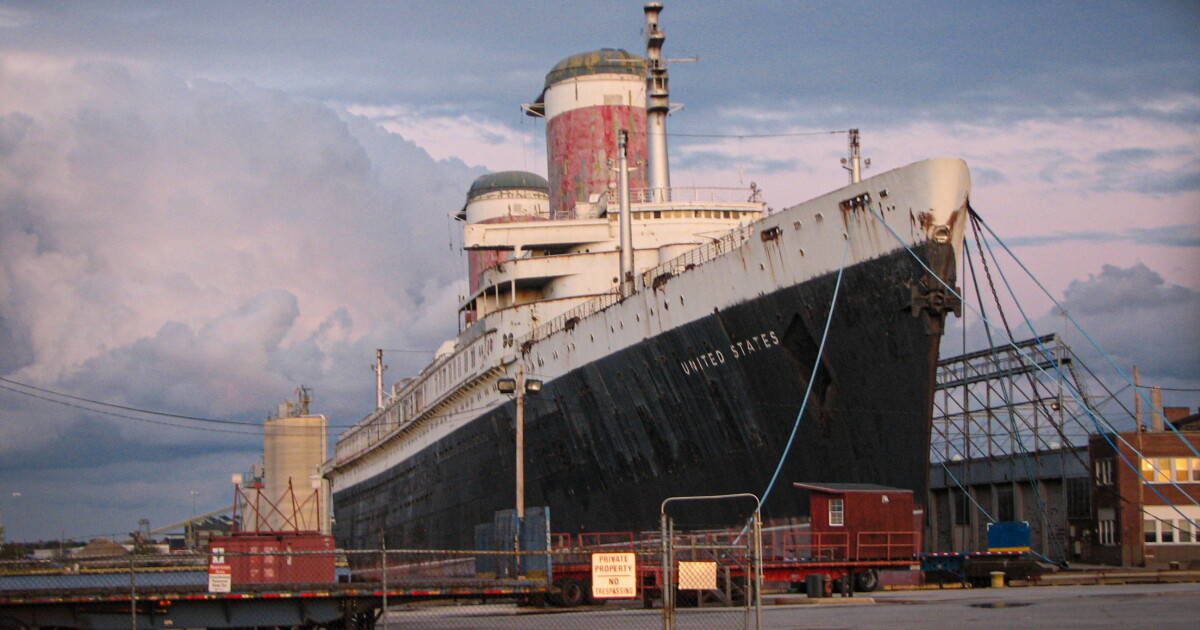
SS United States scuttled off Florida Panhandle as artificial reef, Digi Mart USA News (off the coast of the Florida Panhandle): The SS United States, once the world’s fastest transatlantic liner, has been scuttled off the coast of the Florida Panhandle to become the world’s largest artificial reef. The sinking marks the end of a 74-year career and a new lease on life for the vessel.
On November 11, 2026, marine contractors opened the valves that had once served as the ship’s engine intakes, letting in the sea in a controlled flow so the hulk would sink gently and settle upright. Planners wanted the ship to rest on an even keel without risking breaking apart, and environmental regulations prohibited the use of explosives.
The scuttling was completed at 9:02 pm CST.
The operation was originally planned for November 12 and included a ceremony to mark the occasion. Deteriorating weather conditions forced the exercise to be brought forward by 24 hours, so the sinking and final preparations had to be carried out at the same time.
The vessel’s sinking marks the end of one of the last great transatlantic passenger liners, which dominated the first six decades of the 20th century before being overtaken by air travel. Designed by American naval architect William Francis Gibbs and heavily funded by the US government and United States Lines, the ship was built after the Second World War during the early Cold War.
The government viewed it as a prestige project and a military asset that could be converted into a troopship in wartime, and many of its engine features drew on naval design.
When the liner entered service in 1952, it was already a record breaker. At 900 feet (302 m) with a maximum displacement of 48,022 tonnes, it was the largest liner ever built in the United States.
Its superstructure was made almost entirely of aluminum, a considerable feat for the time, and the ship was designed to be as fireproof as possible following the SS Morro Castle and SS Normandie tragedies. Its only wood included the galley butcher’s block, teak rubbing strakes on the hull and two grand pianos.
Its most famous record was as the fastest transatlantic liner in history. On her maiden voyage, the United States broke the Blue Riband held by RMS Queen Mary, which had held the record since 1938, by 10 hours and 2 minutes with an average speed of 35.59 knots (40.96 mph, 65.91 km/h).
That record for the fastest passenger liner remains unbroken.
During its years of service, the ship attracted many celebrities, including four US presidents, a future president, Eleanor Roosevelt, Emperor Haile Selassie of Ethiopia, the Duke and Duchess of Windsor, Marlon Brando, Marilyn Monroe, John Wayne, Cary Grant, Elizabeth Taylor and others.
Success proved short-lived. By the 1960s, jet airliners such as the Boeing 707 were attracting passengers away, and United States Lines faced union problems and falling government support.
Bookings declined so sharply that trips were canceled, and the ship was withdrawn from service in 1969.
Decades followed in which the rusting liner changed owners as plans to convert it into a cruise ship, hotel, leisure center or floating museum fell through amid lawsuits and debts. The ship was eventually evicted from its pier for lack of payment.
The vessel was ultimately sold to Okaloosa County, Florida, which converted it into an artificial reef to attract sea life and recreational divers. Preparation required removing the two 65-foot funnels, radar mast and interior fittings, cutting holes in the bulkheads, and removing tonnes of fuel and environmentally unfriendly materials.
The ship now rests on the seabed at Large Area Artificial Reef Site C (30° 07.148′ N, 86° 46.755′ W), 22 nautical miles (25.3 miles, 40.7 km) southwest of Destin, Florida. Its rust patches are expected to be covered by coral, barnacles and anemones, and the areas that once hosted presidents and royalty will now host triggerfish, groupers, snapper and morays.