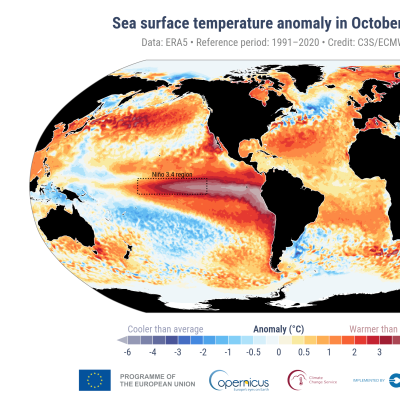
Copernicus October 2026 warmest on record global temperature, Digi Mart USA News: Copernicus says 2026 is now virtually certain to exceed 1.5°C above pre-industrial levels, becoming the second calendar year to do so after 2024, according to a statistical prediction based on ERA5 data up to October.
The Copernicus Climate Change Service (C3S), implemented by the European Centre for Medium-Range Weather Forecasts (ECMWF), said 2026 is most likely to be the second-warmest year on record, with about a 20% chance of tying or exceeding 2024, currently the warmest year on record. The four-year average global temperature for 2023–2026 is also expected to exceed 1.5°C above pre-industrial levels.
October 2026 was the warmest October on record globally, with an average global surface air temperature 1.75°C above the pre-industrial level. It was the third consecutive month to exceed 1.5°C.
Sea surface temperatures remained exceptionally high in October. The average sea surface temperature outside the polar regions reached 20.95°C, the highest on record for October, surpassing the previous October record set in 2023.
In the tropical Pacific, where El Niño conditions continued to intensify, the monthly sea surface temperature anomaly in the Niño 3.4 region reached an all-time high of 3.21°C, exceeding the peaks recorded during previous very strong El Niño events.
Europe experienced its second-warmest October on record. In contrast to September and much of the summer, temperatures were most above average in eastern Europe and Scandinavia, while much of western and central Europe experienced smaller warm anomalies.
Exceptionally low river flows persisted across much of central and eastern Europe, affecting the Rhine, Danube and Vistula. River flows recovered in parts of western Europe as dry conditions in October eased there compared with September.
Heavy rainfall and flooding affected several countries, including the UK and Ireland, Spain, Greece and Türkiye.
Copernicus notes that “virtually certain” means a probability of more than 99%, according to its statistical model. It also cautions that predictions based on other temperature datasets, statistical models or periods of available data may give different probabilities.