Modular-grid audiovisual convergence display technology, Digi Mart USA News: Researchers at the Korea Institute of Machinery and Materials (KIMM) have developed a display technology that lets viewers hear sound from the exact area of the screen where the action happens. Conventional TVs, monitors and smartphones usually output picture and sound separately, with audio coming from built-in or external speakers.
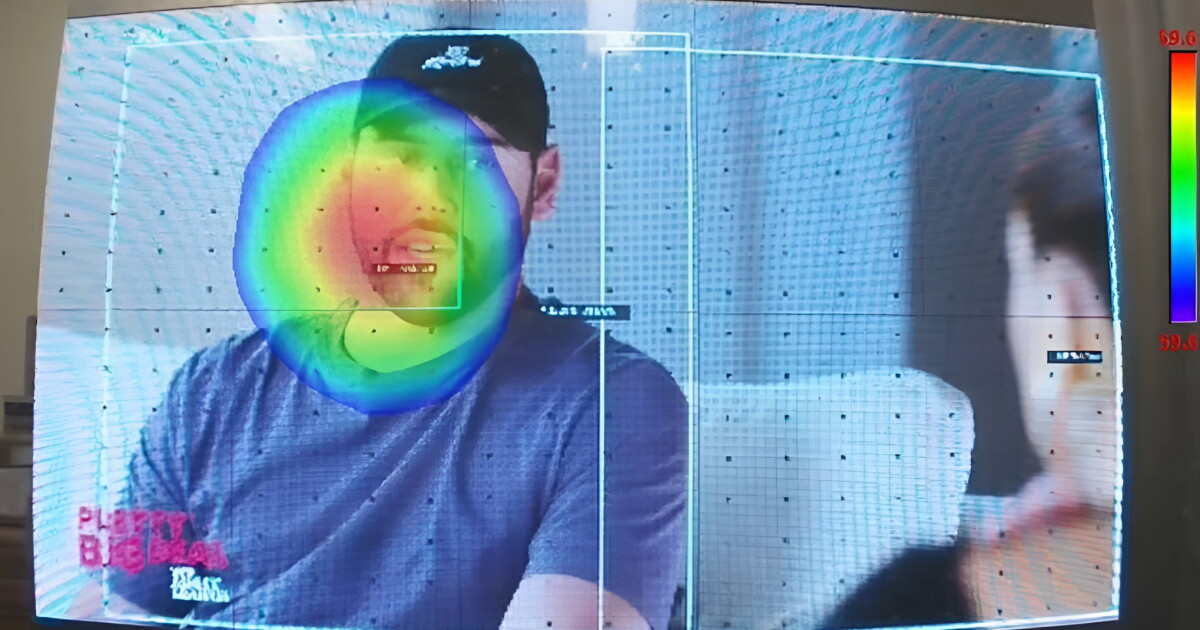
The new system attaches multiple vibration actuators to the rear of a display, so selected sections of the panel emit sound and the screen effectively becomes a large, controllable speaker. A talking character at the top left of the screen would have their voice come from that area, and a moving sound, such as a ball whooshing across the screen, could follow the same path.
For its prototype, the team built an approximately 100-inch display made of a transparent LED film over an aluminum panel, with 80 voice coil motors installed behind it. Because vibrations travel through the solid panel and interact with one another, the researchers analyzed how different sections respond and used the Moore-Penrose pseudo-inverse method to calculate the voltage signals needed to concentrate vibration in a specific area.
To handle instability when the system recalculates as objects move, KIMM used a selective excitation algorithm that excludes poorly transmitting actuators, along with a method for smoothly connecting successive acoustic signals. AI-based sound-source separation and localization was also added to identify sound-producing objects in the video and isolate their audio without manual input.
According to the published report in the Journal of Mechanical Science and Technology, tests showed a reported 99.9% accuracy in selecting intended sound-emitting zones and vibration amplitude differences of up to 35 dB between activated and non-activated sections. The effective localization was demonstrated in low- and mid-frequency bands below 500 Hz.
A modular-grid design allows display modules to be combined or separated for different screen sizes, and the researchers said driving multiple modules together can produce low-frequency effects similar to a large woofer.
Dr. Dongjoon Kim, senior researcher at KIMM’s AX Convergence Research Center, said the team plans to expand the technology to modular LED tile displays.
The source notes that matching the power, depth and overall sound quality of dedicated sound systems with standalone subwoofers remains an open question, and that the technology mainly addresses the spatial mismatch on large displays.