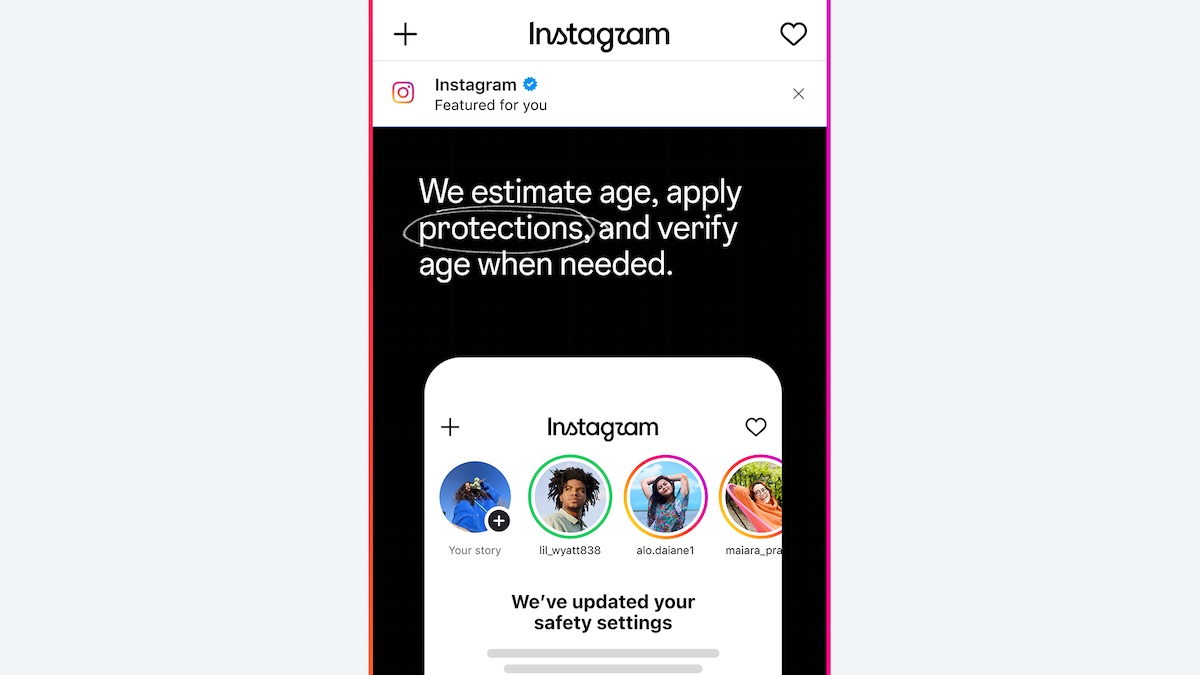
Instagram AI age detection worldwide expansion, Digi Mart USA News: Instagram is expanding its AI-powered age estimation technology worldwide to identify teenagers even when they have entered an incorrect date of birth. In an announcement on November 9, Meta confirmed the technology will be deployed globally to place more suspected teenage users into its protected Teen Accounts.
Teen Accounts automatically restrict who can contact younger users, what content they can access, and certain aspects of their activity on Meta’s platforms. Under the expanded system, these protections no longer depend exclusively on the age entered during registration, so an account claiming to belong to an adult can still be classified as belonging to a teenager.
The underlying technology is not entirely new. Meta announced in May that it was expanding the system into the European Union and Brazil.
According to the company, its estimation can analyze information from profiles, posts, comments and captions, including references to school years or birthday celebrations, and visual analysis of photos and videos can provide additional signals. Meta emphasizes that this process is not facial recognition and does not create biometric identity profiles.
Meta also plans to continue expanding similar protections on Facebook, while Threads is expected to receive a global rollout later in 2026. Parents in the United States will begin receiving additional information through Instagram this month explaining the company’s age assurance approach and the importance of accurate age information.
In Australia, Meta has started using Apple’s age-range signal as an additional way to assess a user’s age. Parents can choose to have an age range assigned when setting up a smartphone for their teenager, and that information is then made available to participating app developers.
Meta is voluntarily using this signal alongside its own estimation technology rather than replacing it, and the company has not announced the same approach for Europe.
Meta has not provided a global accuracy figure or false-positive rate for the expanded system, and the announcement does not include a detailed comparison against conventional age verification methods. The approach raises questions about accuracy, about adult users who may be incorrectly classified as minors, and about the extent of information examined by Meta’s systems.
Whether the expanded system substantially improves protection without creating new problems for legitimate users remains to be seen.